Microphone Reviews
Aston Stealth Review: A Microphone I Didn’t Need, but I’m Glad I Bought
In this article
You ever buy a microphone and not be entirely sure why you bought it? That’s pretty much how I ended up with the Aston Stealth.
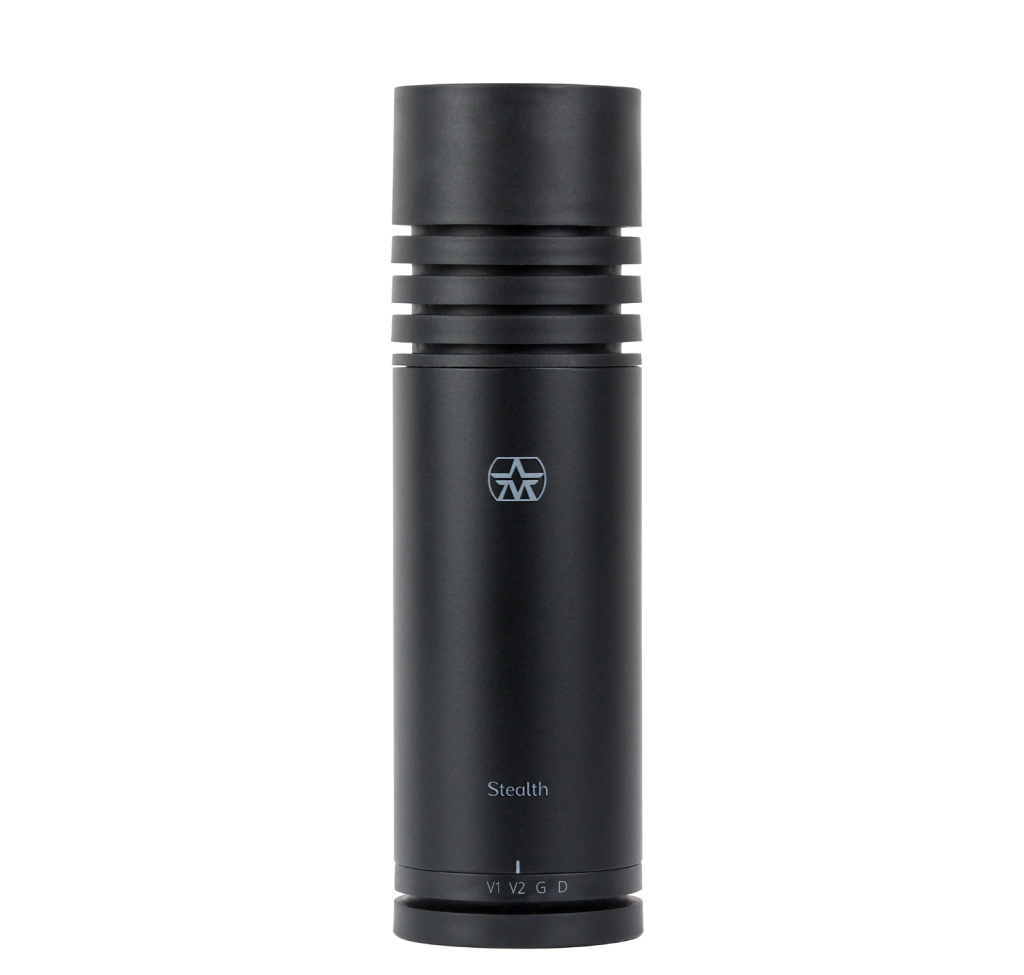
On paper, it looked interesting: a good-looking dynamic microphone with several different voicings and a built-in Class A preamp. And it happened to be on sale at Amazon. So I bought one. Having spent some time with it, I have to say I actually rather like it.
Not Quite an RE20, and That’s Fine
Let’s get something out of the way: the Stealth is not an Electro-Voice RE20 replacement at half the price. The RE20 has a smoothness, weight, and authority that have made it a studio and broadcast standard. To my ears, the Stealth doesn’t quite have that same inherent smoothness or sense of size.
But it does some things differently, and some things arguably better. The RE20 doesn’t have a built-in Class A preamp, nor does it offer four selectable voicings. The Stealth provides flexibility you don’t normally expect from a dynamic microphone.
Perhaps More Like a Sennheiser MD 421
In some respects, the microphone it reminds me of most is the Sennheiser MD 421, with its familiar five-position bass roll-off control. The Stealth takes a different approach: its V1, V2, G, and D settings offer distinct tonal characters rather than simply varying low-frequency attenuation. Two target vocals, one guitar, and one a darker, ribbon-like presentation.
I find the Stealth a little more extended at the top than the 421, and perhaps more extended than the RE20. Extension isn’t the same thing as smoothness, however. The RE20 remains the more naturally polished microphone to my ears.
The Built-In Class A Preamp
One of the Stealth’s more interesting features is its internal Class A preamplifier. Without phantom power, it works as a passive dynamic microphone. Supply 48V and the active circuit increases its output substantially. That’s useful if your interface or preamp doesn’t have abundant clean gain. With excellent outboard preamps, the advantage is less dramatic, but the option is welcome.
More Than Just a Vocal Microphone
The Stealth sounds great on vocals, and the voicing options let you match its character to the source. It can also work well on kick drum, and even snare drum—assuming you can fit the rather substantial body into position. This is a genuinely versatile microphone, not merely a novelty with a few interesting switches.
Construction and Mounting
Mine seem ruggedly built and have given me no trouble. I’ve seen anecdotal reports of mounting hardware breaking, though I can’t substantiate how widespread that is. To be fair, mine don’t see particularly heavy use.
A suitably sized universal shock mount is one possible solution; an inexpensive Gator mount, reportedly around $35, has been recommended. But does the microphone actually need external shock isolation? Not necessarily. Its internal Sorbothane damping already seems to keep quite a bit of mechanical nonsense away from the capsule. I’d consider an external mount more for mechanical security than for isolation.
The Price Changes Everything
Here’s where the Stealth becomes particularly interesting. The microphone normally retails for around $275–$279, which puts it in fairly serious company. But actual selling prices can be considerably lower. I’ve seen new examples advertised for as little as $139, and a used example at Guitar Center for just $99.
I believe I paid about $135 for mine, brand new, during an Amazon promotion.
At $275, it’s a good microphone with interesting features. At $135, it’s an excellent value. At $99 used, assuming everything works properly, it’s almost absurdly inexpensive for what you’re getting.
And if that sounds like faint praise, it isn’t. For that kind of money, I have a difficult time thinking of another dynamic microphone that combines four useful voicings, an integrated Class A preamp, and this degree of versatility.
Final Thoughts
Would the Aston Stealth be the first microphone I’d recommend to someone putting together a recording studio? Probably not. There are more fundamental purchases for a small collection.
But if you already own a reasonable selection of microphones and want something different—something that looks cool, offers several sonic personalities, and doesn’t require a large investment—the Stealth makes a great deal of sense.
It’s a microphone that does a lot of things well, even if it isn’t necessarily my first choice for any single job. I bought mine largely on impulse, without any pressing need for another dynamic microphone. As it turns out, I’m glad I did.
Verdict: A versatile, distinctive, and frequently undervalued dynamic microphone. Not an RE20 replacement, but an excellent addition to an established microphone collection—particularly discounted or used.