Plug-In Reviews
My Very First Mixing Console: Fender 4208
In this article
In 1986, I was in college, and 48th Street in Manhattan was still something of a musician’s paradise. Sam Ash, Manny’s, 48th Street Music, We Buy Guitars, Alex Music, Rudy’s—they were all there. You could spend an afternoon walking from store to store, looking at equipment, talking to salespeople, and occasionally finding a deal you couldn’t pass up.
It was a completely different time.
I was putting together what passed for my recording studio. My setup revolved around a Yamaha CX5M music computer and VHS Hi-Fi decks that I used for recording and laybacks. I needed a proper mixer, preferably one I could afford on a college student’s budget.
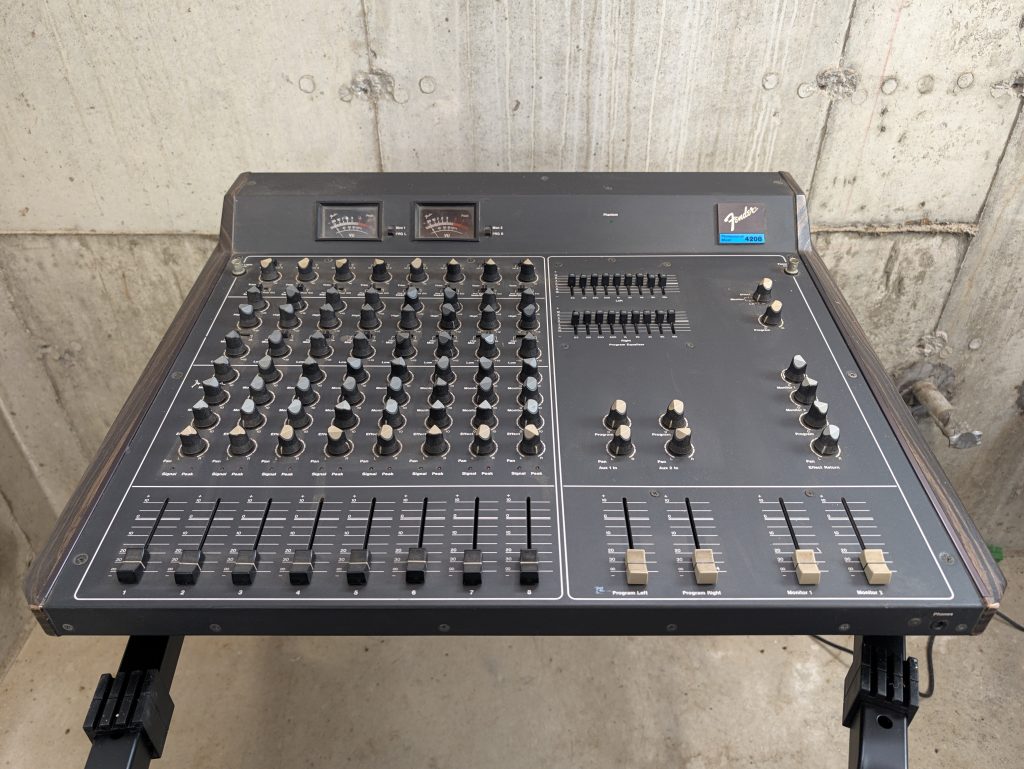
Enter the Fender 4208.
I remember finding one on special for somewhere around $400. That was still considerable money to me in 1986, but for an eight-channel mixer with the features it offered, it seemed like a bargain. And, as it turns out, it was.
More Than Just a PA Mixer
The 4208 was primarily a small-format PA mixing console, rather than a dedicated recording desk. That didn’t concern me. It had eight channels, effects sends, graphic equalization, and enough routing flexibility to be genuinely useful for a modest recording setup.
Coming from relatively primitive equipment, having proper channel controls and the ability to send signals to external effects was a revelation. The graphic EQ was useful, and having everything accessible on one console made recording considerably more enjoyable.
For years, the Fender served as the centerpiece of my recording setup. It wasn’t a professional studio desk, but it did what I needed.
Built When Equipment Was Built to Last
What makes the 4208 particularly interesting today is what Fender put into it. This wasn’t merely an eight-channel mixer with a few knobs. It offered separate program and monitor mixes, channel insert points, effects sends and returns, and graphic equalization. Its microphone inputs used balanced differential circuitry, while its line-output circuitry included transformer isolation—a distinction worth making, since that does not mean the microphone inputs themselves were transformer-balanced.
It has a certain sonic character that distinguishes it from many contemporary budget mixers. I’m not going to pretend it’s some undiscovered Neve or API, because it isn’t. But it sounds perfectly respectable, and there’s something appealing about the way this older equipment handles audio.
More importantly, the construction has proved extraordinary. Forty years later, my Fender 4208 still works perfectly.
This was an inexpensive mixer purchased by a college student in 1986. It has been used for recording, moved around, stored, and repurposed. No major repairs, no elaborate restoration. It just keeps going.
These days it lives in my basement, where it serves as the mixer for a small PA system. It’s hardly a glamorous retirement for something that once occupied the center of my recording universe, but it remains entirely capable of doing the job.
The $100 Mixing Console
You can sometimes find one for around $100 on the used market. For that money, you’re getting an eight-channel analog mixer with useful EQ and effects routing, balanced inputs, and transformer-isolated line outputs, housed in a chassis that seems determined to outlive its owner.
Does it have the convenience or flexibility of a modern digital mixer? Of course not. Does it sound good? Actually, yes.
It has a different sonic character from much of today’s inexpensive equipment. Whether that’s better or worse is largely a matter of taste and application. I wouldn’t recommend one as the centerpiece of a modern recording studio, but for a rehearsal room, a basement PA, or a vintage recording setup, it’s a remarkably appealing little mixer.
Forty Years Later
I’ve owned a great deal of audio equipment since 1986, including consoles that cost vastly more than the Fender 4208. My recording systems have evolved from that Yamaha CX5M and VHS Hi-Fi combination to equipment I couldn’t possibly have imagined owning as a college student.
Yet somehow, the little Fender is still here. It wasn’t prestigious when I bought it. Nobody was going to confuse it with a professional recording console. But it was my first real mixer, it helped me make a lot of recordings, and four decades later, it’s still earning its keep.
And here’s something I hadn’t appreciated at the time: Fender listed the 4208 for $995 in January 1984. If my recollection of paying around $400 in 1986 is correct, I got one heck of a deal.
Not bad for $400. And at today’s used prices, not bad for $100, either.