Microphone Reviews
AEA NUVO N8 Review: A Ribbon Microphone That Makes the Room Sound Better
In this article
The AEA NUVO N8 delivers exceptional low-frequency warmth, controlled cymbals, and a surprisingly lively transient response. More importantly, it makes capturing a usable room sound remarkably easy.
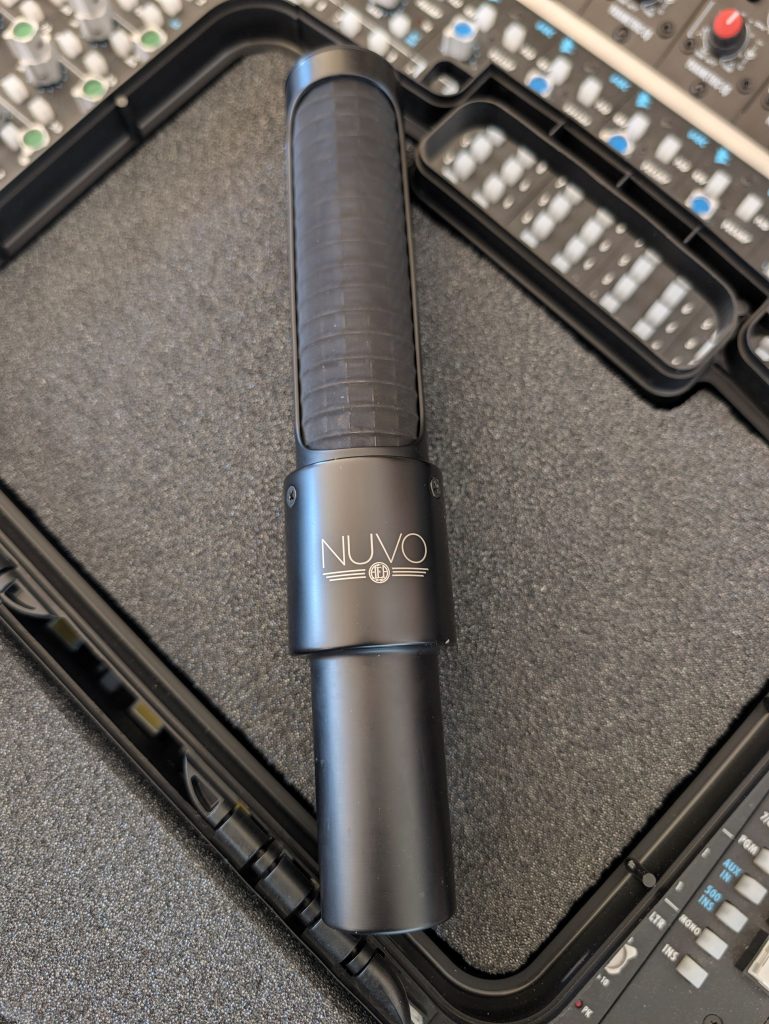
I recently spent time with AEA’s NUVO N8, and it proved to be one of the more compelling microphones I’ve encountered in quite a while.
The first thing to understand about the N8 is that it isn’t designed for close miking. AEA describes it as a far-field microphone, and that designation is accurate. Unlike microphones that perform best just inches from a source, the N8 is intended to capture instruments and ensembles from a distance, preserving the relationship between the source and the surrounding acoustic environment.
That doesn’t preclude vocal use. You can certainly record vocals with it. However, placing your mouth directly in front of the ribbon is inadvisable without a substantial pop filter. Plosives and moving air are particularly hazardous to ribbon microphones, and the N8 is no exception.
AEA specifies a maximum SPL of 141 dB, which is substantial. Even so, this was a review loaner, and I wasn’t willing to place it directly in front of a kick drum. I did, however, position it in nearly every other location around the kit.
That’s where the evaluation became especially interesting.
Drums: All the Good Stuff, None of the Nasties
One of the N8’s most appealing qualities is its ability to remove much of what I find objectionable about a drum kit without sacrificing the characteristics that make drums exciting.
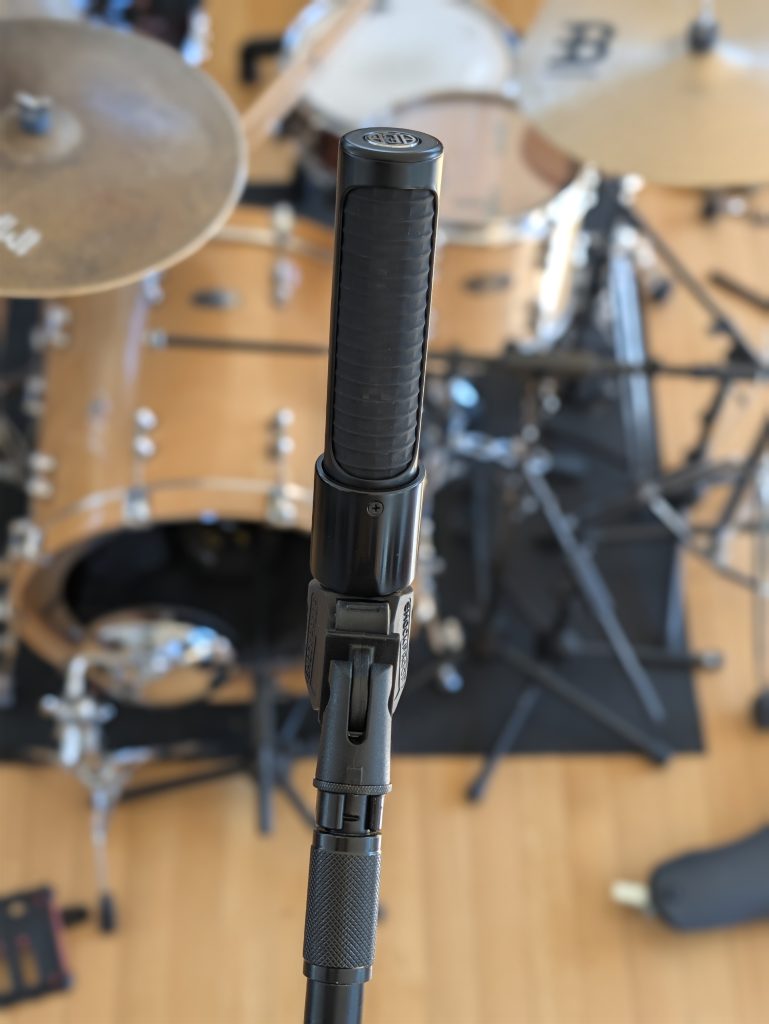
For this evaluation, I used a Pearl Reference Pure kit with a 22-by-18-inch bass drum. This is a particularly substantial-sounding kick, with tremendous low-frequency energy. It’s configured with two packing blankets and a couple of 10-pound weights taped together to keep everything firmly anchored to the floor.
The result is a kick with an excellent thump with very little overhang, due to the interior treatment and open front head.
Through the N8, the low end was beautifully defined, round, and warm. It had genuine weight without collapsing into indistinct rumble.
The biggest surprise, however, was the cymbal response.
I’ve heard plenty of condenser microphones make cymbals sound exaggerated, spitty, or downright unpleasant, particularly when they’re used as room microphones in less-than-ideal acoustic environments.
The N8 did the opposite.
The cymbals were clear and bright, but controlled. They retained their definition without leaping out of the speakers and tearing your head off. That’s a significant accomplishment, especially considering how little processing was required.
Compared with a couple of condensers I had available, the N8 was considerably easier to listen to. It required virtually no equalization to produce a satisfying drum sound.
It also needed very little compression. The natural balance among the drums, cymbals, and room was already convincing.
There’s considerable value in a microphone that gives you a sound you want to use before you reach for the EQ.
Preamps: From API to Mackie
Most of my listening was done through my API 2448 console, which is obviously a highly capable front end. Through the API, the N8 delivered substantial low end, an articulate midrange, and a smooth top end.
I was curious, however, how dependent that performance was on the preamplifier.
So I also ran it through an old Mackie 1604.
It sounded excellent there, too.
That was encouraging. The N8 is an active ribbon microphone, and its phantom-powered electronics are designed to make it considerably less dependent on specialized, high-gain ribbon preamps than traditional passive designs.
My experience supported that proposition. Although the two consoles have distinct sonic characteristics, the microphone’s fundamental personality remained intact.
You don’t need an exotic preamp to appreciate what this microphone does.
Congas: Surprisingly Quick
The N8 sounded absolutely slammin’ on a set of congas.
That was another welcome surprise, because I don’t generally associate ribbon microphones with exceptionally fast transient response. That isn’t to suggest ribbons are inherently slow, but their sonic character is more often described in terms of warmth and smoothness than attack.
The N8 had no difficulty capturing the immediacy of the congas.
The initial attack was convincing, the bodies of the drums were full, and the resulting sound struck an excellent balance between articulation and weight.
Again, very little processing was necessary.
It was one of those situations in which I found myself listening to the instrument rather than thinking about the microphone.
Acoustic Guitar: Warmth Without Mud
I also spent time with the N8 on acoustic guitars, ranging from a mahogany Guild D-20 to a jumbo Martin J16E.
In both cases, the results were appealingly full.
The microphone captured the instruments’ body and warmth without turning them into an indistinct mass of low-midrange energy. There was plenty of substance, but the notes remained clear.
The Martin J16E was particularly revealing, because an instrument with that much harmonic activity can easily become overly bright or congested through the wrong microphone.
The N8 presented it in a highly listenable way.
I would have liked to have a pair of these microphones available for stereo recording. Based on what I heard from a single N8, I suspect a matched pair could make a compelling acoustic-guitar or drum-room setup.
Unfortunately, I had only one microphone, so that experiment will have to wait.
How Does It Compare with Royer?
At its price, the N8 naturally invites comparison with professional ribbon microphones from Royer.
I think it compares very favorably, although it offers a somewhat different sonic perspective.
Based on my recollection, the AEA may provide slightly greater low-frequency extension and weight than the Royer microphones I’ve used.
I want to qualify that observation, however. I haven’t used the Royer recently, and I haven’t evaluated it through my current API console. Consequently, this is not a controlled, side-by-side comparison.
Even so, the N8 made a strong impression and deserves consideration alongside other professional ribbon microphones.
The Real Advantage: Making Difficult Rooms Sound Good
Perhaps the N8’s most compelling quality is its ability to handle rooms that aren’t acoustically ideal.
When I describe a good-sounding room, I mean one that is balanced, warm, and controlled—a room that sounds like a record before you begin processing.
Unfortunately, not everyone has one of those.
Some rooms are bouncy, echoey, spitty, or blatty. They contain reflections and resonances that make conventional room miking more trouble than it’s worth.
That’s precisely where the N8 becomes especially valuable.
Its figure-eight polar pattern provides substantial rejection to the sides, allowing you to shape the balance between direct and reflected sound through placement and orientation. More importantly, its inherently smooth presentation can make the resulting room sound considerably more agreeable.
It doesn’t magically correct a bad room, of course. No microphone can do that.
But it can make an acoustically challenging environment substantially easier to work with.
Instead of reaching for radical EQ, aggressive compression, or elaborate processing to tame an unpleasant room microphone, I found that the N8 often delivered something usable almost immediately.
For anyone working in a project studio or a room that hasn’t been acoustically perfected, that’s a significant advantage.
More Than a One-Trick Pony
AEA’s NUVO family is interesting because its individual microphones are designed around different working distances.
The N22 is intended primarily for near-field applications, the N13 for mid-field recording, and the N8 for far-field use.
I’m interested to hear how much family resemblance exists among them.
After spending time with the N8, however, I wouldn’t treat those designations as rigid limitations.
This microphone is considerably more versatile than its far-field designation might suggest.
It worked beautifully on drum-room duties, sounded excellent on percussion, and produced highly appealing results on acoustic guitar. There’s no reason it couldn’t also be used on vocals with appropriate placement and protection from plosives.
The N8 is definitely not a one-trick pony.
Technical Specifications
| Microphone type | Active ribbon |
| Operating principle | Pressure-gradient transducer |
| Polar pattern | Bidirectional (figure-eight) |
| Frequency range | Below 20 Hz to above 20 kHz |
| Maximum SPL | 141 dB SPL (1% third harmonic above 1 kHz) |
| Sensitivity | 8.3 mV/Pa at 1 kHz, unloaded |
| Output impedance | 92 ohms |
| Recommended load impedance | 1 kΩ or greater |
| Power requirement | 48V phantom power, 7 mA |
| Ribbon material | Corrugated pure aluminum |
| Ribbon thickness | 1.8 microns |
| Ribbon dimensions | 4.7 × 59.7 mm |
| Dimensions | 8.83 × 1.62 × 1.62 inches |
| Weight | 12 ounces (335 g) |
| Connector | 3-pin XLR |
| Manufacturing | Pasadena, California, USA |
Conclusion
The AEA NUVO N8 isn’t an inexpensive microphone for the casual home recordist, but it’s reasonably priced in the context of professional recording equipment.
Considering how little processing it required to produce excellent results, I think it represents a compelling value.
My evaluation period was admittedly brief, but I came away thoroughly impressed.
It has a wonderfully extended, warm low end; a clear and articulate midrange; and a high-frequency presentation that remains detailed without becoming aggressive.
It sounds substantial without sounding sluggish, and smooth without sounding dull.
Most importantly, it makes recording enjoyable. Rather than spending time correcting what the microphone captured, I found myself appreciating the sound coming back through the monitors.
That’s ultimately what a good microphone should do.
The AEA NUVO N8 is a definite winner.
Price: $1,299
Manufacturer: AEA Ribbon Mics
Disclosure: The microphone was supplied by AEA as a temporary review loaner.