Studio Monitor Reviews
KRK V8 Series 4 Review: A Serious Monitor at a Sensible Price
Manufacturer: KRK
In this article
Years of use in two studios reveal a surprisingly neutral and capable eight-inch monitor.
I originally bought the KRK V8 Series 4 after realizing that my original passive Fostex NF-1 monitors simply weren’t up to the task in the larger control room of our main studio. I needed greater output, more low-frequency authority and a speaker that could work comfortably in that space.
The KRKs have since been replaced in the main control room by exponentially more expensive ATC SCM45A monitors with Dynaudio subwoofers. But the V8s haven’t been retired. They’re now working in the C room of our Florida studio, and they’re actually terrific.
Surprisingly neutral
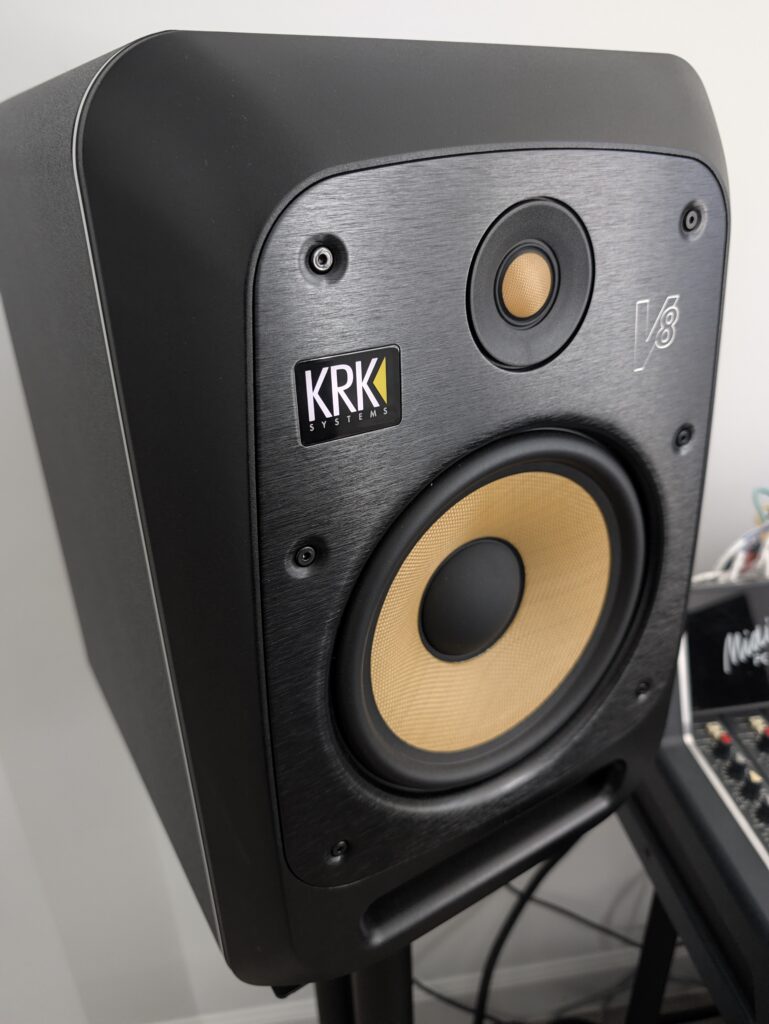
These are much more neutral than some listeners might expect from a KRK design. The overall tonal balance is good, with none of the excessive harshness I remember from certain older monitors. Both the eight-inch woofer and the dome tweeter use Kevlar, and the high frequencies are remarkably well behaved. I don’t hear obvious ringing or the sort of objectionable character that can occur in some poorly implemented metal-dome designs. Of course, diaphragm material alone doesn’t determine how a speaker sounds.
The imaging is particularly good. I suspect the cabinet and front-baffle design contribute to this. The V8 uses an aluminum front baffle and an MDF cabinet, and I think the speakers look great. At a little over 30 pounds each, they’re substantial, even if they aren’t quite as massively constructed as some truly high-end monitors.
Extensive room adjustment
There is an impressive amount of control available on the rear panel. Separate seven-position low- and high-frequency EQ selectors provide 49 combinations, allowing meaningful adjustments to the speaker’s response for different installations.
I was reminded of just how important these settings are when I moved the speakers into our Florida studio. I began my usual integration process, listening to familiar reference material, and everything sounded bizarre. The tonal balance was thin and unnatural. Eventually I remembered that I had previously used the V8s with Dynaudio subwoofers and had left substantial low-frequency attenuation engaged. Once I restored the settings, the speakers sounded like themselves again.
It’s a useful lesson: before judging a monitor in a new room, check how it was configured in the old one. The onboard EQ is powerful enough to make a significant difference. It is not, however, a substitute for proper room treatment or a dedicated subwoofer crossover.
Output, imaging and noise
The V8 has plenty of output capability for a substantial near-field or compact midfield application. Although sold as a near-field monitor, I find it especially sensible at somewhat greater listening distances than a tiny desktop speaker.
There is a little hiss audible if you get very close to the tweeter with the speaker powered on. At normal listening distances it hasn’t been objectionable. More importantly, the overall presentation is clean, controlled and well balanced. There isn’t much to fault here for the price.
Life after the main control room
Replacing the V8s with ATCs wasn’t an indictment of the KRKs. The ATCs are in another price category entirely, and I wanted to move to a higher level of monitoring performance in the main room. The V8s remained useful enough to install in another working studio rather than sell or store.
Now that KRK has introduced the V-Series Five, used V8 S4s can be an especially interesting purchase. Depending on the asking price and condition, they may cost little more than considerably smaller, less capable new powered monitors. I’d be interested to hear the new generation, but we haven’t auditioned it, so any claims of improved sound would be premature.
Conclusion
The KRK V8 Series 4 is attractive, substantially built, surprisingly neutral and capable of convincing stereo imaging. It offers extensive rear-panel response adjustment, useful output and a presentation that remains enjoyable over long periods. The close-range hiss and its limitations relative to much more expensive systems are minor qualifications rather than fundamental faults.
The bottom line: A serious, versatile active monitor that has earned its place in two of my studio installations. At a competitive used price, the V8 S4 is a particularly compelling option.