Technical Articles
Studio Cable and Wire Selection: Capacitance, Shielding, Multiconductor Snakes and Plenum Ratings
In this article
- Choose the cable by application
- Capacitance: why a number needs context
- Microphone cable: twisted pair versus star quad
- Shield types: braid, spiral, foil and combinations
- Multiconductor cable: studio snakes, console looms and patchbay trunks
- Plenum, riser and general-purpose cable: the fire rating is not optional
- Analog audio is not AES3—and AES3 is not Ethernet
- Speaker cable: resistance, not boutique capacitance, usually leads
- What insulation and jackets are made of
- Wiring and buying checklist
- Manufacturer technical references
The right studio cable is determined by its job—not its price, color, or marketing claims. A passive guitar pickup, a balanced microphone, a 32-channel console snake, an AES3 digital connection and a passive loudspeaker all impose different electrical and mechanical requirements. This guide explains what matters when buying cable in bulk or assembling an entire studio.
Choose the cable by application
| Use | Recommended construction | What matters |
|---|---|---|
| Microphone | Balanced twisted pair, braided shield; star quad for difficult interference | Shield coverage, flexibility, handling noise |
| Passive guitar/bass | Low-capacitance shielded coaxial cable | Total capacitance, durability |
| Balanced analog line | Shielded twisted pair | Termination, shielding, mechanical suitability |
| 8–48+ channel console/stage snake | Multiconductor with individually shielded balanced pairs | Individual shields, channel identification, fan-outs |
| Fixed wall/ceiling runs | Correct signal cable with appropriate listed fire rating | Plenum/riser/general-purpose classification, cable support |
| TT/bantam patchbay | Compact balanced pair and highly flexible patch cords | Diameter, strain relief, connector compatibility |
| AES3 digital audio | 110-ohm nominal impedance balanced digital cable | Impedance and termination |
| Dante/AES67/network | Certified category cable suited to the installation | Category rating, channel length, building code |
| Passive speaker | Appropriately gauged two-conductor copper cable | Round-trip resistance, power, length, building rating |
Capacitance: why a number needs context
Conductors separated by insulation form a capacitor. Cable capacitance grows with length: C(total) ≈ capacitance per unit length × length. Manufacturers typically quote picofarads per foot (pF/ft) or per meter (pF/m). Convert pF/ft to pF/m by multiplying by 3.281. Be careful: conductor-to-conductor and conductor-to-shield are different measurements. For star-quad cable, conductor grouping changes which value is relevant.
A source with appreciable output resistance driving cable capacitance behaves approximately as a low-pass circuit, with f(-3 dB) = 1/(2πRC). For example, 20 feet of 30 pF/ft cable presents approximately 600 pF. With a purely resistive 10 kΩ source, the theoretical corner frequency is roughly 26.5 kHz. However, passive guitar pickups are inductive: their inductance and cable capacitance create a resonant network, changing audible brightness and peak response rather than simply imposing this textbook low-pass curve.
That is why low-capacitance cable is particularly important between passive guitars and their first buffered input. Once a signal is buffered by a low-impedance pedal or active instrument output, ordinary short cables generally have much less sonic influence. For a professional low-impedance balanced line, modest differences in cable capacitance at normal studio lengths are rarely a reason to buy costly specialty wire.
Microphone cable: twisted pair versus star quad
Conventional balanced microphone cable has two signal conductors twisted together inside a shield. The balanced input rejects interference that couples similarly into both wires. A star-quad cable has four wires arranged symmetrically; opposite conductors are connected together at each end to form the two signal legs. The geometry can reduce magnetically induced interference, particularly around transformers, lighting and mains equipment.
Star quad is not automatically better in every application. It generally has more capacitance than a comparable standard pair and takes more care to terminate. Canare L-4E6S, for example, specifies nominal capacitance of 150 pF/m between the grouped signal legs and 185 pF/m from grouped conductors to shield, plus approximately 94% braided shield coverage on the current manufacturer table. Those are different measurement configurations, not contradictory figures. In most ordinary microphone runs, its interference rejection may be more relevant than the higher capacitance.
Useful manufacturers include Canare, Mogami, Gotham Audio, Belden, Sommer Cable and Van Damme. Compare actual specifications, availability, termination dimensions and application ratings.
Shield types: braid, spiral, foil and combinations
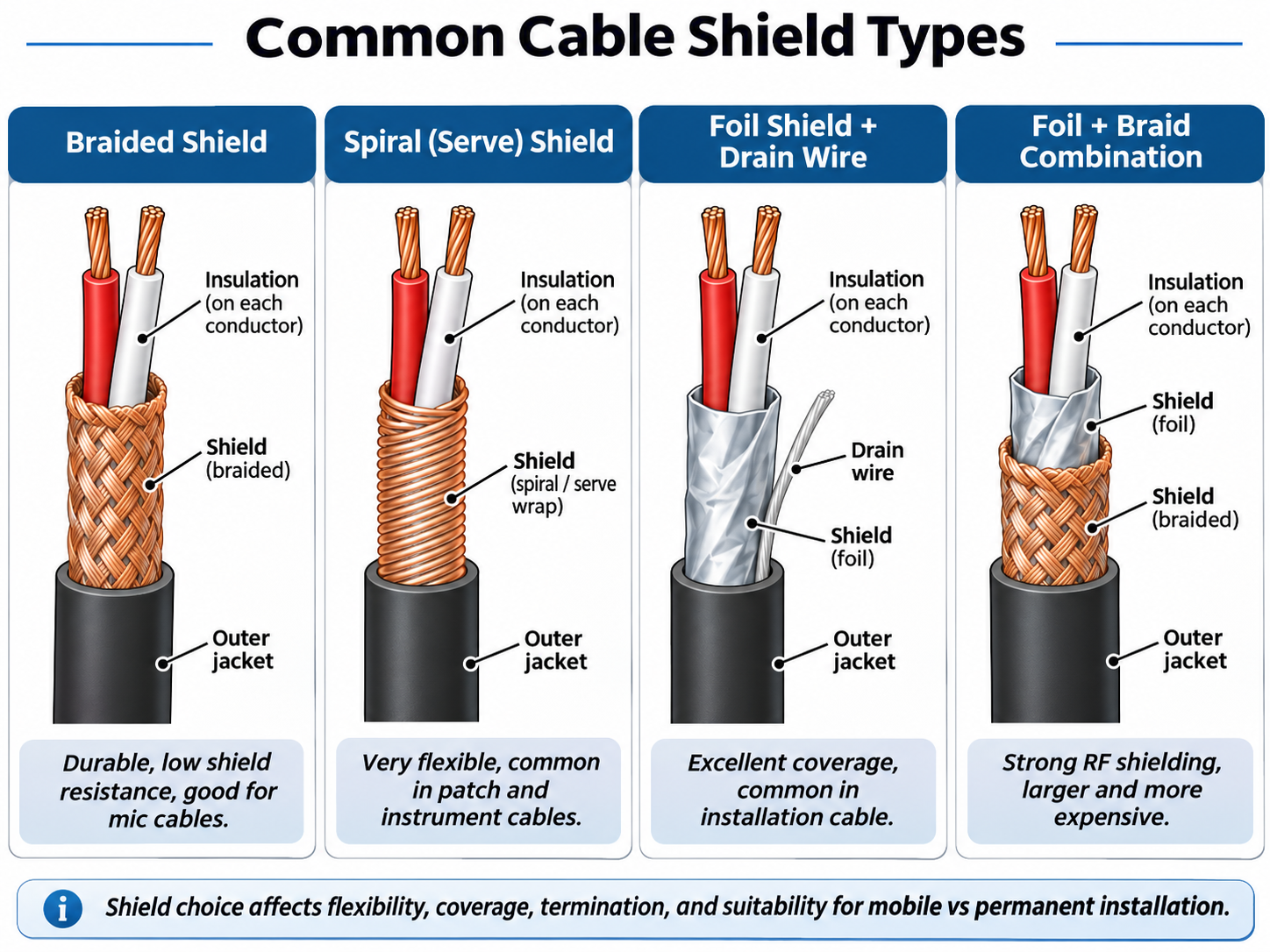
Braided copper shield: interwoven bare or tinned copper strands provide mechanically stable coverage and relatively low shield resistance. Often a good choice for microphone cables handled, coiled and stepped on. Coverage percentage matters, but so does the shield’s transfer impedance and the complete connector/shield termination.
Spiral (serve) shield: helically wrapped strands are flexible and comparatively easy to strip. Useful in instrument and patch cables, though repeated twisting or stretching may open gaps. The shield should be evaluated as part of the whole cable, not judged solely by its nominal percentage coverage.
Foil shield with drain: aluminum/polyester or similar composite foil provides near-continuous coverage and compact dimensions. The drain wire simplifies termination. It is common in permanent multiconductor installation wiring, where flexibility and repeated flex life are less important. A foil shield is not automatically suited to years of stage use.
Combined foil and braid: combines complementary shielding properties, sometimes worthwhile where RF interference is severe. It typically costs more and increases diameter.
Shield material: bare copper and tinned copper are common choices; tin plating helps with corrosion resistance and solderability. Aluminum foil requires an appropriate conductive drain. Silver plating, oxygen-free copper marketing, and exotic metallurgy are not substitutes for good design and sound termination practices.
Multiconductor cable: studio snakes, console looms and patchbay trunks
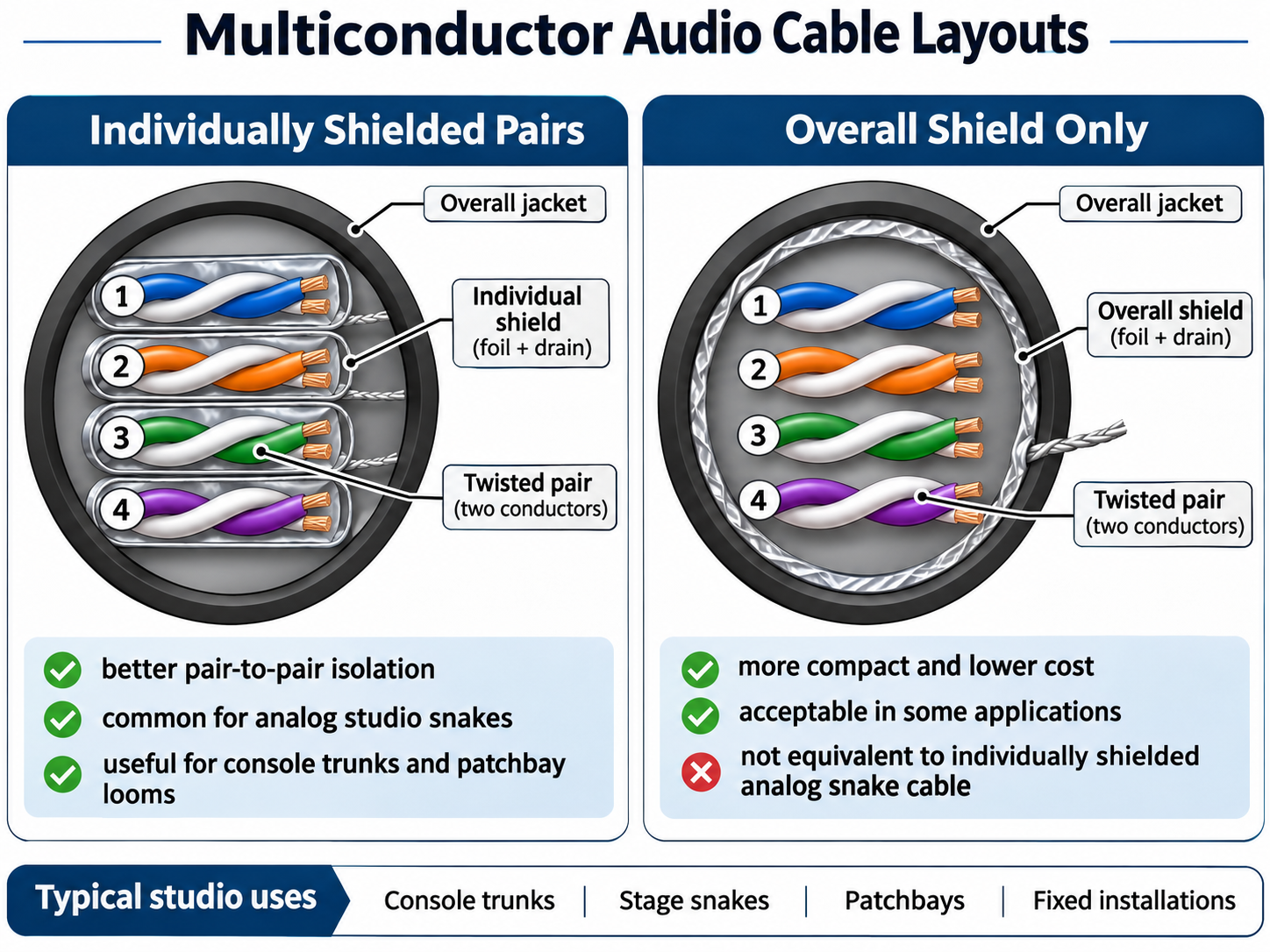
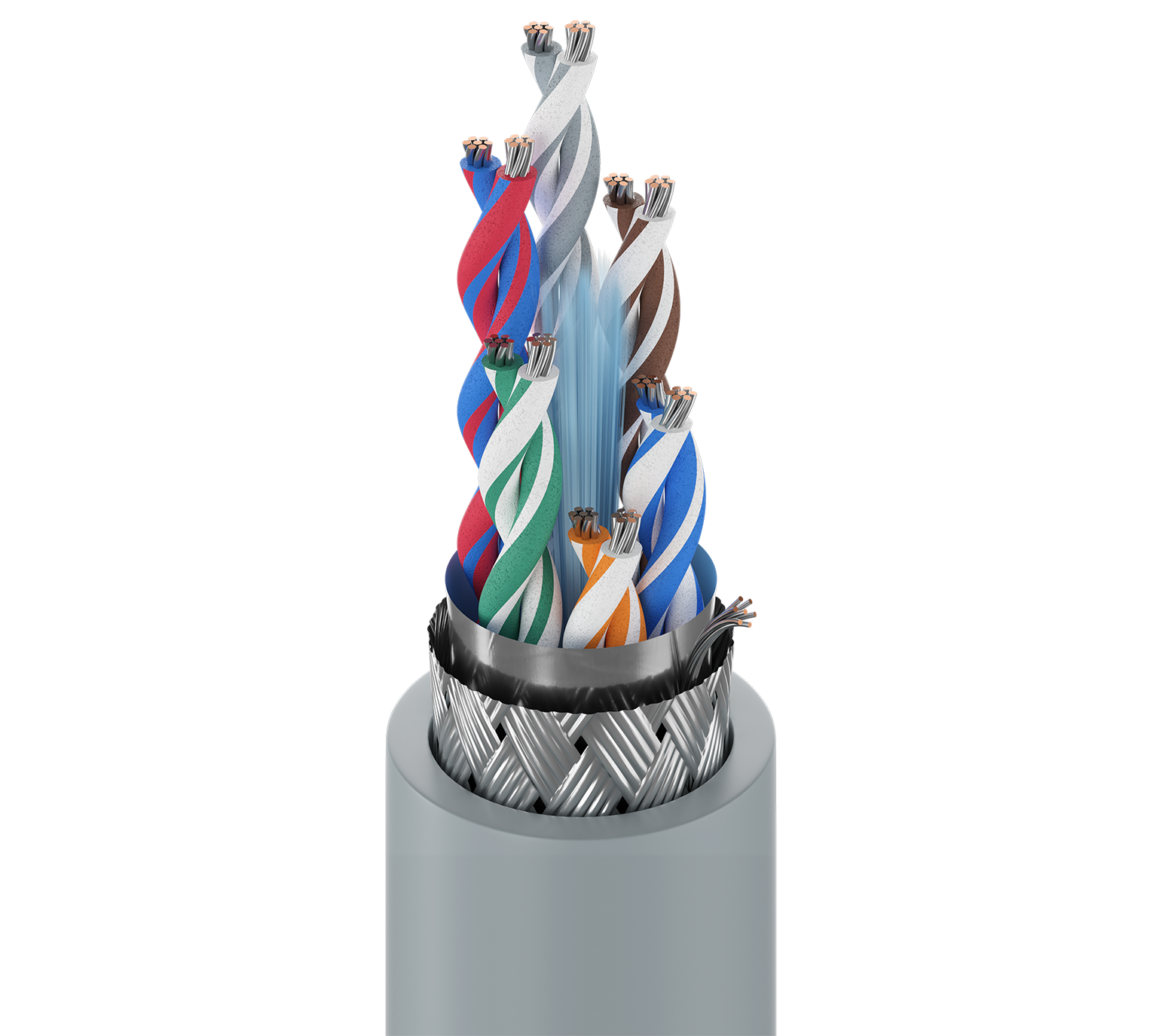
For 8, 16, 24, 32 or more balanced channels, a proper multipair snake is usually neater and easier to manage than dozens of individual cables. Prioritize individually shielded twisted pairs, identifiable channels, sensible conductor gauge, compatible fan-out construction, manageable bend radius and the correct jacket for its route.
Individual shields versus one overall shield: an individually shielded multipair puts a separate foil/drain or braid around each audio pair. This helps limit coupling between channels and permits deliberate termination at each end. A cable with only an overall shield may be suitable for certain balanced or digital systems, but it should not be assumed equivalent to individually shielded analog studio snake cable. Check manufacturer crosstalk and application specifications.
Foil/drain installation snakes: compact, economical and convenient for fixed equipment rooms, patchbays and wall panels. Belden makes several multipair families; verify exact part numbers because its cable catalog spans analog audio, digital audio and other signal systems. Canare, Mogami, Sommer Cable and Gotham Audio also offer multicore constructions.
Touring or mobile snakes: seek a tough, flexible jacket, effective strain relief, proper fan-outs and shields designed for repeated movement. A low-cost foil-only installation trunk may be the wrong tool for this job. Consider spare pairs, additional tie lines and service loops during installation.
Analog patchbays: normalled circuits and TT/bantam patch cords demand correct pinouts and shield treatment. Label both ends and document every channel. Avoid treating audio shields as an improvised safety-earth substitute; chassis grounding, pin-1 practices and equipment design are separate issues.
Plenum, riser and general-purpose cable: the fire rating is not optional
Electrical performance does not establish where a cable may legally be installed. In the United States, the adopted edition of the National Electrical Code (NEC/NFPA 70), the actual circuit classification, the route through the building and the authority having jurisdiction (AHJ) determine what is permitted.
| Typical jacket marking | General meaning | Common context |
|---|---|---|
| CMP | Communications plenum | Permitted communications circuits in spaces defined by the applicable code as environmental-air plenums |
| CMR | Communications riser | Communications riser applications, subject to NEC substitution rules |
| CM / CMG | General-purpose communications | Where general-purpose communications cable is permitted |
| CL2P / CL3P | Class 2 / Class 3 plenum | Appropriately classified power-limited circuits in plenum spaces |
| CL2R / CL3R | Class 2 / Class 3 riser | Appropriately classified power-limited circuits in risers |
Critical distinction: a plenum marking is not a blanket approval for every electrical or audio use, nor does placing a cable in conduit automatically make an otherwise prohibited cable acceptable. The applicable NEC articles, circuit type, raceway provisions, cable substitutions, local amendments and installation method must be checked. Cable installed in a fire-rated assembly may also require approved penetration firestopping. Always inspect the actual cable jacket and listing, rather than relying on an online product category.
Plenum describes spaces used for environmental air handling as defined by code; it does not simply mean “above every suspended ceiling.” Riser relates to specific vertical runs. Jacket compounds and low-smoke flame-test qualifications differ from standard PVC cables. For underground, outdoor and wet locations, check additional suitability markings, not just CMP or CMR. NFPA 70 and the manufacturer’s listing documentation are the proper starting points.
Analog audio is not AES3—and AES3 is not Ethernet
AES3: a balanced digital-audio link nominally uses 110-ohm characteristic-impedance cable and suitable termination. Characteristic impedance is a transmission-line property, not the cable’s DC resistance. Belden 1800F is one example, specified at 110 ohms, 12 pF/ft conductor-to-conductor, and 26 pF/ft conductor-to-other-conductor-and-shield. The same cable can sometimes carry analog signals, but a random analog microphone cable should not be assumed suitable for long or demanding AES3 runs.
Network audio: Dante and AES67 operate over Ethernet. Use installed category cabling and network equipment suitable for the network speed and distance—typically certified Cat 6 or Cat 6A for new permanent copper infrastructure, depending on project requirements. Shielded category cable is not universally necessary; grounding and EMC design must be considered as a system. Do not substitute ordinary audio snake wire for Ethernet.
Speaker cable: resistance, not boutique capacitance, usually leads
For a passive monitor or loudspeaker, the primary cable issue at ordinary lengths is series resistance. Use adequately sized copper conductors, check the amplifier and loudspeaker terminals, and account for the round-trip conductor length. Approximate copper resistance at 20°C: 16 AWG ≈ 4.02 Ω/1000 ft, 14 AWG ≈ 2.53 Ω/1000 ft, and 12 AWG ≈ 1.59 Ω/1000 ft per conductor. A 50-foot one-way run therefore contains about 100 feet of conductor in the loop; at 14 AWG that is about 0.253 Ω, before connectors.
At a 4-ohm load, that resistance is more consequential than it would be for a high-impedance line input. Extremely high-capacitance specialty speaker cables can also be problematic with some amplifiers. For installed loudspeaker wiring, confirm the proper circuit and fire rating rather than selecting by gauge alone. Active studio monitors do not use speaker cable for their line-level input; they require the correct shielded signal connection and separate mains power.
What insulation and jackets are made of
Polyethylene (PE), including foam PE: relatively low dielectric constant, useful for reducing capacitance and controlling impedance. Polypropylene (PP): another low-loss dielectric used in signal pairs. PVC: widely used for jackets and some insulation due to cost and flexibility; ordinary PVC is not necessarily plenum rated. FEP and other specialty polymers: sometimes chosen for particular electrical, temperature and flame-performance characteristics. Thermoplastic elastomers and polyurethane: appear in flexible and abrasion-resistant cable constructions. Material alone does not establish code compliance; the finished listed cable assembly matters.
Wiring and buying checklist
- Identify whether the connection is balanced analog, unbalanced/instrument, AES3, Ethernet or amplified speaker-level.
- For passive instruments, compare total capacitance at the actual cable length, not only price per foot.
- For long analog snakes, specify individually shielded pairs, conductor count, spare channels, crosstalk performance and termination plan.
- Specify stranded flexible cable for repeatedly moved cords and appropriate installation cable for permanent routes.
- Check the exact NEC cable designation on the jacket against the intended space and circuit, with the installer/AHJ where necessary.
- Plan connectors, label schemes, strain relief, bend radius, segregation from mains wiring and testing before pulling cable.
- For balanced systems, follow equipment manufacturers’ pinouts and grounding recommendations; do not indiscriminately lift safety earth or short unused signal conductors.
Manufacturer technical references
For construction drawings and data sheets, begin with Canare analog audio cable, Mogami cable, Belden 1800F digital audio specification, Belden multipair construction, Sommer Cable, Gotham Audio, Van Damme and NFPA 70. Check current data sheets for your exact part number and regional approval markings, as specifications and listings can change.
Bottom line: buy low capacitance where source impedance makes it matter, proper shielding where interference is plausible, correctly constructed multiconductor cable where many channels travel together, and appropriate listed jackets wherever wiring becomes part of the building. Reliable terminations and suitable installation practices usually deliver more value than exotic conductors.