Accessories Reviews
Gravity MS 43 Microphone Stand Review: First Impressions and a Test of Customer Support
In this article
For decades, I’ve used predominantly K&M microphone stands. König & Meyer stands are widely acknowledged to be among the best in the music industry. You see them on stages, in professional recording studios and in the homes of musicians everywhere. Why? Because they’re heavy, they’re made well, and they provide good support.
Now, I won’t say their customer support has always been perfect. Some years ago I ordered two of their large studio boom stands from Amazon. These things are monsters, and the casters arrived broken. K&M ultimately supplied replacement casters, but it took weeks of emails and photographs. The bases probably weighed at least 15 to 20 pounds each, and they appeared to be packaged sufficiently, although perhaps not sufficiently for UPS. Other than that, in decades of ownership, I’ve never broken anything on a K&M microphone stand.
Enter Gravity
A couple of weeks ago, I needed another boom microphone stand and found a Gravity stand on Amazon at a very attractive price. I was genuinely impressed by the quality. Made in China? Yes, but Gravity is a brand of the German-based Adam Hall Group, and the stand appeared to have been manufactured with considerable care.
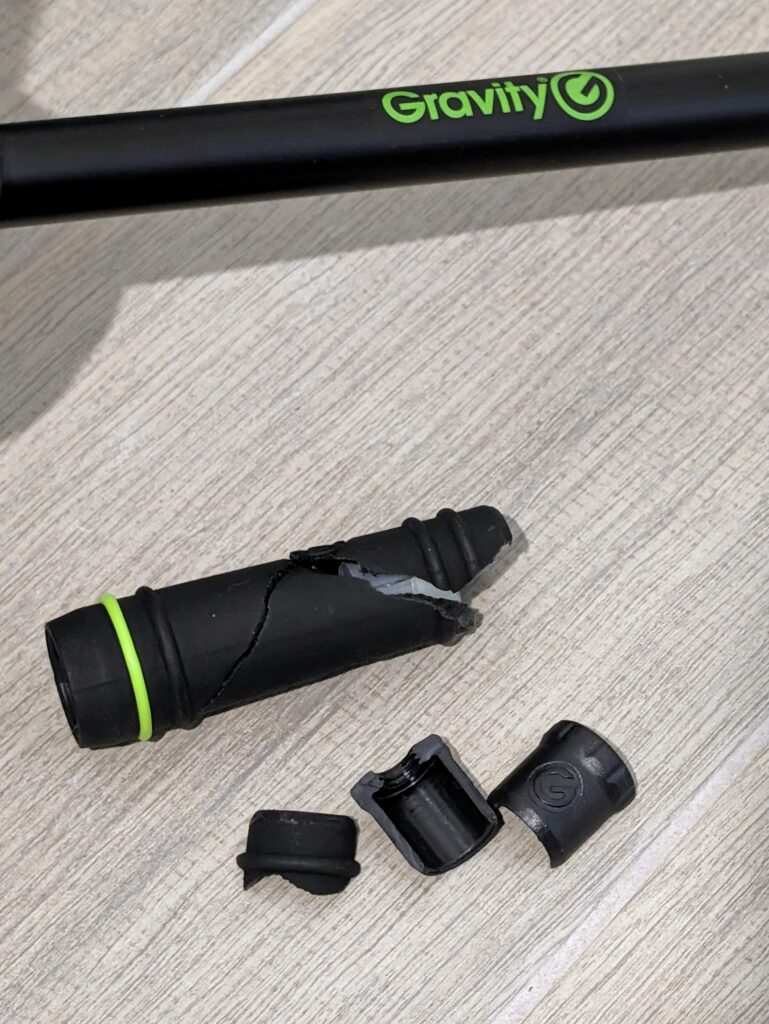
Fast-forward to today. I ordered another Gravity stand, this time the MS 43 straight tripod microphone stand, also from Amazon. It arrived with the clutch that allows you to raise and lower the main stand completely shattered.
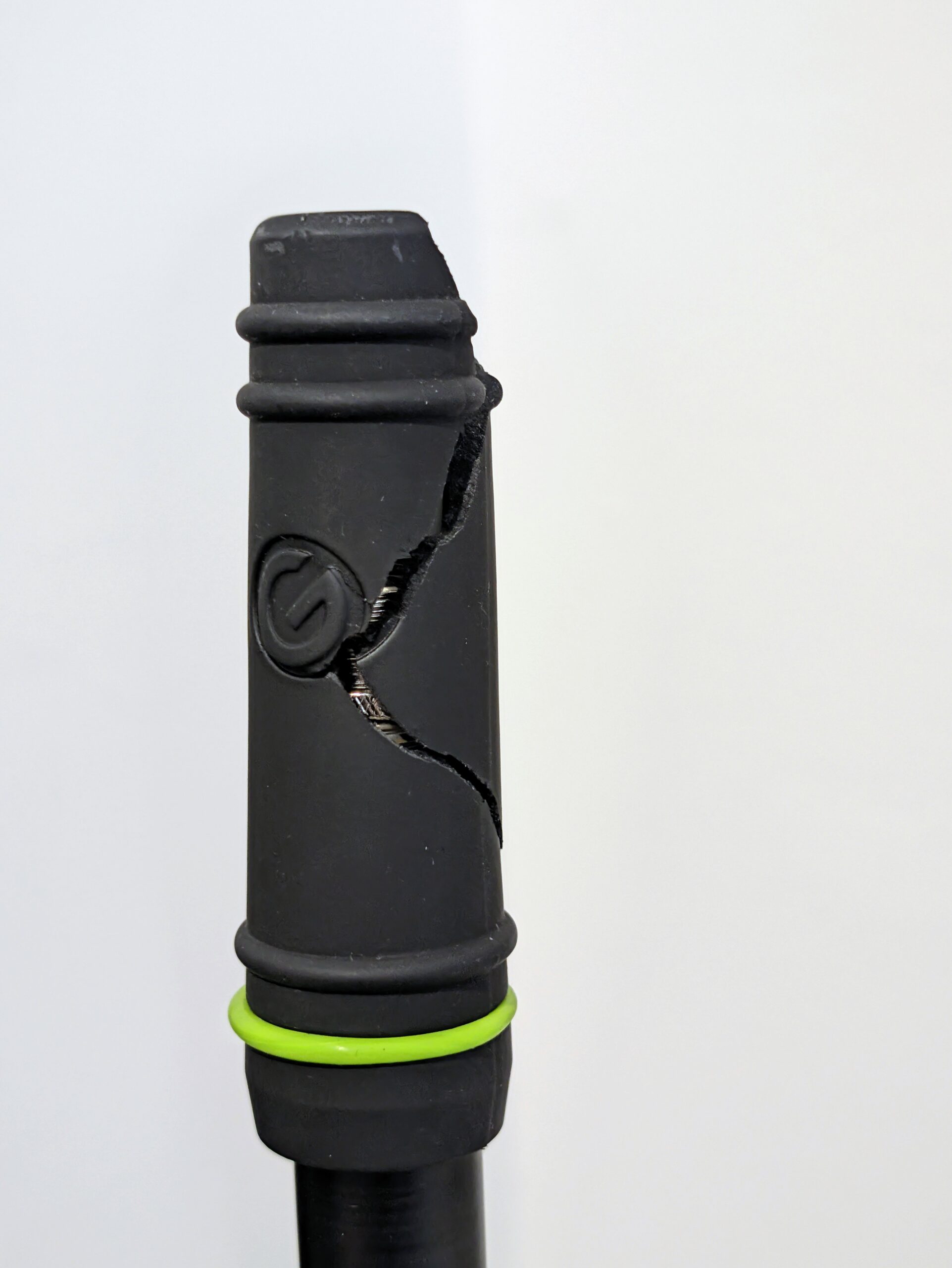
Anybody’s products can break. Nevertheless, I’ve never broken a K&M microphone stand, nor, for that matter, have I ever broken an On-Stage stand. On-Stage is probably the inexpensive alternative I would recommend to someone who doesn’t want to spend K&M money. Hercules makes perfectly good stands, as does Gator, but On-Stage makes those ubiquitous, inexpensive stands that seem to turn up everywhere. They’re not disposable products, and in my experience they hold up remarkably well.
I think I overtightened an old Atlas stand and cracked a phenolic component when I was 12 or 13 years old. Since then, I can’t recall breaking a microphone stand.
Build quality versus durability
What makes this particular failure somewhat more surprising is that the MS 43 is a straight microphone stand. There is no boom assembly to introduce additional leverage or to swing around and strike the height-adjustment clutch during transportation. All other things being equal, one would expect the straight stand to be mechanically simpler and potentially more robust.
Gravity specifically promotes the durability of its height-adjustment mechanism. The manufacturer’s MS 43 product page describes a steel stand with a folding tripod base and an ABS height-adjustment handle with a soft-touch coating. That does not necessarily establish the material of the particular component that fractured.
Microphone stands lead surprisingly difficult lives. They get thrown into the backs of cars, knocked over in studios, dropped during setup and subjected to all manner of abuse on stages. If a height-adjustment clutch can shatter during a trip with UPS, it raises a legitimate question about how it might fare under those conditions. Of course, one damaged stand does not establish a pattern of poor reliability, and I have no way of knowing precisely what happened in transit.
The customer support experiment
I’ve reached out to Gravity through its website to inquire about obtaining a replacement part. I deliberately used a generic email address rather than identifying myself as someone associated with an audio publication. I want to see what the experience is like for an ordinary customer.
Gravity advertises a five-year warranty. We’ll see how quickly the company responds, whether replacement components are readily available and what its policy is regarding their replacement. I haven’t yet explained how the damage occurred, but the stand did, in fact, arrive broken in the box.
The height-adjustment clutch is a critical functional component, not merely a cosmetic fitting. A microphone stand should be a long-term purchase, and there’s no particularly good reason to discard an otherwise perfectly functional stand because a single mechanical component has failed. The ability to obtain inexpensive replacement components ten or fifteen years after purchasing a stand is arguably even more valuable to a professional user than a lengthy warranty.
The verdict is still out
As much as it pains me to say it, my initial impression that Gravity stands were exceptionally well-built, virtually bulletproof alternatives to K&M may have been premature. That doesn’t mean they aren’t good stands. The first one I purchased certainly impressed me, and the damaged second stand may prove to be an isolated incident.
How Gravity handles the situation will tell me considerably more about the company and its products than an initial inspection ever could. I’ll update this review when I hear back from Gravity.
In the meantime, the show must go on.