Accessories Reviews
Radial JDI Review: Buy Once, Cry Once
In this article
Mechanics, at least the ones I know, are often fond of the expression buy once, cry once. Construction guys seem to like it, too. And it’s pretty good advice.
The idea is simple: if you know you’re going to need something for years or decades, buy the good one in the first place. Spend the money up front, suffer through the initial financial discomfort, and enjoy owning something that works properly for the rest of your life.
There’s an economic argument, too. Over time, things generally get more expensive. There are exceptions, of course, especially with technology, but if you’re buying a well-made electrical device that you expect to use for decades, there’s a lot to be said for buying it now.
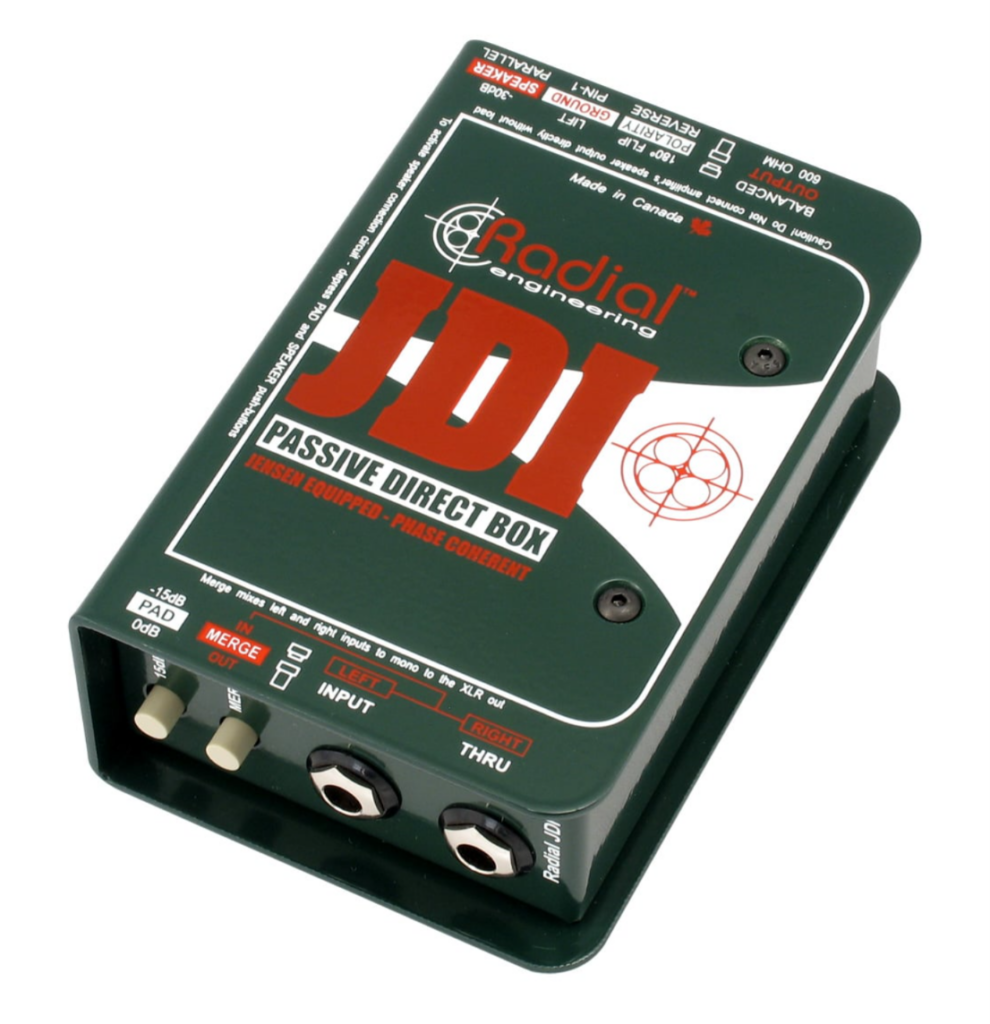
And I can’t think of a product that better exemplifies this philosophy than the Radial JDI.
Thirty years and counting
I’ve owned one of the original-style Radial JDI direct boxes for probably thirty years. It still works perfectly. It still looks great. It still sounds great. And I have absolutely no reason to believe it won’t continue doing all three long after I’m gone.
That’s an impressive accomplishment for a piece of recording equipment, particularly one that doesn’t require special attention or even a power supply. The JDI is a passive direct box. There are no batteries to replace, no phantom power requirements and no active electronics waiting to become obsolete. It’s simply a well-designed piece of equipment built from excellent components. At its heart is a Jensen transformer.
The Jensen transformer
The transformer is what makes the JDI what it is. It converts an unbalanced instrument or line-level signal into a balanced, low-impedance microphone-level signal suitable for a microphone preamplifier. That sounds straightforward, but transformers aren’t all created equal.
A poorly designed transformer can introduce unwanted distortion, restrict frequency response or saturate prematurely. A good one can deliver excellent signal integrity while providing galvanic isolation between source and destination. That isolation is useful when dealing with ground loops, without resorting to questionable electrical practices. And the JDI doesn’t require power to do its job.
Simple is better
One thing I appreciate about the JDI is that it doesn’t try to be clever. There’s an instrument input, a parallel throughput connection and a balanced XLR output, along with practical switches for attenuation, ground lift and other application-specific functions. Plug your instrument into the JDI, connect the XLR to a microphone preamp, and you’re ready to record.
The parallel output lets you feed an amplifier at the same time, making it especially useful for bass. You can capture a direct signal while the player uses an amp and decide later how to blend them.
You already have the preamp
There are excellent active direct boxes on the market. The Countryman Type 85 has been a studio and live-sound staple for decades. Avalon also makes sophisticated active DI and preamplifier products. Those are legitimate alternatives, and there are situations where an active DI is preferable, particularly with passive pickups that benefit from a very high input impedance.
But if you already own good microphone preamps, why not use them? The JDI allows you to take advantage of whatever preamp you prefer. Want a clean, transparent sound? Connect it to a clean preamp. Want a little transformer coloration or something more aggressive? Connect it to a Neve-style or API-style preamp. The JDI does its job, and the preamp does the rest.
Every studio should have one
I genuinely believe every recording studio should have at least one excellent direct box. Not an adequate one. Not something bought simply because it was the cheapest option in the catalog. A really good one.
For my money, the Radial JDI is the one to buy. There are cheaper direct boxes, certainly, but I don’t believe there are better passive direct boxes for the general-purpose studio work most of us do. Spread the price difference over twenty or thirty years and it becomes almost meaningless.
The Radial family
Years ago, we reviewed one of Radial’s multichannel direct boxes, and the company has continued to expand its range considerably since then. Radial makes direct boxes, splitters, reamplification devices, switching systems and all sorts of other useful products.
But I still think the JDI represents the heart of the company. It’s a beautifully executed solution to a common problem, built with excellent components and designed to last. There’s nothing particularly fashionable about it. And that’s exactly why I like it.
Final thoughts
The Radial JDI is the perfect example of buy once, cry once. I’ve had mine for roughly thirty years, and it’s still as useful as it was when I bought it.
It doesn’t need software updates, firmware revisions, replacement batteries or a subscription. It doesn’t have a touchscreen. It doesn’t connect to the internet. It doesn’t do anything particularly exciting.
It just works. And it works extremely well.
If you need a direct box and plan to keep making music for a long time, buy a Radial JDI. There are cheaper ones. I don’t think there are better ones. Thirty years from now, you probably won’t remember what you paid for it. You’ll just be glad you bought it.