Plug-In Reviews
LEWITT LW6 Review: Wireless Studio Headphones That Actually Make Sense
In this article
- The Latency Question
- Sixteen Feet of Freedom
- How Do They Sound?
- Sound Profiles and Virtual Monitors
- Are These Things on Backwards?
- Comfort: Outstanding
- The App Is Surprisingly Good
- Loudness Guard: A Useful Feature With an Important Question
- Packaging and Accessories: Everything You Need, Almost
- A Remarkably Finished Product
- The Bottom Line
Uncompressed wireless audio, excellent sound quality, and a few milliseconds of reality.
The new LEWITT LW6 headphones are interesting for several reasons, not least of which is that they offer three different ways to listen. Please, no jokes about three-input headphones.
You can use them wired, over conventional Bluetooth, or through LEWITT’s proprietary RealSound wireless system. That third option makes them particularly interesting in a recording studio. RealSound transmits uncompressed PCM audio with remarkably low latency: LEWITT specifies 5.8 milliseconds. But is that imperceptible? Well, not entirely.

The Latency Question
Six milliseconds is not zero milliseconds, and I can hear the difference. I remember experimenting with digital delays of two, three, six, or ten milliseconds and hearing the comb filtering and phasy cancellations when a delayed signal was combined with an undelayed one. Of course, that isn’t quite the same as perceiving a monitoring delay, but small timing differences can be audible under the right circumstances.
When you’re playing or singing, especially when you hear some of your own sound acoustically, a few milliseconds can matter. Is it objectionable? Not particularly. Would I prefer zero latency? Certainly. But digital conversion, processing, and wireless transmission take time. The LW6’s performance is remarkable, and I suspect most musicians will adapt quickly. Remember that any additional audio-interface or DAW latency adds to the wireless delay. For most applications, I don’t see this as a dealbreaker.
Sixteen Feet of Freedom
LEWITT specifies a maximum RealSound range of approximately five meters, or 16 feet. In my experience, the practical range was perhaps a little less. That might seem limiting compared with Bluetooth, but I don’t think it’s much of a problem.
In a traditional recording studio with substantial masonry, double-glazed windows, and heavily isolated rooms, expecting high-bandwidth wireless transmission through those assemblies isn’t realistic. Older studios sometimes incorporated metal or lead; today mass-loaded vinyl and other specialized materials are more common. A properly equipped studio generally has headphone tie lines and patch panels. Connect the transmitter to the headphone feed in the room where you’re working. Problem solved.
LEWITT even recommends mounting the transmitter upside down when ceiling-mounted. Keep it close, preferably with an unobstructed path. For a musician moving around a live room, that freedom can be extremely useful.
How Do They Sound?
Terrific. There’s really no other way to put it.
The LW6 is genuinely excellent-sounding, competitive with better Beyerdynamic and Audio-Technica headphones I’ve heard. I haven’t heard the latest Focal models, so I can’t compare them directly. And then there’s Ultrasone, another German manufacturer whose headphones I’ve never particularly cared for.
These are not dull headphones. There’s plenty of detail, clarity, and high-frequency information, without the exaggerated brightness I’ve found objectionable in some Sony headphones. In fact, I’d describe them as almost the opposite of Sony shrill. They’re revealing without constantly drawing attention to the upper frequencies. A headphone doesn’t need to sound bright to sound accurate.
My initial impression wasn’t entirely positive: there seemed to be too much bass. My wife agreed: “Wow, that’s a lot of lows.” It turned out they were operating in the Enhanced Bass profile. I don’t know whether they arrived that way or I inadvertently selected it with the onboard buttons. Once I switched to a more neutral presentation, the balance made considerably more sense. The low end became appropriate and the overall tonal balance was excellent. Your impression of accuracy will depend on the selected profile.
Sound Profiles and Virtual Monitors
The LW6 includes several sound profiles and custom equalization options. There’s a virtual studio monitor mode intended to simulate listening to loudspeakers. I didn’t particularly care for it. I’ve never been enthusiastic about attempts to make headphones sound like studio monitors, and this didn’t change my mind. I preferred listening to the LW6 as headphones.
There are additional profiles and customization options in the software, though I couldn’t figure out how to access everything as quickly as I’d have liked during the review period. I’ll probably contact LEWITT for clarification and add an update. The basic sound quality was good enough that I didn’t feel compelled to improve it.
Are These Things on Backwards?
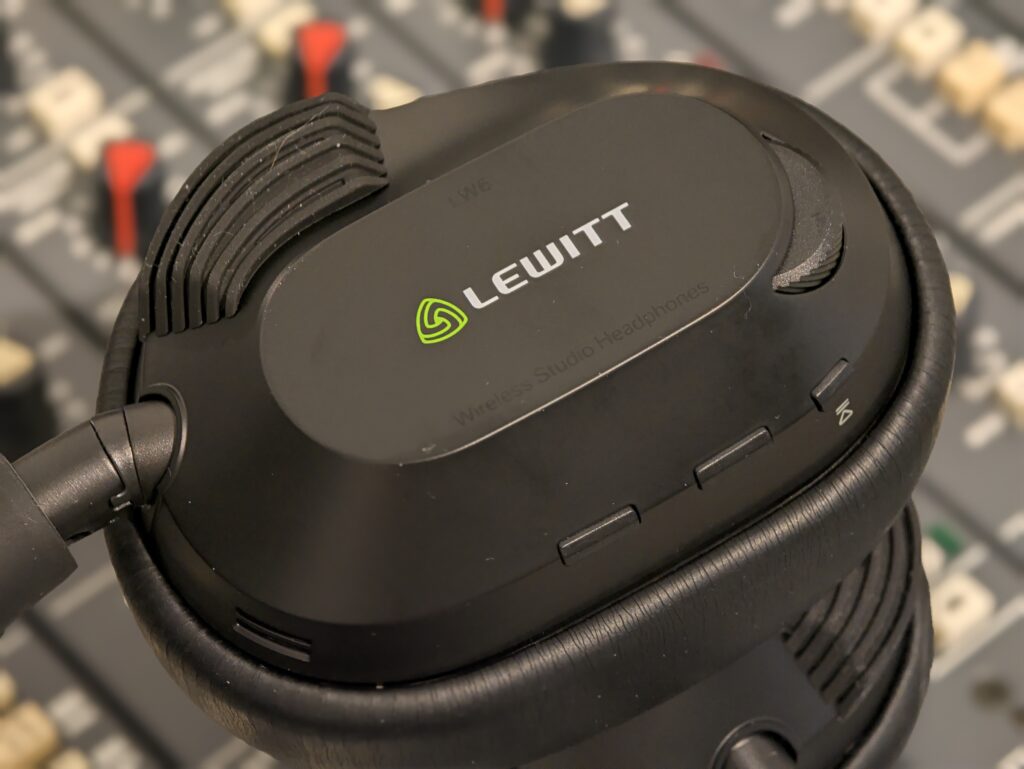
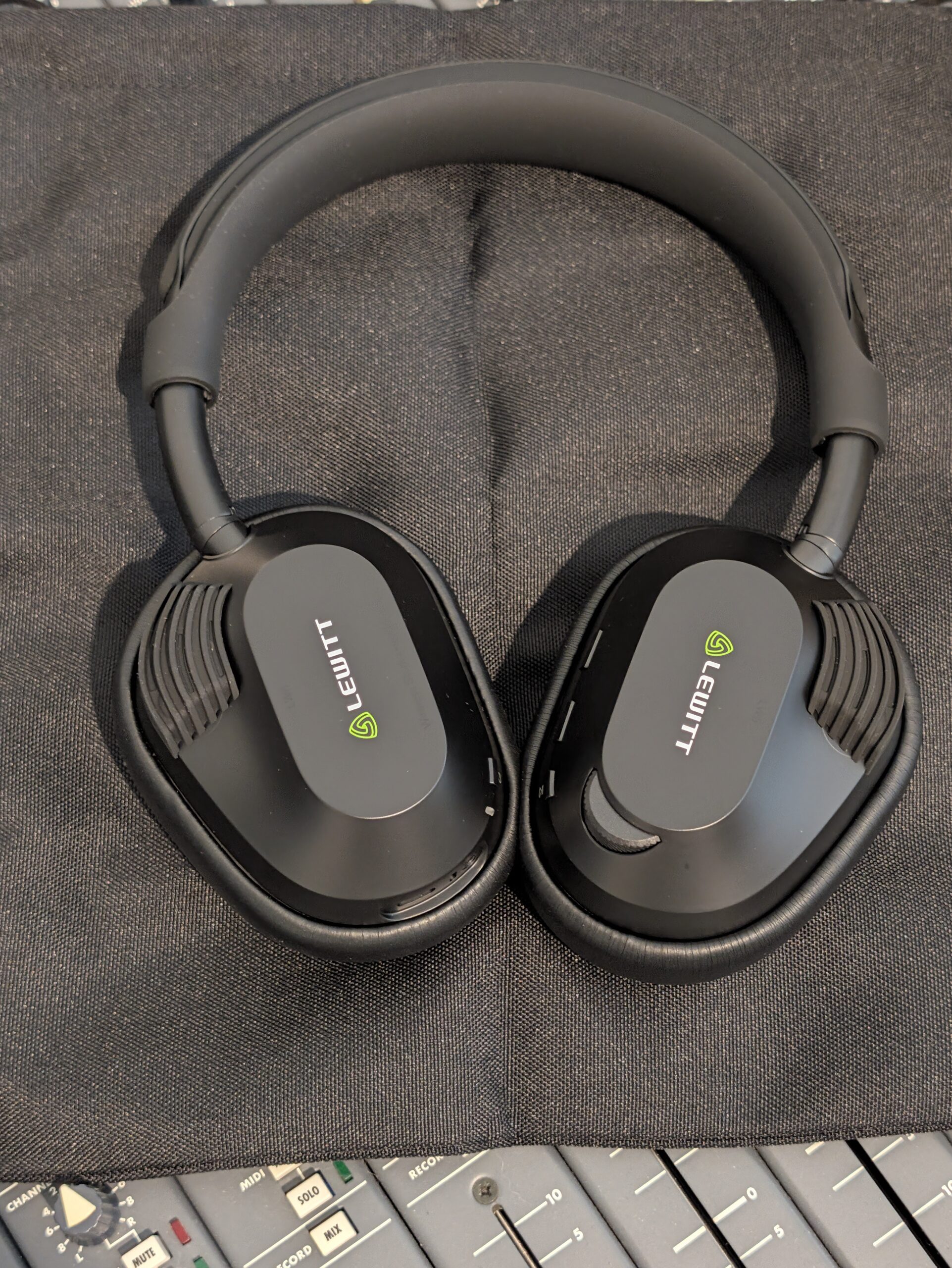
There’s one amusing aspect of the design: every time I initially picked them up, I wanted to put them on backwards. The antenna assembly looks like an automotive spoiler. Having spent a lifetime looking at cars, I associate spoilers with the rear: Porsche 911 Turbo, Mazda RX-7, even old Saabs. On the LW6, the spoiler is at the front, at least as my brain interprets it.
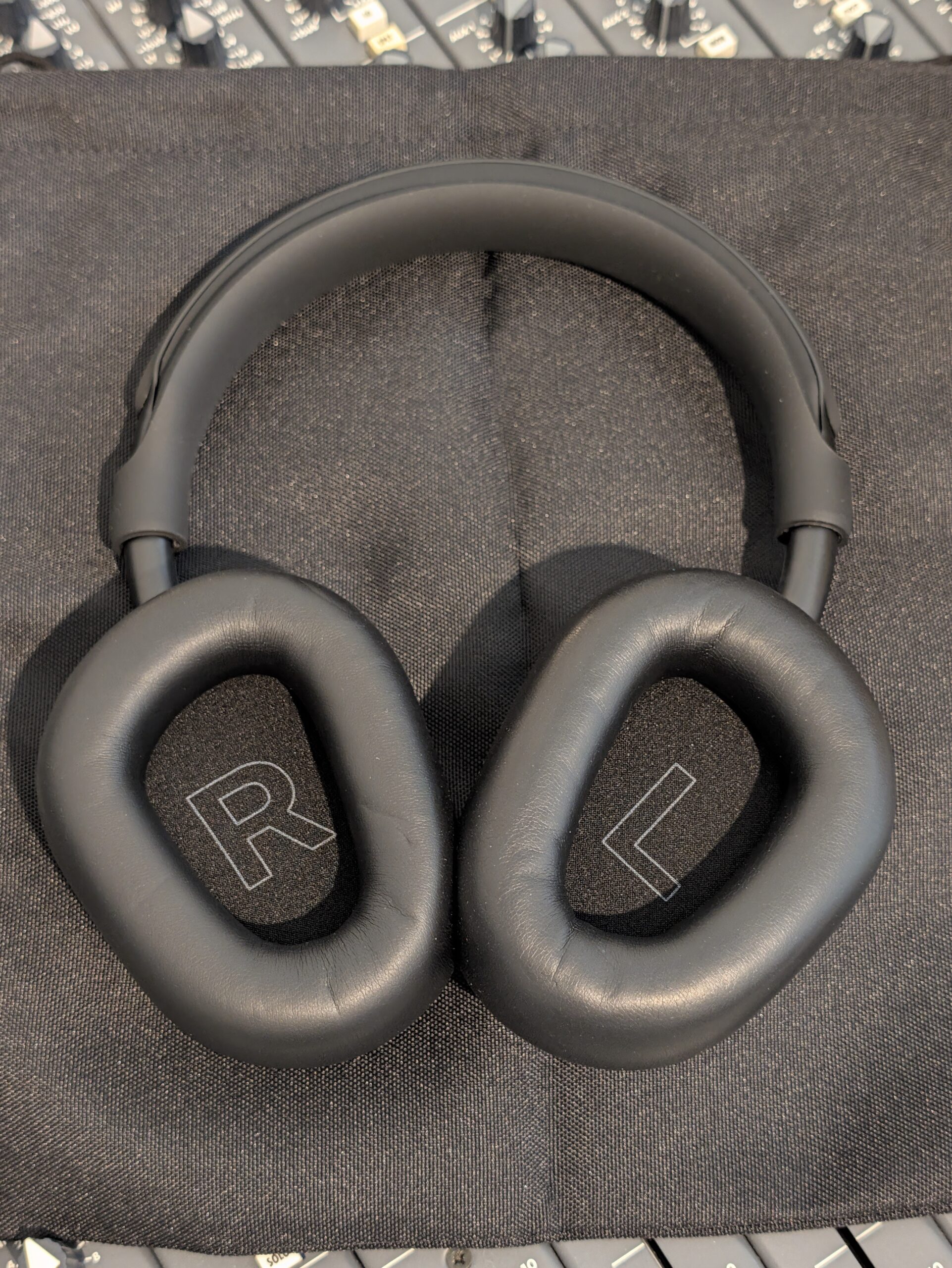
Fortunately, LEWITT clearly marks left and right inside the ear cups. Without those markings I would almost certainly have put them on backwards. After a day I got used to it. It’s distinctive, and ultimately I like it.
Comfort: Outstanding
LEWITT has absolutely nailed comfort. These are exceptionally comfortable headphones, reasonably lightweight considering the batteries, wireless circuitry, and active electronics. The ear cushions are extremely soft and compliant; the flexible silicone headband is equally comfortable. The construction feels premium and carefully considered.
There’s also a rotary volume control exactly where your fingers naturally find it. I really like that. Instead of hunting for tiny buttons, you can adjust the level immediately. A small detail that makes the headphones pleasant to use every day.
The App Is Surprisingly Good
I used the LEWITT HEADPHONES app on Android and came away impressed. For a new product and presumably an early generation of software and firmware, it feels remarkably mature. It controls sound profiles, monitoring functions, and configurable buttons. I assigned a button to dim the headphones, a very useful studio feature.
You can switch to mono, reverse stereo, or listen to stereo side information, in mono or stereo. Isolating the side information is useful for assessing reverb, ambience, and how wet a mix is. These aren’t gimmicks; they’re genuine production tools. The app even includes nice input and output metering. Desktop software is available for Windows and macOS, with mobile apps for Android and iOS. It feels like part of a professional monitoring system, not an afterthought.
Loudness Guard: A Useful Feature With an Important Question
LEWITT’s Loudness Guard allows a maximum listening level to be set. I found 105 dB considerably louder than I wanted and reduced mine to 98 dB, still plenty loud on most material. Of course, 98 dB isn’t conservative for extended listening, and actual hearing risk depends on exposure duration.
What I don’t know is how quickly the protection responds to sudden transients. If a microphone produces a burst of feedback, can the limiter clamp down before a potentially damaging peak reaches your ears, or is it intended primarily for longer-term level control? Those are different things. I’d like to ask LEWITT about attack characteristics and protective capabilities. Don’t assume any limiter guarantees protection from every hazardous sound.
Packaging and Accessories: Everything You Need, Almost
LEWITT has done an excellent job with packaging and accessories. Everything arrived very securely packaged and protected. All the required cabling is included, so you don’t need to hunt for another cable to use the different connection modes.
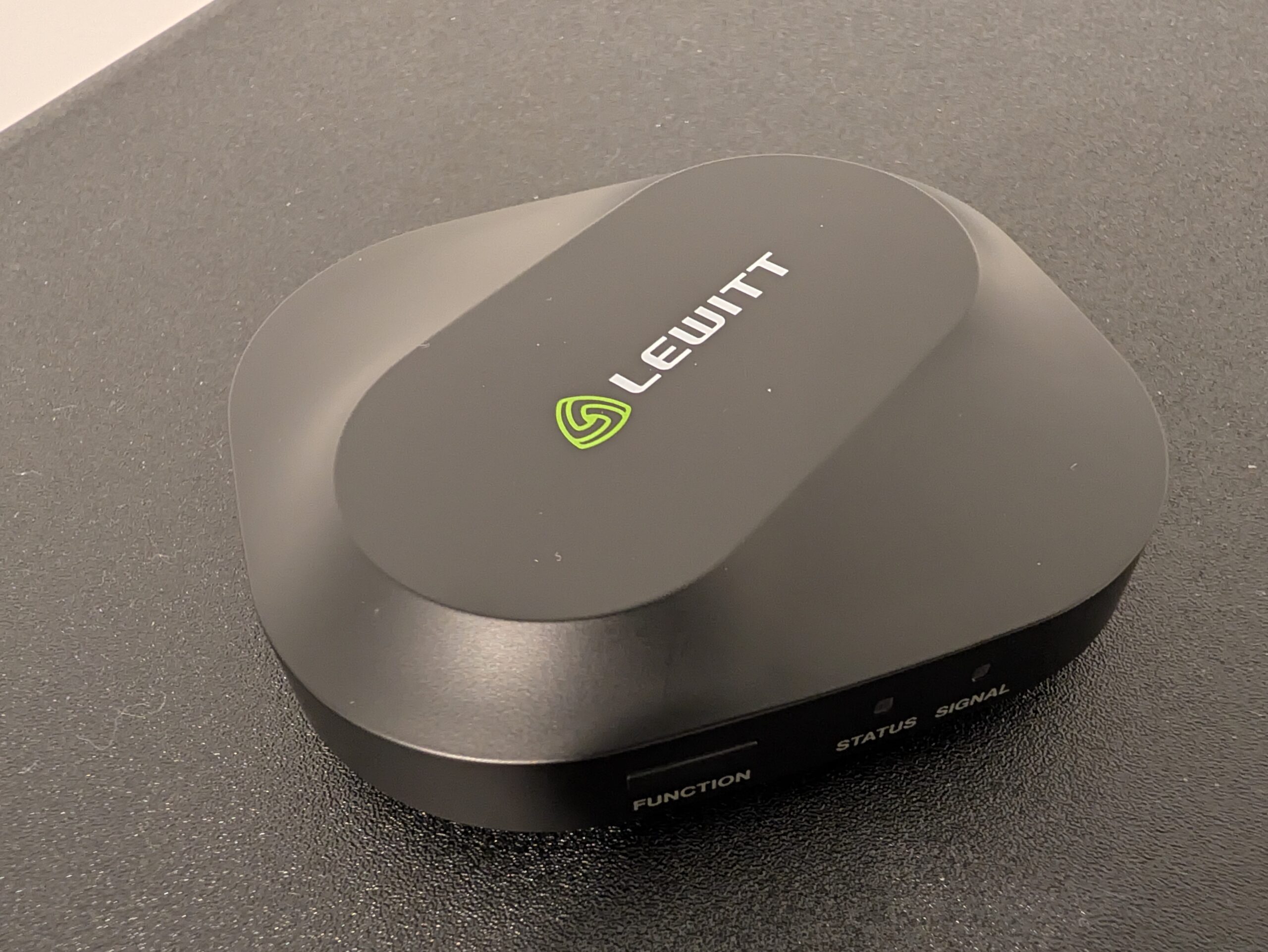
The RealSound transmitter can attach to a microphone stand, with mounting options for both larger and smaller stand threads. That’s thoughtful for studio use: you can put the transmitter where it belongs instead of balancing it on equipment. There’s also a carry bag for travel between studios.
The one omission is USB-C charging power adapters. You’ll need your own charging blocks. Given how many most of us already have, I don’t consider that a serious problem. The packaging and accessories reinforce the impression of a carefully considered professional product.
A Remarkably Finished Product
This is LEWITT’s first headphone product, yet it doesn’t feel like an experimental first-generation device. The mechanical design is excellent, comfort outstanding, sound first-rate, software well integrated, and wireless system works as intended. Even the accessories and mounting arrangements are thoughtful. Some advanced functions could be easier to discover, but nothing feels unfinished. That’s a significant accomplishment.
The Bottom Line
The LEWITT LW6 is an excellent headphone with genuinely useful wireless capability. Its sound quality competes with serious professional studio headphones, comfort is outstanding, and software provides sophisticated monitoring tools.
Uncompressed PCM with about 5.8 ms latency is impressive. Yes, I can perceive the delay under some conditions, and yes, the roughly 16-foot range is limited. Neither issue substantially diminishes the usefulness of the product.
For guitarists who move around, keyboard players who don’t want cables, or violinists for whom a cord gets in the way, it’s compelling. For critical work you can use it wired or with the uncompressed RealSound connection. I haven’t encountered a better overall combination of wireless performance, fidelity, comfort, and functionality.
The LEWITT LW6 is an excellent product, and one of the more interesting developments in professional headphone monitoring I’ve seen in quite some time.
— The Audio Magazine
Manufacturer: LEWITT
Product: LW6 Wireless Studio Headphones
Design: Closed-back, circumaural
Connectivity: RealSound wireless, Bluetooth 5.3, USB-C, 3.5 mm analog
RealSound latency: 5.8 ms (manufacturer specification)
RealSound range: Up to 5 m / 16.4 ft (manufacturer specification)
Battery life: Up to 21 hours (manufacturer specification)
Included: Cables, microphone stand mounting hardware, carry bag
Not included: USB-C charging power adapters
Software: Windows, macOS, Android, iOS