Microphone Reviews
DW Moon Mic Review: The Ultimate Kick Drum Sub-Bass Microphone
In this article
The DW Moon Mic is probably the ultimate expression of one of the simplest and most ingenious ideas ever devised for recording a bass drum.
It’s a speaker in a box.
That’s essentially it.
And if that sounds ridiculously simple, that’s because it is.
But it’s also remarkably effective.
When a Speaker Becomes a Microphone
For decades, recording engineers have experimented with using ordinary loudspeakers as microphones.
The principle is straightforward. A conventional dynamic loudspeaker and a moving-coil dynamic microphone operate on essentially the same electromagnetic principle.
When you drive a loudspeaker with an electrical signal, the voice coil moves within a magnetic field, causing the cone to move and produce sound.
But the process also works in reverse.
Move the speaker cone with sound pressure, and the voice coil generates an electrical signal.
In other words, a speaker can function as a microphone.
And because a relatively large speaker cone responds differently from a conventional microphone diaphragm, it can be particularly useful for capturing the very low-frequency energy produced by a kick drum.
Of course, engineers figured this out a long time ago.
And being engineers, they immediately started improvising.
The Original Homemade Subkick
Years ago, if you wanted to try this technique, you generally found a small, inexpensive loudspeaker and figured out some way to position it in front of the bass drum.
You might put it on a concrete block.
You might suspend it from a cable.
You might construct some sort of homemade bracket.
Whatever worked.
I remember doing it with a cheap five-inch Radio Shack speaker.
And it worked.
There was nothing particularly sophisticated about the arrangement, but the speaker captured a useful amount of low-frequency energy that could be blended with the sound of a conventional kick drum microphone.
I also remember people using Yamaha NS-10 woofers for this purpose, although I wouldn’t swear that those were the particular drivers everyone preferred.
The point is that the concept didn’t require anything especially exotic.
You needed a speaker, a way to connect it to your recording system, and some means of keeping it in position.
Eventually, manufacturers recognized that there might actually be a market for a properly engineered version of what engineers had been cobbling together for years.
Yamaha introduced the Subkick, which packaged the concept into a much more practical product.
And then there’s the DW Moon Mic.
The Moon Mic Takes the Concept Seriously
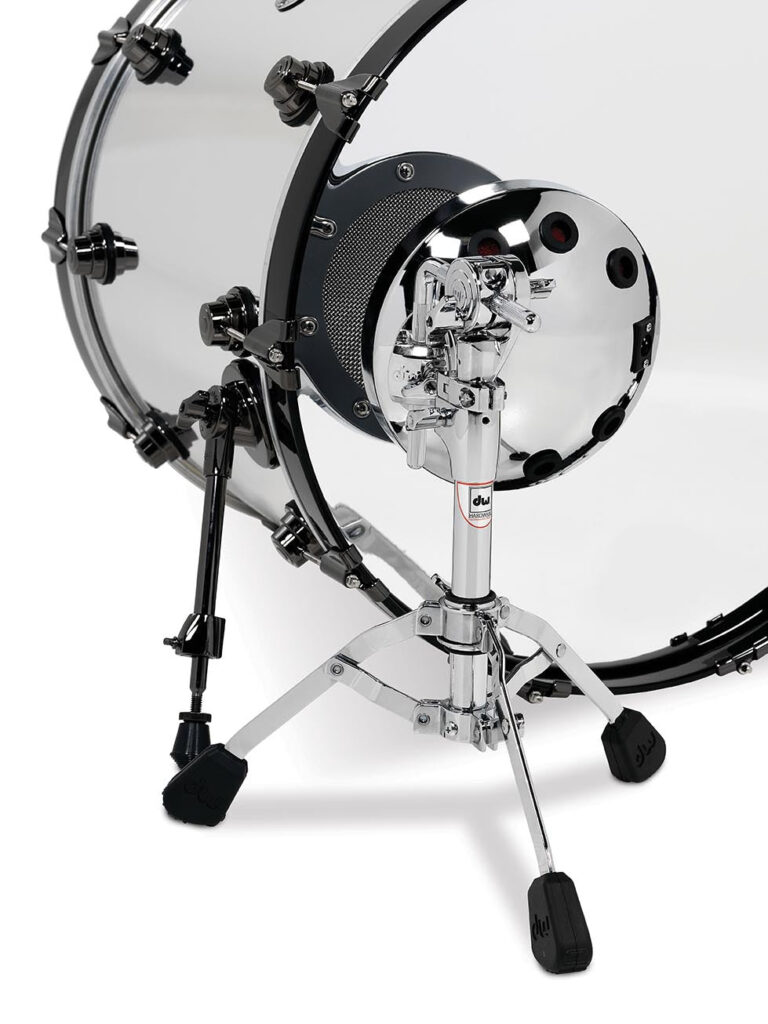
The DW Moon Mic is, in my opinion, the most beautifully executed version of this idea.
It’s almost comically elaborate when you consider what it actually does.
After all, we’re still talking about a loudspeaker being used as a microphone.
But DW approached the concept with the same attention to mechanical design and presentation that you’d expect from a company known for high-end drums and hardware.
First of all, it comes mounted on a proper DW stand.
That’s a significant improvement over balancing a Radio Shack speaker on a concrete block.
The assembly is substantial, stable, and easy to position.
Then there’s the appearance.
Mine has a beautiful chrome finish, although I believe black versions were also offered.
It looks like a serious piece of professional equipment rather than something you assembled from spare parts in the garage.
Which, admittedly, is exactly how many of us started doing this.
Inside the enclosure is a dynamic loudspeaker driver that functions as the pickup element.
My Moon Mic also has a polarity-reversal switch, which is useful when combining its output with another microphone.
I’m not certain whether every version has that feature, particularly the later production models.
But it’s a sensible addition.
And the entire thing is beautifully made.
One Job, Done Extremely Well
The Moon Mic does one thing.
It captures the extreme low-frequency energy of a bass drum.
And it does that extremely well.
This is not a microphone you’re going to use by itself to create a complete kick drum sound.
At least, I wouldn’t.
It doesn’t provide the beater attack, upper-frequency definition, or overall tonal balance that you’d normally expect from a conventional kick drum microphone.
Instead, you use it alongside another microphone.
That might be a microphone positioned inside the drum, or one placed near the port in the front head.
You establish your primary kick drum sound with that microphone, and then blend in the Moon Mic to add the bottom end.
And when I say bottom end, I mean serious bottom end.
The effect can be quite impressive.
You can position the Moon Mic relatively close to the front head, adjust its location, and blend its output until you have the amount of low-frequency energy you’re looking for.
It’s a particularly useful technique when you want a very substantial, extended kick drum sound without relying entirely on equalization to manufacture it.
Of course, you need a monitoring system capable of reproducing those frequencies accurately.
Otherwise, it’s remarkably easy to add considerably more low-frequency energy than you realize.
But with a good monitoring system, the Moon Mic gives you another useful element to work with.
Combining It With a Conventional Microphone
One important consideration when using the Moon Mic is its relationship to the primary kick drum microphone.
Because the two transducers are positioned differently and have different responses, the signals won’t necessarily combine in a straightforward manner.
Polarity and timing matter.
That’s one reason I appreciate the polarity-reversal switch on mine.
It’s worth experimenting with polarity, positioning, and the relative levels of the two microphones rather than simply assuming that adding more Moon Mic will automatically produce a better sound.
Sometimes a small amount is all you need.
And sometimes you can get a much more substantial effect by adjusting the relationship between the two signals.
The Moon Mic is really a specialized tool for shaping the low-frequency component of the kick drum.
It doesn’t replace a conventional microphone.
It complements one.
The Problem Is Finding One
Unfortunately, the Moon Mic isn’t necessarily the easiest piece of equipment to find.
Availability has been inconsistent, and prices have increased considerably over the years.
That’s unfortunate, because I think it’s an excellent product.
Yes, you can accomplish something similar with an inexpensive loudspeaker and a little ingenuity.
I know that because I’ve done it.
And the underlying principle hasn’t changed.
But there’s something to be said for having a properly engineered, beautifully finished piece of equipment that does exactly what you need without requiring you to improvise a mounting system every time you want to use it.
The Moon Mic is one of those products.
The Verdict
The DW Moon Mic is a wonderfully executed version of a very old recording trick.
It’s beautifully constructed, comes with excellent DW hardware, and provides a substantial amount of very low-frequency energy that can be blended with a conventional kick drum microphone.
It isn’t particularly versatile.
It isn’t intended to be.
It does one thing, and it does it extremely well.
The biggest disadvantages are availability and price.
But if you’re looking for a way to capture the extreme low-frequency component of a bass drum, and you can find a Moon Mic at a reasonable price, it’s certainly worth seeking out.
You could always build something similar yourself.
But it probably wouldn’t look nearly as nice.
Highly recommended.