Processor Reviews
Accutronics AccuVerb Review: The Unusual Tube Spring Reverb
In this article
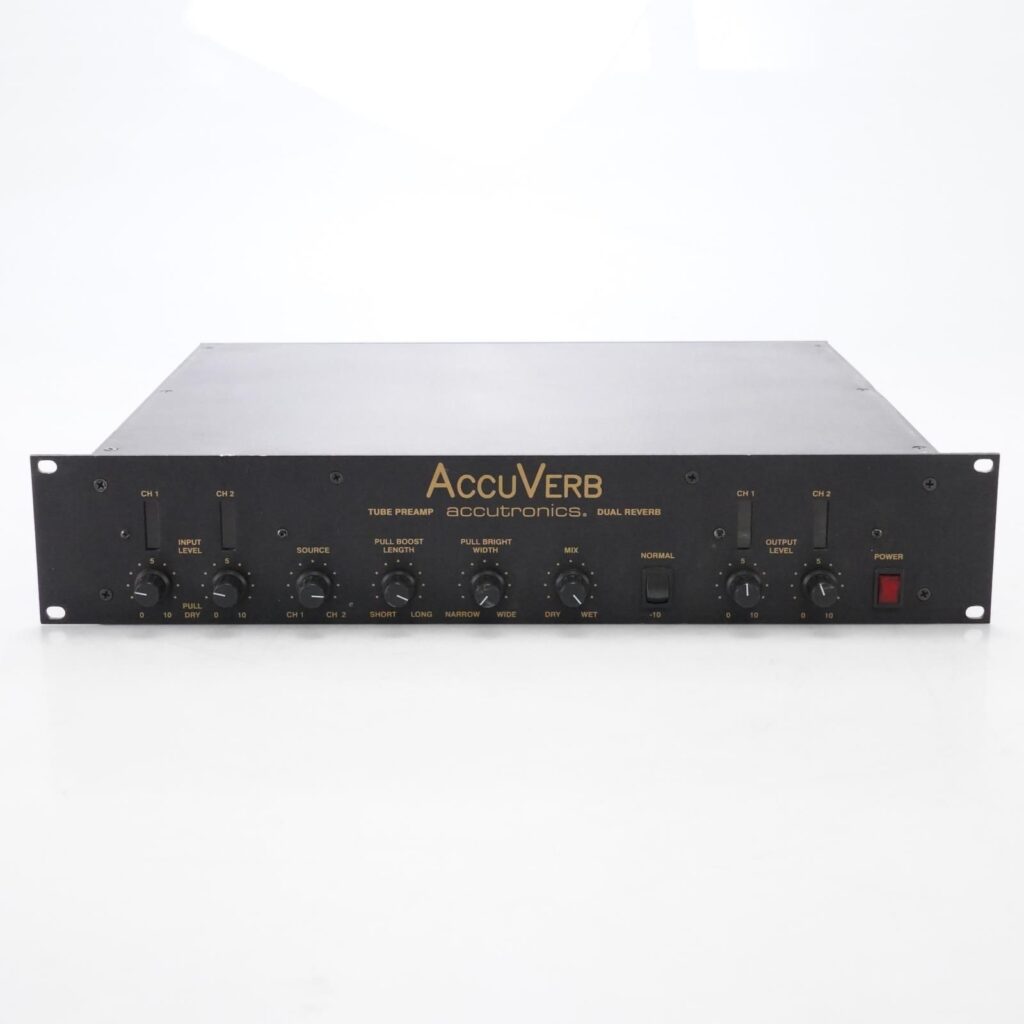
Here’s one of the stranger pieces in The Audio Magazine racks: the Accutronics AccuVerb. It’s a tube-driven spring reverb from the 1990s, which is a rather odd thing to have been making in the 1990s.
You might reasonably assume that tube spring reverbs had already had their day by the 1960s. In a sense, you’d be right. The classic example is the outboard Fender tube reverb unit, familiar to generations of guitar players. But apparently somebody at Accutronics decided that what the world really needed was a thoroughly over-engineered, professional-looking version of the idea.
And I have to admit, I’m glad they did.
Built like a piece of industrial machinery
The first thing you notice about the AccuVerb is its weight. This thing is unbelievably heavy for what it does. I’d put it somewhere around twenty pounds, although I haven’t put mine on a scale. It’s also extraordinarily well built. Nothing about it suggests that Accutronics was trying to save a few dollars on the chassis.
It uses 12AU7 tubes, and it came from a company that knew a thing or two about spring reverbs. Accutronics made the spring reverb tanks found in countless amplifiers, including many of the sounds guitar players have loved for decades. So while the AccuVerb is an unusual product, the technology was hardly unfamiliar territory for its manufacturer.
Almost two channels, but not quite
The AccuVerb is a slightly peculiar device to describe. It has something resembling two-channel operation, but the channels aren’t completely independent in the way you’d expect from a conventional dual-channel processor. Their operation is interconnected, so I wouldn’t call it a straightforward stereo reverb.
It can also be used as a tube preamp, which gives it another reason to occupy space in the rack. There’s no phantom power, however, so if you’re planning to use it with a microphone, you’ll need a dynamic microphone or another microphone arrangement that doesn’t depend on phantom power from the AccuVerb. A tube microphone with its own suitable power supply is another possibility.
What does the Accutronics AccuVerb sound like?
It sounds great—provided you actually want a spring reverb.
That qualification matters. If you’re expecting the pristine, perfectly controlled decay of a modern digital reverb, this isn’t it. On the other hand, it doesn’t have the exaggerated, cartoonish boing that people sometimes associate with spring tanks. It lives somewhere in between: recognizably a spring reverb, with the character and physicality that implies, but more refined than you might expect.
It’s a sound that can be genuinely useful precisely because it isn’t trying to impersonate a digital hall, plate or room. Sometimes you want something with its own personality. The AccuVerb has one.
A genuinely uncommon piece of gear
Accutronics didn’t make many of these, at least judging by how rarely they turn up. I reviewed the AccuVerb a long time ago, although I can’t remember where, and I’m not even certain the original review was ever published. So perhaps this is its second review, or perhaps it’s finally getting its first.
Either way, it remains one of the more interesting oddities in my racks. It’s big, heavy, beautifully constructed and completely out of step with the period in which it was made. In other words, exactly the sort of thing that makes collecting and using older recording equipment interesting.
Should you buy one?
If you come across an Accutronics AccuVerb at a good price and you enjoy unusual analog equipment, I’d be inclined to grab it. Not because everybody needs a tube spring reverb—they don’t—but because this is an uncommon, exceptionally solidly built example of a device with a distinctive sound.
Just make sure it works properly, and remember that old tube equipment and mechanical spring tanks can require service. Beyond that, if you love something different, this is definitely worth a look.