Microphone Reviews
A Tale of Two Equiteks: CAD E200 vs E300S Microphone Review
In this article
Back in 1996, I purchased a CAD Equitek E200 condenser microphone. I still have it, which either says something about the microphone’s longevity or my inability to get rid of things.
At the time, inexpensive condenser microphones weren’t nearly as plentiful as they are today. There was the Audio-Technica AT4033, the relatively affordable Neumann TLM 193, a Beyerdynamic condenser or two, and the CAD E200. I believe I paid around $400 for mine. That was a substantial amount of money in 1996, even if it was inexpensive by professional condenser microphone standards.
The E200 had developed something of a reputation as a good microphone for the outside of a bass drum. That’s why I bought it. Unfortunately, I didn’t really know what I was doing with it at the time, and my results were less than spectacular. Nevertheless, I enjoyed having it, and eventually it went into storage, where it spent much of the next couple of decades.
About ten years ago, I pulled it out to record a singer with an extraordinarily nasal, whiny voice. This was not a particularly pleasant voice to begin with, and finding a microphone that didn’t make matters worse was something of a challenge.
Surprisingly, the E200 worked rather well.
One of the interesting characteristics of the E200 is that it isn’t particularly bright. I wouldn’t describe it as dark, either, and it certainly doesn’t sound closed-in or muffled. Rather, it has a way of smoothing out the rough edges of a source without completely robbing it of detail.
In the case of this singer, that was exactly what was needed. The E200 managed to make an otherwise fairly unpleasant vocal sound almost acceptable. Given what I had to work with, that was no small accomplishment.
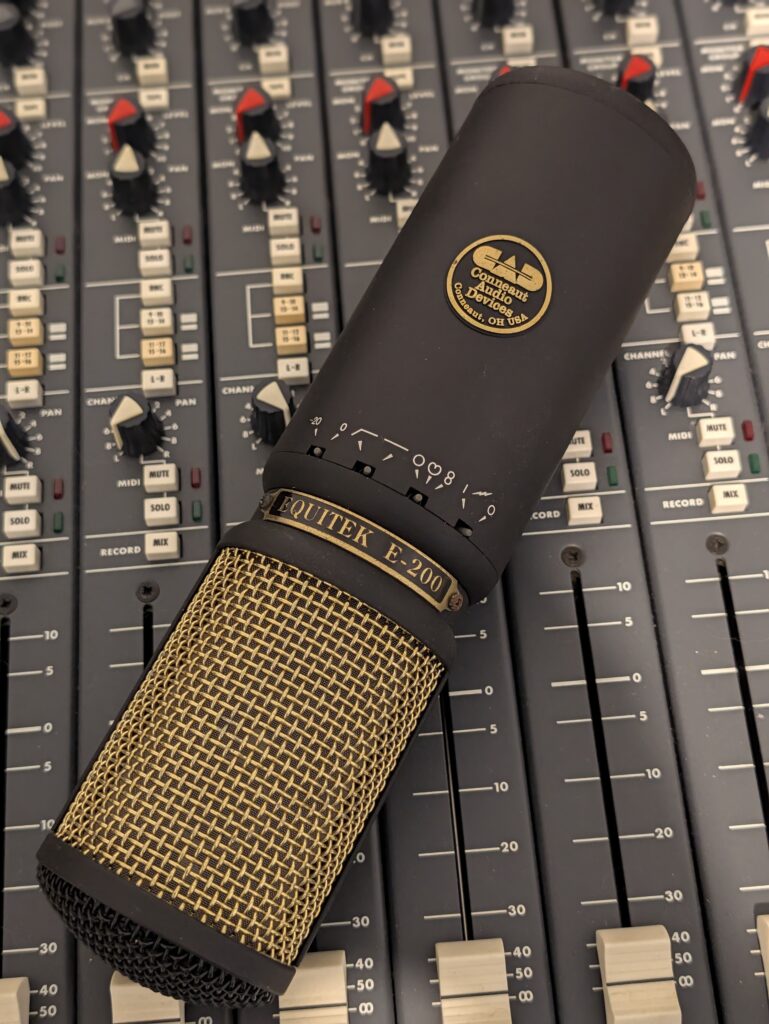
The CAD Equitek E200
The E200 is interesting from an engineering standpoint. It uses two back-electret capsules mounted back-to-back, rather than a conventional externally polarized large-diaphragm capsule. That arrangement gives it three selectable polar patterns: cardioid, omnidirectional, and figure-eight.
It also uses two rechargeable nine-volt batteries as an internal current reserve. The original batteries were nickel-cadmium (NiCd). CAD’s own battery guidance explains that phantom power charges the batteries, which provide the additional current required by the microphone’s circuitry. If you’re buying one today, the condition of the batteries and compatibility of any replacements deserve attention.
My E200 was made in the United States. As I recall, its capsules were Japanese; the original design has been associated with Primo back-electret capsules. I haven’t independently verified the origin of the capsules in my particular microphone.
Physically, the E200 is a substantial piece of equipment. It’s enormous, solidly constructed, and rather impressive-looking. In fact, it looks considerably more expensive than it is, or ever was.
There’s something appealing about that. You put an E200 in front of a singer, and it certainly looks as though you mean business.
The build quality is excellent, at least on my example, which has survived thirty years without falling apart. Admittedly, it hasn’t spent all thirty years being used, but there’s nothing about it that feels cheap or disposable.
Sonically, its greatest strength is that it doesn’t insist on emphasizing every bit of upper-midrange aggression and high-frequency hash that comes its way. That makes it useful on sources that are already bright, strident, or otherwise difficult to listen to.
Used E200s can be found around the $100 mark, sometimes more. At that sort of price, I think they’re a terrific value, provided they’re in good working condition. They’re not the most detailed microphones in the world, but detail isn’t always what a recording needs.
Sometimes a little restraint is a virtue.
Enter the CAD Equitek E300S
The E300S is a considerably more modern design, and sonically it could hardly be more different. Where the E200 is smooth and somewhat forgiving, the E300S is bright, crisp, and extremely detailed. It uses an externally biased large-diaphragm condenser capsule rather than the E200’s electret arrangement.
Unlike my American-made E200, the E300S was manufactured in China. That doesn’t automatically make it an inferior product. Mine seem quite well constructed, and the E300S comes with a genuinely excellent hard case and shock mount. It also uses a rechargeable battery-assisted power arrangement, so battery condition matters here, too.
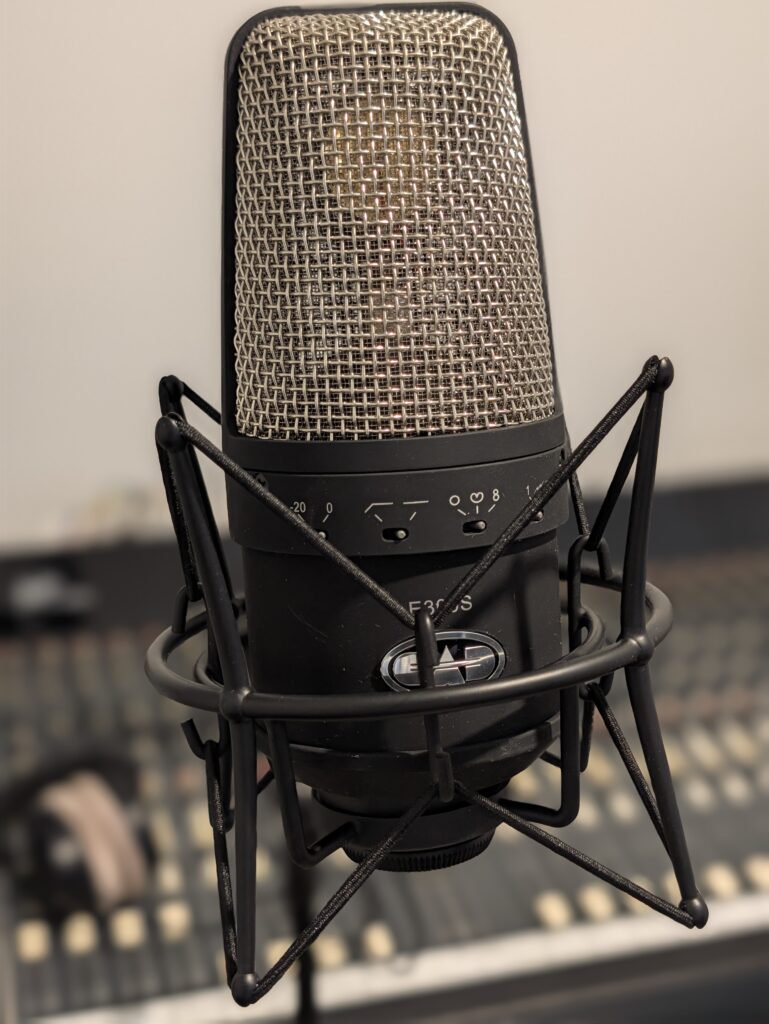
Which brings us to the sound.
There’s a lot of top end.
A lot of top end.
Now, that isn’t necessarily a bad thing. The E300S actually does this rather better than many inexpensive condensers, some of which seem to have been designed on the assumption that adding another five decibels at 10 kHz automatically makes a microphone sound expensive.
The E300S has genuine detail and clarity, but it is emphatically not a mellow microphone. If you’re trying to tame a nasal singer, the E300S would be pretty far down my list of candidates. Where the E200 smooths out the rough edges, the E300S is quite happy to present them to you in high definition.
On the other hand, put it in front of a good acoustic guitar, and things get considerably more interesting. With a well-balanced instrument, particularly one where you want to emphasize string articulation and upper-frequency detail, the E300S can sound absolutely wonderful. It captures the attack and sparkle of an acoustic guitar in a way that the older E200 simply doesn’t.
Of course, if the guitar is already excessively bright, you may find yourself reaching for something else.
I own two E300S microphones, although I’ve never actually tried them as drum overheads. I suspect they could be excellent on the right kit, in the right room, with the right cymbals.
They could also tear your head off.
Until I actually try them in that application, I’m not prepared to say which.
I have used the E300S as a mono room microphone, positioned some distance from the source in a good-sounding room, and the results can be quite impressive. The microphone’s detail and high-frequency presentation can work nicely when there’s enough distance to let the sound develop.
But the room matters enormously. In a bright, reflective space, the E300S is likely to give you considerably more of that brightness than you really want.
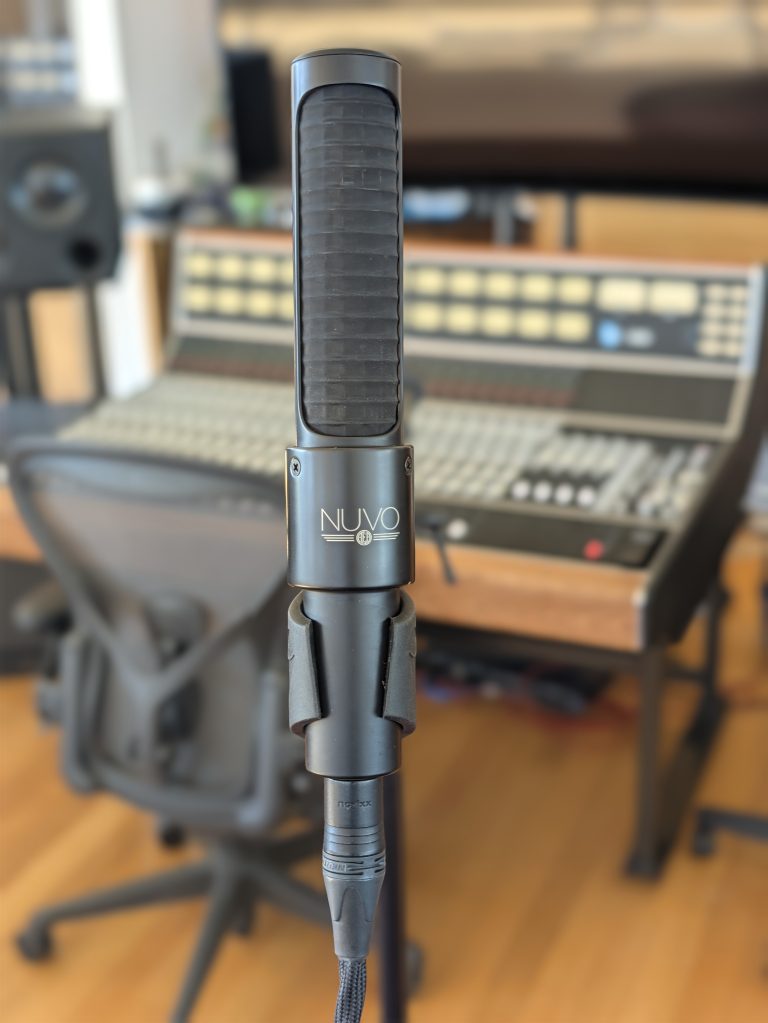
For that application, I’d generally prefer something like the AEA NUVO N8, which I reviewed previously in The Audio Magazine. It’s a much more forgiving choice when you don’t want the microphone emphasizing every hard reflection in the room.
Like the E200, the E300S is no longer a current model. Used examples can be found around the $200 range, although asking prices vary. At that price, they’re worth considering. The construction seems respectable, and the included case is another point in its favor.
Whatever Happened to CAD?
CAD is an interesting company. Over the years, it has produced some genuinely useful and occasionally rather ambitious recording equipment.
At one point, the company even manufactured a large-format mixing console called the CAD Maxcon. These have been out of production for many years, and from what I’ve heard, maintaining one can be something of an adventure. I haven’t owned one, so I can’t speak from personal experience, but their reputation for serviceability isn’t particularly encouraging.
CAD’s current product lineup seems to occupy a considerably more budget-oriented part of the market than some of its earlier offerings. That’s a little unfortunate, because microphones like the E200 and E300S demonstrate that the company was capable of producing some interesting equipment that didn’t simply follow the prevailing fashion.
The important distinction between these two microphones isn’t their country of origin. It’s how they sound. And these two certainly don’t sound like variations on the same theme.
Two Microphones, Two Very Different Personalities
The E200 is relatively smooth, restrained, and forgiving. It’s the microphone I’d reach for when a source has too much edge and I don’t want to spend the rest of the afternoon trying to remove it with equalization.
The E300S is detailed, lively, and unapologetically bright. It’s the microphone I’d consider when I want to bring out the articulation and sparkle of a good-sounding instrument.
Neither is inherently better. They’re simply different tools. More detail isn’t necessarily more musical, and a microphone that flatters a difficult source may ultimately be more useful than one that faithfully reproduces every unpleasant characteristic.
At roughly $100 for an E200 and $200 for an E300S, both represent potentially excellent values on the used market. Just make sure you understand what you’re buying, particularly the condition of the rechargeable batteries.
Thirty years after buying my first E200, I still find it interesting that a relatively inexpensive microphone from the mid-1990s can have a sonic personality that’s arguably more useful on certain sources than many of today’s brighter, more technically impressive designs.
And if I ever find myself recording another exceptionally nasal, whiny singer, I know exactly which microphone I’ll reach for.
The E300S can stay in its case.
Disclosure: Both microphones were purchased by the reviewer. No manufacturer supplied a review sample.