Microphone Reviews
Audio-Technica AT4033a Review: My First Condenser Microphone, for Better or Worse
Manufacturer: Audio-Technica
In this article
Oh boy. This is a loaded one.
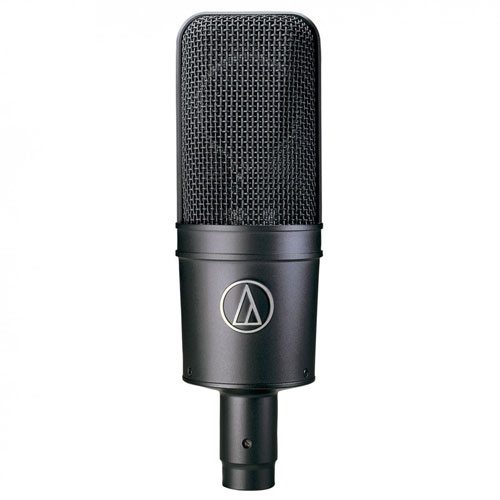
The Audio-Technica AT4033 has a special place in my recording history, although not necessarily for all the right reasons.

It was the first condenser microphone I ever owned. Not my first microphone, mind you. I’d already had a Shure Unidyne B, but the AT4033 represented my first step into what I considered serious studio recording.
And some of the sounds I got out of it were absolutely dreadful.
In fairness, most of that had very little to do with the microphone.
I simply didn’t know what I was doing.
The Early Days
When I bought my original AT4033, I was still learning how to record properly. My microphone technique wasn’t particularly good, my understanding of placement was limited, and some of the other equipment I was using wasn’t helping matters.
Among that equipment was a Tascam DA-88 digital multitrack recorder.
Now, the DA-88 was a remarkable machine in many respects, particularly considering what it cost relative to professional digital recording systems of the time. But warm and forgiving are not the first adjectives that come to mind when I think about its sound.
Combine a relatively bright condenser microphone, questionable microphone placement, an unforgiving recording chain, and an inexperienced engineer, and you’re not necessarily going to end up with something wonderful.
I certainly didn’t.
And unfortunately, those early experiences left me with some fairly negative associations with the AT4033.
Which is probably unfair to the microphone.
But there you have it.
Still Around After All These Years
One of the more remarkable things about the AT4033 family is its longevity. The microphone was introduced in the early 1990s, and versions of it have remained available for decades. The later AT4033a and AT4033/CL carry on the basic concept of the original microphone.
That’s an impressive run for a relatively affordable studio condenser.
I don’t know exactly how many of these Audio-Technica sells today, or who is buying them. I’ve always had the impression that they were particularly popular in country music recording, where their bright, clean presentation could work well on vocals and acoustic instruments.
But that’s an impression, not something I can substantiate with sales figures.
The AT4033 is certainly a clean and relatively quiet microphone, and it’s capable of producing very good recordings.
The question is whether its particular sonic character is still especially compelling when there are so many alternatives available. Including alternatives from Audio-Technica itself.
A Sound I’ve Never Quite Loved
Of the Audio-Technica microphones I’ve owned, the AT4033 is probably my least favorite. And that’s saying something, because I’ve generally had excellent experiences with the company’s microphones.
My AT4060 tube microphones, for example, are wonderfully neutral and have performed flawlessly for decades. The AT4033, by comparison, has always struck me as a little too eager to announce its presence.
It’s bright.
Not necessarily in the flattering, airy, detailed way that makes a good condenser microphone sound open and expensive.
Sometimes it’s bright in a slightly nasty way.
There’s an upper-midrange character that I don’t particularly care for, especially on sources that already have a lot of energy in that region. With the wrong voice or instrument, the AT4033 can sound somewhat aggressive.
Of course, microphone placement matters enormously, and there are undoubtedly people who have gotten excellent results with these microphones for years.
I’m not suggesting that the AT4033 is a bad microphone.
I’m suggesting that it’s a microphone whose sound I don’t especially like.
There’s a difference.
Where It Worked
Despite my reservations, there were applications where the AT4033 performed quite well. Twelve-string acoustic guitar was one of them.
A good twelve-string has a complex, shimmering high-frequency character, and the AT4033 could capture that rather nicely. Its brightness, which I sometimes found objectionable on vocals, could work to its advantage on an instrument where articulation and sparkle were desirable.
I also used it as a drum overhead, and the results weren’t bad. Not my favorite overhead microphone, certainly, but perfectly serviceable.
As with most microphones, the results depended heavily on the source, the room, and the placement.
The AT4033 was never completely without merit in my studio. It just wasn’t a microphone I found myself particularly enthusiastic about using.
The Nostalgia Purchase
About ten years ago, I bought another AT4033, apparently out of nostalgia.
I suppose I thought that revisiting the first condenser microphone I’d owned, this time with considerably more experience, might change my opinion of it.
It didn’t.
I still have the microphone somewhere, and I’ve barely used it. Not because there’s anything wrong with it, but because I have other microphones I’d rather use.
The Verdict
The AT4033 deserves credit for helping make professional-quality condenser microphones affordable at a time when the alternatives were considerably more limited.
It’s clean, quiet, well built, and capable of excellent results on the right source. I particularly liked it on twelve-string acoustic guitar.
But it’s never been a favorite of mine. Its upper-frequency character can be a little aggressive, and with so many excellent alternatives available today, including from Audio-Technica itself, I find it difficult to recommend enthusiastically.
Perhaps that’s unfair. After all, the AT4033 was there when I was learning to record, and it had to endure some pretty terrible engineering.
Then again, I bought another one decades later, when I presumably knew what I was doing.
And I still don’t use it much.