Microphone Reviews
Audio-Technica AT4060 Review: The Tube Microphone That Doesn’t Sound Like One
Manufacturer: Audio-Technica
In this article
By Richard Alan Salz

The Audio-Technica AT4060 is an interesting microphone. Interesting, in part, because it’s been around for the better part of thirty years, which is an eternity in an industry where manufacturers regularly introduce new models to replace perfectly good old ones.
The original AT4060 was introduced in 1998. A revised AT4060a followed in 2014, in part because the original design needed changes to comply with European restrictions on certain materials. That’s not necessarily the same thing as redesigning a microphone because there was something wrong with the way it sounded.
I own a pair of the original AT4060s, dating from the late 1990s. Interestingly, my second microphone was previously owned by guitarist Blues Saraceno.
Not that you care.
These microphones came from an era when your choices in serious studio microphones were considerably more limited than they are today. There were the established classics, which were often very old and very expensive, and relatively few affordable alternatives.
Today, you can buy a tube microphone for $200 and change. And quite a few of them sound like $200 microphones.
The AT4060 was a different proposition.
Where’s the Tube Sound?
What’s interesting about the AT4060—and presumably the AT4060a, although I haven’t auditioned that microphone—is that it doesn’t really sound like a tube microphone.
It just sounds like a microphone.
A very good microphone.
It isn’t particularly dark. It isn’t excessively warm or veiled. It doesn’t sound slow or soft around the edges. It doesn’t have that exaggerated, romanticized tube character that people sometimes expect when they see a glass envelope glowing inside a microphone.
It’s simply very neutral.
And I suspect that’s one of the reasons the AT4060 never became quite as popular as some other high-end tube microphones.
People often reach for a tube microphone specifically because they want a tube sound. They want something with character. Something that will smooth out a source, round off the transients, or impart a little extra personality.
They want vibe.
Sometimes they want vibe because the source they’re recording doesn’t have quite enough of its own.
The AT4060 isn’t especially interested in doing that for you.
It just sounds nice.
And I realize that sounds as though I’m damning it with faint praise. Perhaps I am.
But there’s something to be said for a microphone that doesn’t insist on making everything sound like the microphone.
When the Source Is Good, the AT4060 Is Excellent
The AT4060 is at its best when you put it in front of something that already sounds terrific.
A great drum kit, for example.
I’ve used my pair as drum overheads, and they can sound fantastic. You get a very natural presentation of the cymbals and the kit without the exaggerated brightness or splashiness that can make some condenser microphones tiring to listen to.
The microphones don’t seem to be trying to impress you. They simply reproduce what’s there.
Piano is another application where they can be exceptional.
I once recorded a Steinway Model D concert grand with my pair of AT4060s, and the results were absolutely glorious.
Of course, a well-maintained Steinway D in a good room is a pretty glorious instrument to begin with. But that’s precisely the point. The AT4060s didn’t get in the way.
They captured the body, detail, and character of the instrument without adding an obvious sonic signature of their own.
And when you’re recording an instrument of that caliber, that’s exactly what you want.
Thirty Years of Reliability
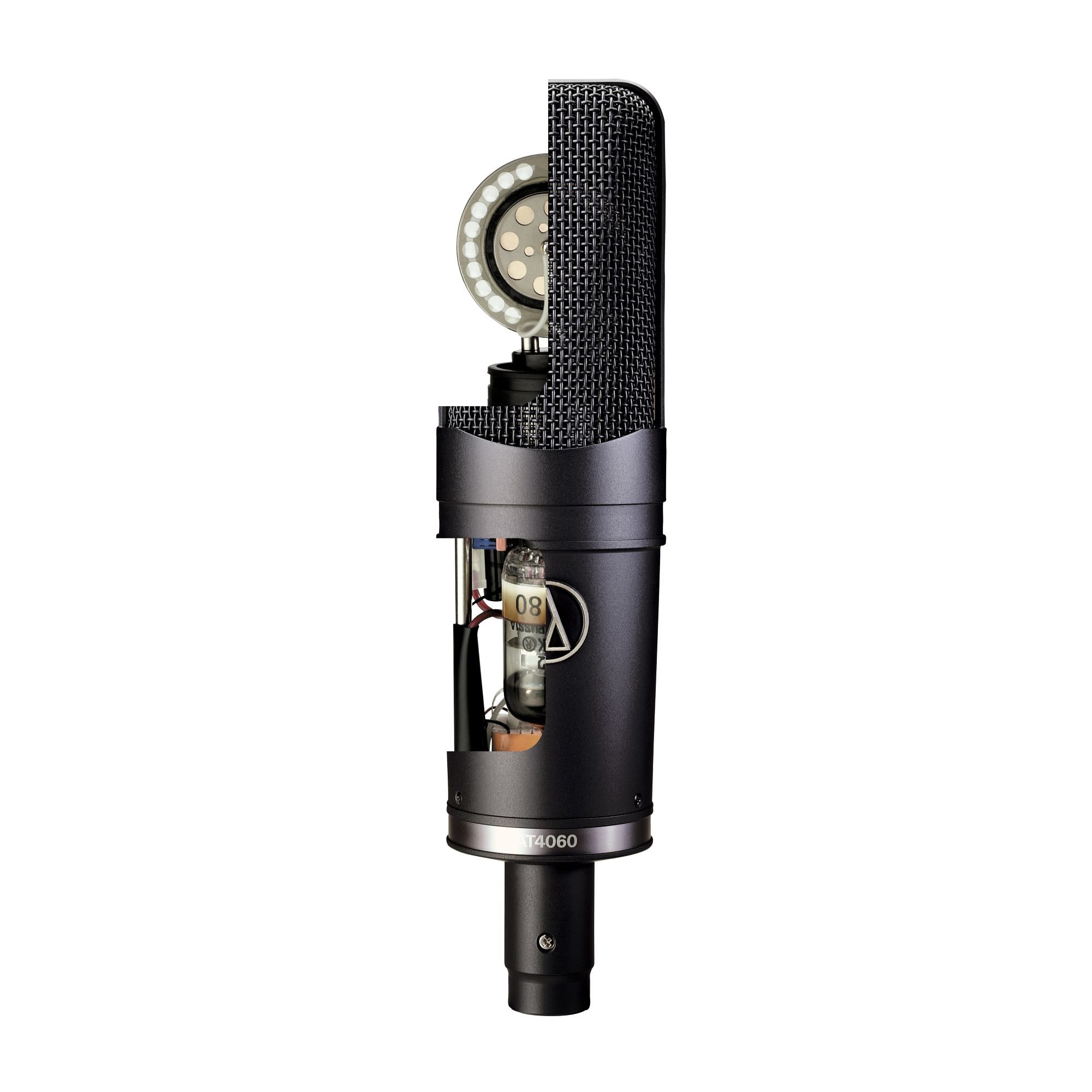
I can’t speak for every microphone Audio-Technica has ever manufactured, or even every model in the company’s 40 Series. I can speak for the ones I’ve owned.
And my experience has been uniformly excellent.
These microphones are approaching thirty years old, and they’ve performed flawlessly. I haven’t had problems with noise, intermittent operation, or any of the other aggravations that can accompany aging studio electronics.
That’s particularly noteworthy with tube microphones, which have more components and a dedicated power supply to worry about.
The other advantage is that Audio-Technica is a major, established manufacturer with a long history in professional audio. You’re not buying an obscure boutique product from a company that may disappear next year.
That doesn’t guarantee that every replacement part for a thirty-year-old microphone will remain available forever, but it does provide a degree of confidence.
And after decades of trouble-free operation, I’m inclined to give Audio-Technica considerable credit for the original AT4060’s engineering and construction.
What About the AT4060a?
I haven’t heard the AT4060a, so I’m not going to pretend that I can tell you how it compares with the original.
I’d certainly be interested in hearing one.
It would be interesting to know whether the revised microphone preserves the exceptionally neutral character of the original, or whether Audio-Technica made any audible changes along the way.
But that’s a comparison for another day.
The Verdict
The original Audio-Technica AT4060 is a rather unusual tube microphone because it doesn’t seem especially concerned with sounding like one.
It doesn’t add a great deal of warmth, thickness, or personality. It doesn’t flatter everything you put in front of it. And it certainly isn’t going to rescue an uninspiring source by magically supplying the character that isn’t there.
What it does is reproduce a good source remarkably well.
For drum overheads, acoustic instruments, and especially a great piano, that’s a very useful quality.
If you’re looking for a microphone to impart a distinctive tube character, there are probably more appropriate choices.
But if you have a great-sounding instrument, a good room, and you want to capture what you’re hearing without much editorializing from the microphone, the AT4060 deserves serious consideration.
I haven’t heard the newer AT4060a, and I won’t speculate about its performance.
But I can say that the original AT4060 is a very fine microphone, and if you come across a well-maintained example at a reasonable price, it’s well worth considering.
Sometimes the best thing a microphone can do is stay out of the way.
The AT4060 is particularly good at that.