Microphone Reviews
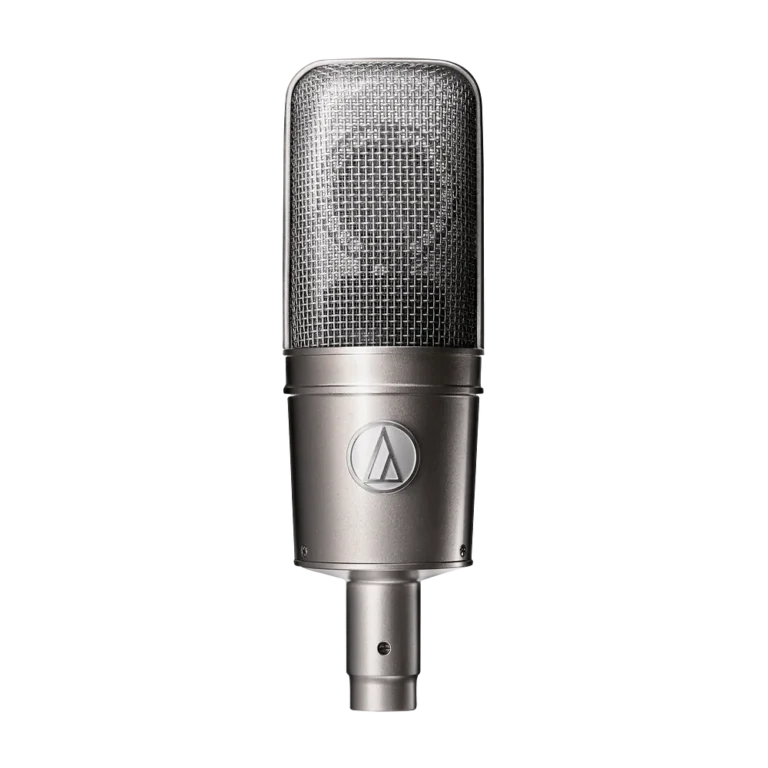
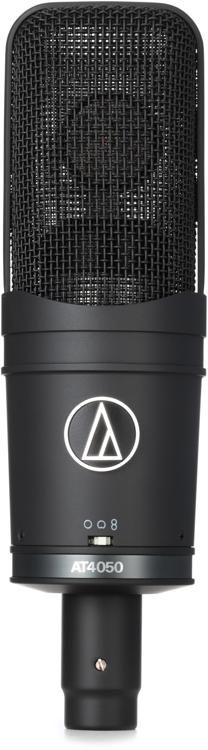
Audio-Technica AT4050 Review: A Dependable Workhorse, but Not My First Choice
Manufacturer: Audio-Technica
In this article
The Audio-Technica AT4050 is an interesting microphone, although perhaps not for the reasons you might expect.
Introduced in 1994 as the AT4050/CM5, it was Audio-Technica’s first multipattern studio condenser microphone. At the time, that was a fairly significant development. The company had already established itself as a serious contender in the professional condenser market with the AT4033, and the AT4050 expanded the possibilities considerably.
Three polar patterns—cardioid, omnidirectional, and figure-eight—in a well-built, relatively affordable professional microphone.
That was a compelling proposition in 1994.
More than thirty years later, it’s still a very good microphone.
But here’s the thing: I’ve never found it particularly exciting.
The Definition of a Studio Workhorse
There’s absolutely nothing wrong with the AT4050.
It’s a clean, neutral-sounding microphone with a wide range of applications. It has that relatively unhyped Audio-Technica character that I generally appreciate, and its three polar patterns make it substantially more versatile than a conventional cardioid-only condenser.
It’s also a microphone that doesn’t seem particularly interested in drawing attention to itself.
And that’s both its strength and, at least for me, its limitation.
I’ve owned and used a lot of microphones over the years, and when I’m choosing one for a particular source, I usually have something specific in mind. Perhaps I want a little more body, a particular high-frequency character, or a microphone that flatters an instrument in some recognizable way.
The AT4050 has never been the first microphone I reach for in any particular application.
Not because it performs poorly, but because I’ve generally found something else in my collection that gives me what I’m looking for a little more quickly.
That’s a rather different criticism from saying that a microphone sounds bad.
The AT4050 doesn’t sound bad at all.
It simply doesn’t have a particular sonic characteristic that makes me feel I absolutely must use it.
More Time in the Field Than in the Studio
Interestingly, I’ve probably used AT4050s more often in live sound reinforcement than in studio recording.
I’ve used them inside pianos and suspended above string sections, where their natural sound and selectable polar patterns can be particularly useful.
Those are applications where you don’t necessarily want a microphone with a lot of personality.
You want something that captures the instrument accurately, gives you some control over the pickup pattern, and behaves predictably.
The AT4050 does all of those things.
In a piano, for example, having a choice of polar patterns can be useful depending on the placement, the amount of isolation required, and how much of the surrounding stage you want to capture.
Similarly, when you’re working above a string section, a clean microphone that doesn’t impose an exaggerated tonal signature can be a very good thing.
And unlike some more delicate or temperamental studio microphones, the AT4050 is something I’d be perfectly comfortable taking out into the field.
Which brings us to another reason I respect it.
Audio-Technica Reliability
One thing I’ve never spent much time worrying about with Audio-Technica microphones is whether they’re going to work.
Across the company’s various product ranges, my experience has been remarkably consistent. They’re well engineered, well manufactured, and dependable.
That includes some of the relatively inexpensive 20 Series models, not just the professional 40 Series.
And reliability involves more than whether a microphone works today.
There’s also the question of what happens if something goes wrong ten or twenty years from now.
Audio-Technica has maintained a substantial American operation in Stow, Ohio, for decades. It’s an established manufacturer with a long history, an organized support structure, and service resources.
That matters.
I’ve seen plenty of equipment from smaller or less stable companies become difficult to maintain because the manufacturer disappeared, changed distributors, or simply stopped supporting the product.
With Audio-Technica, I have considerably more confidence that there will be someone to contact if a microphone eventually needs attention.
That doesn’t guarantee that every part for every discontinued model will remain available forever, of course. But it’s a meaningful advantage when you’re buying equipment you expect to own for decades.
Would I Buy Another AT4050?
That’s where things get interesting.
Audio-Technica now offers the AT4047MP, a multipattern version of the AT4047.
And I really like my AT4047.
In fact, I like it considerably more than the AT4050.
So it stands to reason that I might prefer the AT4047MP if I were shopping for a multipattern Audio-Technica condenser today.
But I should qualify that.
I haven’t actually heard the AT4047MP.
I’m making an educated guess based on my experience with the cardioid AT4047 and its transformer-coupled design, rather than claiming to have compared the two multipattern microphones.
Still, if I were buying another one today, the AT4047MP would certainly be on my list.
The Verdict
The Audio-Technica AT4050 is a very good microphone.
It’s versatile, neutral, dependable, and suitable for an enormous range of studio and live applications. If you’re looking for a professional multipattern condenser that doesn’t impose a particularly strong sonic character on everything you record, it’s an excellent choice.
It’s also a product from a manufacturer whose reliability and long-term support I have considerable respect for.
But in my own collection, the AT4050 has never become indispensable.
In fact, thinking about it, I can’t really remember the last time I used mine.
Would I use it again?
Absolutely.
Would I go out of my way to choose it over some of my other microphones?
Probably not.
And I think that sums it up rather nicely.