Drum and Percussion Reviews
Choosing a Drum Throne: Round vs Motorcycle Seats, Backrests, Roc-N-Soc and SoundSeat
In this article
- Round versus motorcycle-style seats
- With a backrest or backless?
- Bernard Purdie on switching to a motorcycle seat
- Roc-N-Soc: Nitro and other configurations
- SoundSeat: a personal favorite, but is production back?
- TAMA 1st Chair: round, hybrid and saddle options
- AHEAD Spinal-G, Gibraltar and other options
- DW: substantial round and tractor-style thrones
- Pork Pie: plush traditional thrones with distinctive finishes
- Pearl Roadster: Multi-Core foam, round and saddle designs
- Don’t economize on a wobbly drum throne
- Threaded spindle versus pneumatic or hydraulic adjustment
- Why drum thrones can be excellent guitarist chairs
- Buying checklist and conclusions
A drum throne is an instrument accessory you actually use throughout the entire session. Its height, stability, foam, shape and back support affect how freely a drummer can operate two pedals and rotate around a kit. A properly chosen throne can be just as useful for guitarists, bassists and keyboard players. This guide compares traditional round seats with motorcycle-style (saddle) seats, backs with backless designs, fixed spindle and pneumatic height mechanisms, and the established brands worth considering.
Round versus motorcycle-style seats
Round thrones offer a symmetrical surface. You can turn or shift position without trying to stay aligned with a seat contour. Many guitarists enjoy this freedom when placing an acoustic guitar or electric guitar on either leg, and many drummers prefer the uninterrupted edge of a round seat. But diameter, firmness and edge construction matter: a narrow, overstuffed seat can place pressure on the backs of the legs.
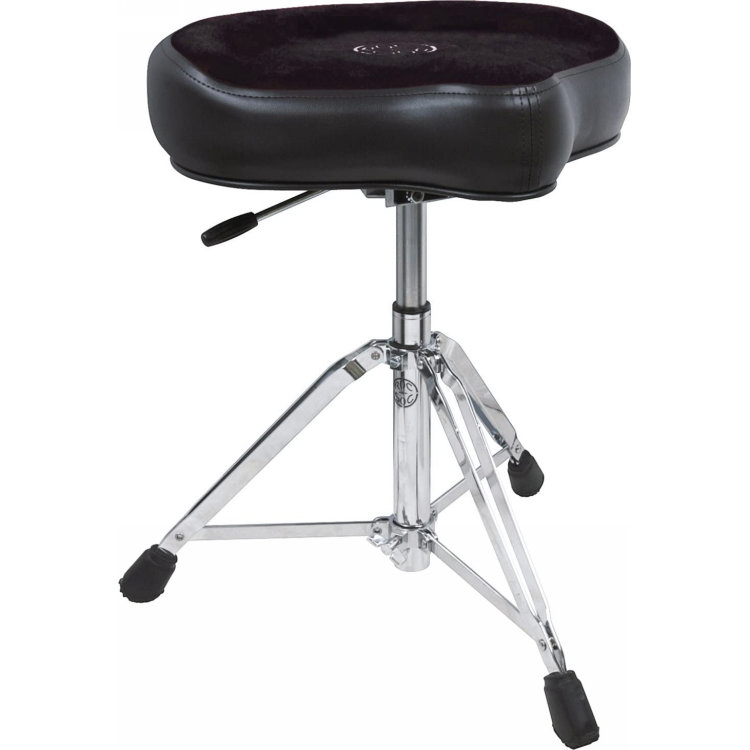
Motorcycle or saddle thrones have a sculpted outline and narrower front sections designed to create thigh clearance. For some drummers this makes independent kick and hi-hat operation more comfortable. The wider rear area may also help distribute support under the pelvis. The shape is a personal fit decision, however: a pronounced contour can put pressure in the wrong place or restrict a guitarist who changes position frequently.
Hybrid seats split the difference. TAMA’s 1st Chair Ergo-Rider combines round-seat movement with a saddle-inspired front cutaway. It is worth trying alongside true round and motorcycle designs rather than relying on product photographs alone.
| Consideration | Round throne | Motorcycle / saddle throne |
|---|---|---|
| Thigh clearance for pedals | Depends on edge shape and seat height | Front cutaways can provide more clearance |
| Changing sitting direction | Usually more natural | Contouring encourages a forward position |
| Guitarist use | Good for changing leg and instrument positions | Often comfortable, but check the shape with your guitar |
| Comfort and posture | Depend on individual anatomy, seat dimensions, foam and playing height—not shape alone | |
With a backrest or backless?
A backless throne offers freedom to move around the kit, usually weighs less, and takes less space for travel. The trade-off is that you cannot recline against anything during long setup, editing or rehearsal breaks. Backrest-equipped thrones provide an additional resting position and can be especially appealing when a musician alternates playing with DAW editing. The backrest should be adjustable enough that it does not push the player forward or block rotation. Some drummers prefer to play mostly clear of the back and use it between songs.
A backrest is not an automatic cure for back pain, nor is a backless stool automatically harmful. Seat height, pelvic position, foot placement, movement and rest breaks matter. Any ongoing severe or worsening pain deserves professional evaluation. Confirm retrofit-backrest compatibility against the exact throne and manufacturer—not merely the brand name.
Bernard Purdie on switching to a motorcycle seat
One of the more memorable pieces of advice our editor received came directly from Bernard Purdie. Purdie told him that he had experienced terrible back trouble until he switched to a motorcycle-style seat. He uses a Roc-N-Soc.
That firsthand account is meaningful given the extraordinary demands of Purdie’s career. It illustrates how much seat geometry can matter to an individual drummer. It is nevertheless one musician’s personal experience, not clinical proof that saddle seats prevent or treat back problems.
Roc-N-Soc: Nitro and other configurations
Roc-N-Soc Nitro is notable for its contoured seat, pneumatic height adjustment and gas-shock suspension. The slight vertical movement is part of its character: some players enjoy the responsiveness, while others prefer a rigid spindle throne. The Nitro seat swivels and a backrest is available. Roc-N-Soc also offers round and alternative seat shapes, so the brand should not be equated solely with the motorcycle seat.
The manufacturer lists seat dimensions of approximately 17 × 15 inches for Original, 15 × 14 inches for Hugger, and 14 inches diameter for Round. Its FAQ states a one-year general warranty and two-year coverage on gas shocks, subject to the published terms. Make sure the shock model is suitable for the player’s weight; its stated warranty coverage limit differs from some non-shock thrones. Roc-N-Soc specifications and FAQ.
SoundSeat: a personal favorite, but is production back?
The Audio Magazine’s editor owns a SoundSeat and loves it. It is an unusually relevant choice because SoundSeat was designed not only for drummers but also for guitarists, keyboard players and studio personnel. Its construction uses a contoured plywood foundation, molded foam and top-grain leather. The manufacturer describes two main seat sizes, various gas-lift heights, caster or glide bases, optional backs and armrests, and an optional foot ring useful for a guitarist seated higher than a conventional drum-playing position.
There was previously a pause in SoundSeat production, which makes availability worth checking carefully. As of November 2026, the official SoundSeat website remains active and its custom-order configurator is accessible. A regular backless configuration currently displays a base price of $270 plus shipping and options. The company’s own website also carries a personal note from Bretta Baker about continuing founder J.R. Baker’s work.
Important availability qualification: an active ordering webpage is not conclusive evidence that the factory is currently accepting and shipping new orders, or that an earlier production pause has formally ended. We have not independently verified current manufacturing or fulfillment. Contact SoundSeat directly and confirm current lead time and order acceptance before making payment.
The SoundSeat Regular seat is advertised at 19 inches wide by 16.5 inches deep, while the larger MP measures 21 × 18.5 inches. Those are substantial dimensions: players should check how the seat fits inside a tightly spaced kit and whether the base offers adequate stability for their intended height. The optional guitar foot ring and possible backrest make this especially interesting as a multipurpose studio seat.
TAMA 1st Chair: round, hybrid and saddle options
TAMA 1st Chair spans traditional Round Rider seats, the hybrid Ergo-Rider and larger saddle-style choices. Some configurations use threaded adjustment and others the company’s HYDRAULIX height system. Models with adjustable backrests are available. This range makes TAMA a good starting point for an in-person seat-shape comparison, provided you compare the exact model’s height range, base and adjustment system.
AHEAD Spinal-G, Gibraltar and other options
The AHEAD Spinal-G is distinctive for its divided seat with a central opening intended to alleviate direct pressure in that area. It has supporters, but individual responses to that geometry vary, and the design should not be treated as a medical device. Confirm the exact model and whether a suitable backrest is available.
Gibraltar’s 9608 round throne offers a more straightforward, substantially built alternative: a 13-inch round memory-foam seat, double-braced tripod and advertised 20–26 inch adjustment range. The manufacturer lists it at approximately $120 at the time of writing. Gibraltar also sells larger and contoured models, so a basic model can serve as a price benchmark against premium choices.
Pork Pie padded round thrones and DW drum thrones are also worth trying at a local dealer, particularly if a plush traditional seat is the goal. Evaluate cushion support after sitting for a while; the softest showroom seat isn’t necessarily the best long-session seat.
DW: substantial round and tractor-style thrones
Drum Workshop (DW) offers both round and tractor-style seats across several hardware ranges. Its premium 9000 Series 9100 has a 14-inch round foam seat, a Double Locking Clamp and a Vise Lock seat attachment designed to keep the top securely coupled to the base. The 9120 tractor-top provides a 14-inch contoured alternative, a substantial 1-inch base and a stated 20–27-inch height range. The 9000 Series is worth investigating for permanent studio kits where stability takes priority over portability. Check current dealer stock: the manufacturer pages consulted listed these specific models as out of stock.
Pork Pie: plush traditional thrones with distinctive finishes
Pork Pie Percussion is particularly known for heavily padded, traditional round seats, offered in multiple fabrics and conspicuous finishes, including glitter and patterned upholstery. Its lineup also includes a Big Boy model. The appeal is a generous cushion and a fairly conventional seating posture, making these interesting for drummers who prefer round seats and guitarists who shift their position. But thick padding does not guarantee suitable support: test the seat after a longer session and confirm its base and height adjustment suit you.
Pearl Roadster: Multi-Core foam, round and saddle designs
Pearl’s Roadster D-1500 uses a 15-inch round Multi-Core foam cushion and a reversible Lock/Spin mechanism that lets the player choose whether the seat rotates. Its listed height range is 19.5–26.2 inches, and it accepts Pearl’s optional DTBR-1535 backrest. The D-3500 is the saddle-style alternative, while the D-1500TGL Trilateral Gas Lift offers a differently shaped cushion intended to provide round-like or saddle-like support depending on seat orientation. Pearl is a good comparison point if you want a round seat with a more engineered cushion, or a saddle design with an optional backrest.
Don’t economize on a wobbly drum throne
A cheap throne that rocks, flexes, twists unexpectedly or changes height is a bad bargain. Drummers repeatedly shift weight while operating kick and hi-hat pedals, and a loose seat-to-post connection or an undersized tripod can make the playing position unstable. Guitarists can experience the same problem when leaning, reaching for pedals or moving around an instrument. Persistent wobble is not merely irritating: it makes it harder to maintain consistent positioning and may create a tip-over hazard.
Not every affordable throne is poorly made, and not every premium throne is perfect. Before purchasing—or before deciding an existing stool is safe to keep—test the chair on a level floor. Fully open the tripod, set the intended height, lock the collar or spindle, and deliberately shift weight forward, backward and sideways while seated. Check separately for movement at the floor and base, seat-to-post clamp, height-adjustment mechanism, and cushion itself. A slight amount of designed suspension travel on a pneumatic shock throne is not the same as uncontrolled lateral wobble. If the seat can unexpectedly rotate, tilt, collapse or rock enough to make you feel insecure, do not use it until the cause is corrected.
Thin tripod legs, loose rivets, poorly fitting tube sections, small plastic seat mounts, weak clamps and inferior hardware are all reasons to be cautious. On a tight budget, a sound used professional throne from DW, TAMA, Pearl, Gibraltar or another established manufacturer may be a better investment than a new no-name bargain stool. Inspect it carefully for wear, damaged threads and fatigue before buying.
Threaded spindle versus pneumatic or hydraulic adjustment
A threaded spindle generally offers secure, repeatable height adjustment and comparatively simple repair. It can take longer to adjust but does not depend on a gas-lift cartridge. A pneumatic or hydraulic-style lift makes seat-height adjustment quick, especially when multiple musicians share a studio. Gas-shock designs may add vertical motion, which some players appreciate and others find distracting. Check minimum and maximum seat height, rated load, replacement-parts availability and whether the seat swivels independently.
For drums, set the throne height with feet on the pedals, not merely with both feet resting flat on the floor. Avoid a height that jams the knees up toward the chest or leaves the player reaching for the pedals. Then verify that the stool remains stable during active heel-up and heel-down footwork.
Why drum thrones can be excellent guitarist chairs
Drum thrones have several advantages over conventional office seating for guitar: no armrests to obstruct the instrument, compact footprints, stable seated playing positions, and easy movement around the instrument. For acoustic guitar, a round throne may provide flexibility when changing leg support; for electric guitar or bass, a contoured throne may suit longer static sessions. Try the actual playing posture before selecting.
A backrest can be useful for tracking breaks and computer work, but some guitarists prefer it absent or well behind the playing position. The SoundSeat’s optional foot ring is a particularly relevant feature if you want a higher guitarist’s position. Avoid using a tall seat without adequate foot support; suspended legs can create discomfort and destabilize the playing posture.
Buying checklist and conclusions
- Try round and saddle seat shapes at your actual drum or instrument setup.
- Evaluate seat firmness after 20 minutes, not just on first contact.
- Check usable height, tripod/base stability, weight rating and swivel behavior.
- Decide whether a backrest is for active playing, resting, or both.
- For guitarists, verify instrument clearance and foot support.
- Check parts availability, warranty, shipping and actual current production before ordering specialty models.
The bottom line: a good drum throne is a major comfort upgrade and can double as an excellent guitarist seat. For traditionalists, start with a substantial round seat. For pedal clearance and a defined seated position, try a motorcycle-style seat. Bernard Purdie’s experience with Roc-N-Soc provides a compelling personal example, while SoundSeat remains a particularly interesting premium option for multi-instrument studios—subject to confirming current production availability.
Manufacturer specifications, listed price and SoundSeat ordering-page availability checked November 2026. Product dimensions and warranties are model-specific. Editor ownership and the Bernard Purdie anecdote are disclosed as firsthand editorial observations.