Processor Reviews
dbx 530 Review: If It Was a Mistake, I Made the Mistake 24 Times
Our API 2448 was purchased unloaded. We already own plenty of outboard equalization—including Manley Pultecs and other EQs—but there is still something extremely useful about having an equalizer immediately available on every console channel.
The obvious solution would have been to fill the API with API equalizers. The problem is arithmetic. Outfitting 24 channels with API EQs can easily turn into a $20,000–$30,000 proposition, depending on the modules chosen. As much as I like API equalization, that was not an expense I was particularly interested in making immediately after buying the console.
I also knew what kind of EQ I wanted. For this application I preferred a fully parametric design rather than fixed-frequency bands or a hybrid arrangement in which some bands are shelving and others are parametric. I wanted control over frequency, gain and bandwidth, with enough overlap between bands that the modules could handle both routine tone shaping and more surgical work.
That narrows the field considerably—especially when you need 24 of them.
When you need a bank of EQs
When you need one equalizer, you can indulge yourself. You can buy something unusual, vintage, boutique or highly specialized simply because you like what it does.
When you need 24 equalizers, the priorities change.
There is a real advantage to having one EQ design repeated across the console. Once you learn the 530—how far to turn the frequency control, how its Q behaves, how much boost starts to become too much—you know what every channel is going to do. That consistency becomes valuable when you are working quickly.
There is nothing inherently wrong with filling a console with several different EQ designs. In fact, having different flavors available can be useful. But it also means certain channels can gradually become associated with particular instruments or jobs simply because of the module installed in that slot. With 24 identical 530s, any input channel can perform the same role as any other.
Then there are the less glamorous considerations.
Power consumption matters. Twenty-four modules represent a substantial continuous load on a 500-series power supply. A design that seems perfectly reasonable when you own two of them may become considerably less attractive when multiplied by twenty-four.
There is also the question of 500-series compatibility itself. The format is far more standardized than it was in its early days, but not every module adheres equally well to every electrical and mechanical aspect of the 500-series specification. Current draw, connector implementation, physical dimensions and interaction with different racks can all become relevant when an entire console is being populated rather than a lunchbox containing a handful of modules.
That was another argument in favor of the dbx. The 530 is a mainstream production module from a major manufacturer, designed to be an ordinary working 500-series product rather than an exotic interpretation of the format. When the plan is to install two dozen of something, boring compatibility starts to look like a feature.
Replaceability matters too. If one channel develops a problem, I want to be able to pull the module, install another 530 and continue working. I do not want the replacement process to involve finding an out-of-production boutique EQ, matching a revision, or trying to determine whether a current kit is electrically identical to one I built several years earlier.
Why the dbx 530?
There are some excellent boutique 500-series equalizers, along with a surprising number of interesting kits and small-production designs. Buying one or two is easy to justify. Buying two dozen changes the equation. Availability matters. Consistency matters. Replacement matters. And the cost per channel suddenly matters a great deal.
The dbx 530, which can sometimes be found for under $200 and is commonly available below $300 on the used market, became the natural choice. It is inexpensive enough to buy in quantity without feeling disposable, and common enough that replacing one later should not become a scavenger hunt.
I started buying them.
And then I kept buying them.
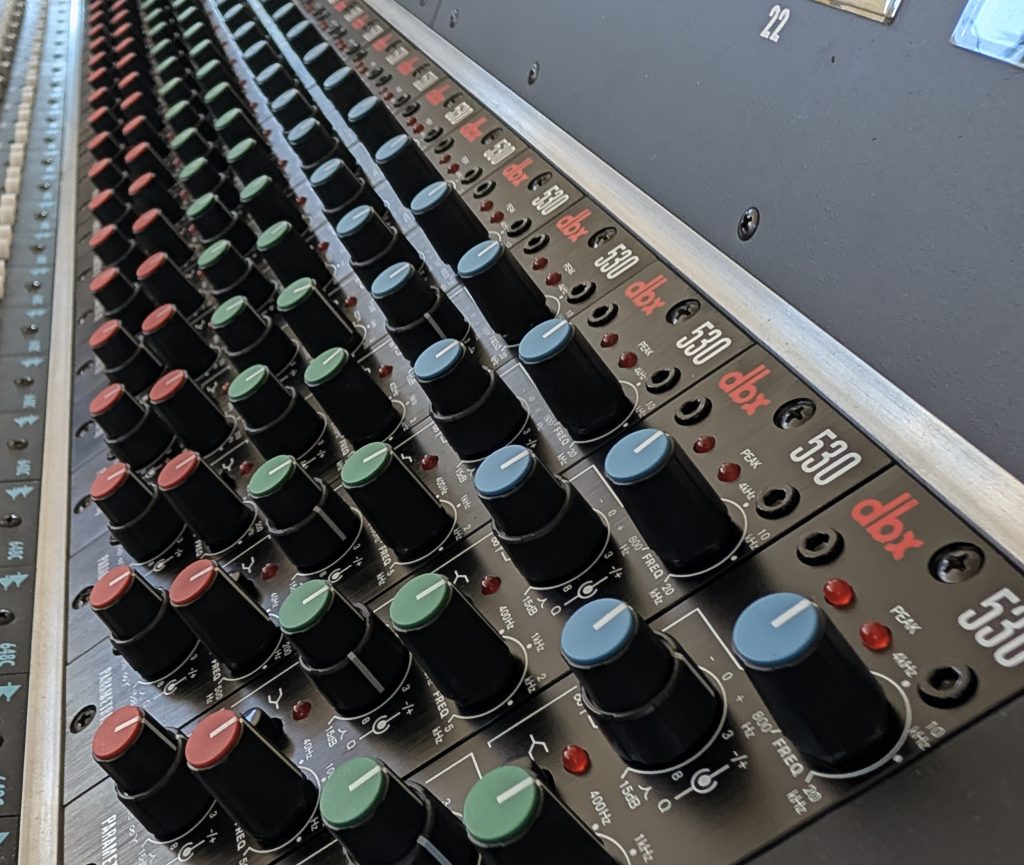
At this point there are 24 dbx 530s here.
So if choosing the 530 instead of immediately spending considerably more on API equalizers was a mistake, I have now made exactly the same mistake twenty-four times.
Three bands, fully parametric
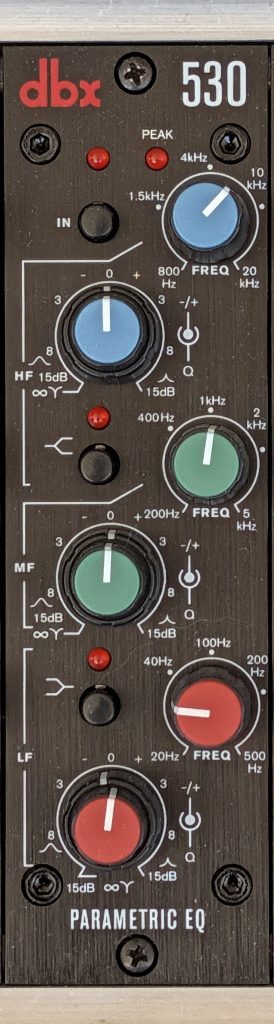
The 530 is based on the circuit used in the older dbx 905 and gives you three overlapping bands of parametric equalization. Each band provides frequency, gain and Q control. The low and high bands can also be switched between bell and shelving operation, and each band has an Infinite Notch mode for very narrow, deep cuts.
The ranges are sensibly divided: 20 Hz to 500 Hz on the low band, 200 Hz to 5 kHz in the midrange and 800 Hz to 20 kHz on the high band. Each band offers ±15 dB of boost or cut. In practice, that is wide enough that the module rarely feels boxed into one specific job.
That matters to me more than having a particular “signature” EQ sound. I wanted something that could live on every channel and handle whatever showed up there rather than an equalizer whose personality dictated how the channel should be used.
The controls are straightforward, and that becomes increasingly important as the channel count grows. After enough time with the 530, the layout becomes almost automatic. You stop thinking about the module and simply reach for the band you need.
Power and compatibility
dbx specifies the 530 at 85 mA per power rail, or 2.72 watts per module. Multiplied by 24, that becomes a real load rather than a trivia-line specification. This is exactly why current draw deserves attention when you are planning to populate an entire frame.
The same is true of physical and electrical compatibility. One 500-series module that is a little eccentric can be charming. Twenty-four eccentric modules can become an infrastructure problem. The 530 is a conventional one-slot module designed around the expected ±16 V 500-series power environment, which is exactly what I wanted in this application.
How it works in our studio
In practice, the 530 does exactly what I bought it to do. It sounds great, is easy to use, and its range is broad enough that it never feels like the budget module you reach for only when the better EQs are occupied.
Would I trade all 24 of mine for API 550As, 550Bs or 560s?
Absolutely.
But that is not really the point.
The 530s were purchased to solve a specific problem: give every channel of our API 2448 a capable, familiar and replaceable equalizer without immediately spending another $20,000–$30,000 populating the console with API modules. They have done exactly that.
They work just as naturally when we are tracking to 2-inch 24-track tape as they do when the console is being used with Pro Tools, Bitwig or LUNA. They are not tied to a particular workflow, genre or source. They are simply useful equalizers that happen to be inexpensive enough to own in quantity.
Verdict
There are more glamorous 500-series EQs, more collectible EQs and certainly more expensive EQs. But there are very few that I would be as comfortable buying twenty-four times.
So if the dbx 530 was a mistake, it was apparently a mistake worth repeating.
Twenty-four times.
Key specifications
| Type | Single-slot 500-series, 3-band fully parametric EQ |
|---|---|
| Low band | 20 Hz–500 Hz; bell or shelf |
| Mid band | 200 Hz–5 kHz |
| High band | 800 Hz–20 kHz; bell or shelf |
| Gain range | ±15 dB |
| Notch mode | Infinite Notch on each band; typically greater than 40 dB attenuation |
| Maximum input/output | +22 dBu |
| Frequency response | 20 Hz–20 kHz, +0/−1 dB |
| THD+N | <0.006% typical |
| Dynamic range | 112 dB |
| Power | ±16 V DC; 85 mA per rail; 2.72 W |
| Rack space | 1 slot |
| Weight | 1.3 lb / 0.59 kg |
Technical reference: dbx 530 product information and specifications. Listening impressions, pricing observations and studio-use comments are our own.
Related TAM reviews: API 2448 · dbx 160SL · Manley Enhanced Pultec EQ