Microphone Reviews
Beyerdynamic M88 TG Review: Vocals, Guitar, Bass and a Kick Drum Warning
In this article
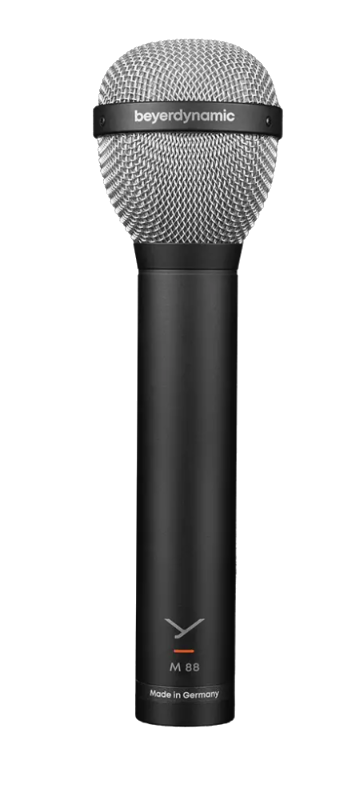
The Beyerdynamic M88 TG is one of my favorite microphones.
For years, it was my first choice for recording close-up male vocals, particularly singers who weren’t excessively loud. It has a rather unusual combination of warmth and clarity, with a fullness that you don’t always associate with dynamic microphones. It’s also reasonably resistant to plosives, although I wouldn’t suggest abandoning your pop filter entirely.
There’s something about the M88 TG that makes a male voice sound substantial without turning it into a muddy mess. It has presence without the exaggerated upper-midrange character that can make some dynamic microphones unpleasant on certain singers.
A design that has stood the test of time
The M88 has been around for a very long time. Beyerdynamic introduced the original design in the early 1960s, and the M88 TG is a descendant of that microphone. As far as I’m aware, there haven’t been many significant changes over the years. I remember a silver special edition that was available sometime in the 1990s or perhaps the early 2000s, but the basic microphone has remained remarkably consistent.
And why change it? It’s a slightly funny-looking microphone, a little squat, but who cares? The thing sounds terrific.
Vocals, guitar cabinets and bass
One of the best things about the M88 TG is its versatility. I’ve always particularly liked it on male vocals, where its combination of warmth, clarity and proximity effect can be extremely flattering.
It’s also a champ on guitar cabinets. The M88 TG has enough detail to capture the character of a guitar amplifier without necessarily making the result sound harsh or brittle. Depending on placement, it can produce a wonderfully substantial guitar sound.
It’s excellent on bass cabinets, too. The microphone has impressive low-frequency extension for a dynamic design, and its hypercardioid pickup pattern can be useful when isolating an instrument from other sounds in the room. It’s one of those microphones that can move from one application to another without feeling like a compromise.
Well, almost.
The one thing I’d be careful about: kick drums
The M88 TG is frequently recommended as a bass drum microphone, and I understand why. It has excellent low-frequency response, handles substantial sound pressure levels and can produce a satisfying kick drum sound.
But I have a cautionary tale. I’ve destroyed very few microphones in my years of recording. Unfortunately, one of them was an M88 TG. I placed it inside a bass drum, and the diaphragm was damaged.
The microphone was repaired with a replacement diaphragm, and I still own it. But is it really the same microphone?
It’s a little like that old story about George Washington’s axe. It’s the original axe, except that the handle has been replaced three times and the head twice. My M88 TG is still my M88 TG, except that the diaphragm isn’t the one it left the factory with. I suppose that’s close enough.
Now, I’m not suggesting that every M88 TG placed inside a bass drum is destined for destruction. Plenty of engineers have used them successfully for exactly that purpose. But there’s a difference between high sound pressure and a concentrated blast of air striking a diaphragm. The latter is what concerns me.
If you’re going to use an M88 TG on a bass drum, I’d be inclined to keep it outside the drum, away from the port and the direct blast of air. A suitable windscreen or other protective arrangement may also help. Personally, I have plenty of other microphones I’d rather risk on the inside of a kick drum. I’m not particularly interested in replacing another M88 diaphragm.
Is the Beyerdynamic M88 TG worth the money?
The M88 TG isn’t cheap. There are plenty of dynamic microphones that cost considerably less, and some of them are very good. But the M88 TG offers a compelling combination of characteristics.
It has the warmth and low-frequency extension that make it excellent for male vocals and bass instruments, along with the clarity and presence necessary for guitar amplifiers and other sources. And unlike some specialized microphones, it’s useful on enough different instruments to justify owning one even if you don’t have a particularly large microphone collection.
Final thoughts
The Beyerdynamic M88 TG remains one of my favorite dynamic microphones. It’s warm without being muddy, clear without being excessively bright, and versatile enough to earn its place in just about any microphone locker.
It’s terrific on male vocals, excellent on guitar cabinets and a great choice for bass. Just be a little careful about sticking it inside a kick drum. I’ve already conducted that particular experiment, and I wasn’t especially happy with the results.
Other than that, the M88 TG is a great microphone, and one that deserves a serious look.