Microphone Reviews
Audio-Technica ATM25 Review: Maybe I Should Give It Another Chance
Manufacturer: Audio-Technica
In this article
Apparently, Audio-Technica has reintroduced the ATM25.
Which is funny, because I didn’t realize it had gone away.
The ATM25 was first introduced in 1983, and Audio-Technica has now brought it back, apparently unchanged from the original design.
And seeing it again has made me think that perhaps I ought to pull mine out of the microphone locker and give it another chance.
My First Kick Drum Microphone
The ATM25 was the first dedicated kick drum microphone I purchased.
Unfortunately, my earliest experiences with it weren’t particularly inspiring.
At the time, our studio drum kit was a set of Pearl Exports. Now, there’s nothing inherently wrong with Pearl Export drums, but getting a really great sound out of an inexpensive kit requires a combination of good heads, careful tuning, proper damping, and someone who knows what they’re doing.
And I wasn’t exactly a drum-tuning genius.
Nor did I have all the ancillary equipment and experience that I would eventually acquire.
Consequently, the kick drum sound wasn’t particularly impressive.
And since the ATM25 was sitting inside the drum, I suppose some of that disappointment became associated with the microphone.
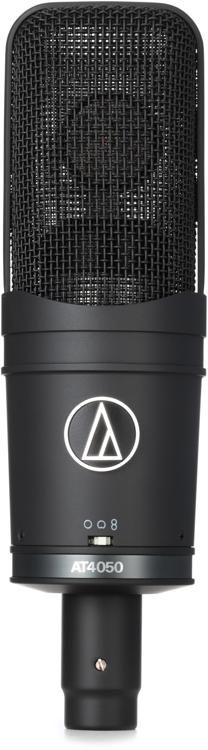
This is a little different from my experience with the Audio-Technica AT4033, where I developed a somewhat negative impression of the microphone itself.
With the ATM25, I’m not entirely certain I ever gave it a fair opportunity.
After a while, it went into the microphone locker, where it spent quite a bit of time.
A Very Solid Little Microphone
One thing I can say about the ATM25 is that it’s extremely well built.
It’s a compact, all-metal dynamic microphone with an integrated stand mount and a hypercardioid pickup pattern.
It’s also remarkably rugged.
I know I’ve dropped mine.
I’ve used it in the studio and taken it out into the field for live sound reinforcement, and it has survived all of that without complaint.
The interesting thing about the newly reintroduced version is that Audio-Technica says it hasn’t changed the original design.
It’s still made in Japan.
And it sells for $249.
Think about that for a moment.
A Japanese-made professional dynamic microphone, with an all-metal body, from a major manufacturer with a long history of supporting its products, for $249.
That strikes me as a screaming deal.
Of course, a low price doesn’t automatically make something sound good. But the construction quality alone makes the ATM25 worth considering.
Not Just for Kick Drums
Although the ATM25 was designed primarily as an instrument microphone for high sound pressure levels, I’ve found it useful on sources other than kick drums.
In fact, the last time I remember using mine, I believe it was on a floor tom.
I’ve also used it on bass guitar cabinets with some success.
Those applications make sense. It’s a microphone with a solid low-frequency response, good isolation characteristics, and the ability to handle very high sound pressure levels.
And it’s compact enough to position in places where a larger microphone might become inconvenient.
It’s certainly not a bad microphone.
In fact, the more I think about it, the more I wonder whether my early disappointment had considerably more to do with the drums and my own inexperience than with the ATM25.
Then Came the Audix D6
Eventually, I moved to an Audix D6 for kick drum recording.
And I was very happy when I did.
The D6 has a much more deliberately shaped sound, with the sort of low-frequency weight and beater definition that can make getting a contemporary kick drum sound considerably easier.
It was much closer to what I wanted at the time.
Later, I acquired a vintage AKG D12E, which is another microphone I like very much.
The D12E has a character of its own, and it’s a rather different proposition from either the ATM25 or the D6.
But the fact that I preferred those microphones doesn’t necessarily mean that the ATM25 was inferior.
It meant that I found sounds I liked better, given the drums I was recording and the results I was trying to achieve.
There’s an important distinction there.
And Then There’s the AKG D112
Speaking of AKG kick drum microphones, there’s one I never particularly liked.
The D112.
That’s the model that followed the D12 family, and although it became enormously popular, I’ve never been a fan of its sound on kick drums.
To me, it can sound like someone bouncing a basketball.
There’s a particular resonant, hollow quality that I just don’t care for.
Obviously, plenty of engineers disagree with me. The D112 has been a professional standard for decades, and I don’t doubt that people have made excellent recordings with it.
But it never gave me the sound I wanted.
And that’s one of the interesting things about microphones.
Two microphones can both be perfectly competent, well-designed products, yet one can make your job considerably easier simply because its particular response happens to suit what you’re trying to accomplish.
Maybe It’s Time to Try It Again
What makes the ATM25 interesting to me now is that my circumstances have changed considerably since I first purchased it.
I have better drums, better equipment, and a lot more experience.
And I’m no longer necessarily looking for every kick drum microphone to deliver an instantly finished, heavily contoured sound.
Sometimes a more natural response is exactly what you want.
The ATM25 is worth considering if you’re looking for something less aggressively voiced than microphones such as the Audix D6.
It’s also a useful option for floor toms, bass cabinets, and other high-output instruments.
And at $249, with Japanese manufacture and Audio-Technica’s reputation for build quality, it’s difficult to find much to complain about.
The Verdict
I’m not going to pretend that the ATM25 is suddenly my favorite kick drum microphone.
It isn’t.
At least, not based on my past experience.
But looking back, I think there’s a reasonable possibility that I underestimated it.
The ATM25 is rugged, versatile, well made, and comparatively affordable. It has survived years of use in my studio and on live sound jobs, and I’ve found applications for it beyond the kick drum.
Its reintroduction is a welcome surprise, particularly since Audio-Technica has retained the original Japanese-made design.
If you’re looking for a relatively natural-sounding alternative to some of the more heavily voiced kick drum microphones, it’s certainly worth an audition.
And as for me?
I think it’s time to dig mine out of the microphone locker and find out what I think of it now.
And now that Audio-Technica has brought back the ATM25, I wonder when the ATM23 is going to come back?