Microphone Reviews
Neumann KM184 Review: Buy Once, Cry Once, and Record for a Lifetime
Manufacturer: Neumann
In this article
There aren’t that many truly famous small-diaphragm condenser microphones. Of course, there are the classic AKG C451s, the Schoeps Colette series, and the original Neumann KM84s. These are microphones that have earned their reputations over decades of professional use.
But what can you buy today that’s likely to stand the test of time? That’s an easy question: the Neumann KM184.
Almost thirty years of getting it right
The KM184 was introduced in the late 1990s and has been a professional recording standard ever since. As far as I’m aware, Neumann hasn’t made any particularly dramatic changes to it over the years. The price has certainly changed, as prices tend to do, but the microphone itself remains fundamentally the same.
And that’s a good thing. The KM184 was a serious microphone when it was introduced, it’s a serious microphone today, and I suspect it will still be a serious microphone thirty years from now. There’s something reassuring about a product that doesn’t need to be reinvented every few years.
What makes the KM184 special?
The KM184 is a transformerless, cardioid small-diaphragm condenser microphone. It has low self-noise, excellent transient response, and a frequency response that’s generally quite neutral, although there’s a modest upper-frequency presence rise.
That last characteristic is worth mentioning because the KM184 isn’t simply a modern version of the old KM84. The earlier microphone had a somewhat different sonic character, and there are engineers who prefer it. That’s perfectly reasonable. But the KM184 is an extremely capable microphone in its own right.
It’s detailed, consistent and useful across a wide range of recording situations. There are less expensive small-diaphragm condensers available, including some very good ones. But with a KM184 you’re buying a mature professional design with a long track record.
Terrific on acoustic guitar
If there’s one application where I think the KM184 really excels, it’s acoustic guitar. It captures the articulation of the strings, the attack of the pick or fingers, and the character of the instrument without requiring a great deal of effort.
Of course, microphone placement still matters. A great microphone pointed at the wrong part of an acoustic guitar can produce a terrible recording. But when properly positioned, the KM184 can deliver an exceptionally natural and detailed result.
Overheads, cymbals and piano
The KM184 is also an excellent choice for drum overheads and cymbal microphones. Its transient response and clarity make it very good at capturing the detail of a kit. As with any microphone with an upper-frequency presence rise, placement and the cymbals themselves matter; the objective is detail, not unnecessary brightness.
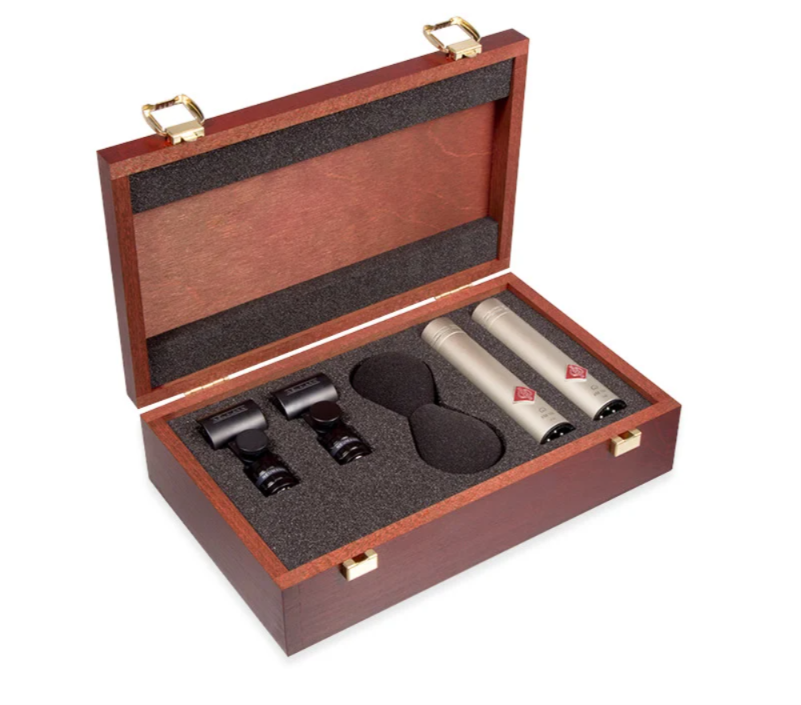
I’ve also used KM184s on piano, where a pair can capture a detailed, articulate stereo picture. A matched stereo pair is particularly useful for overheads, acoustic instruments and piano recording, and that’s how I prefer to own and use them.
I haven’t tried them on horns, and I don’t think I’d choose them as my first option for that job. That isn’t a criticism. No microphone is the best choice for every source.
Buy once, cry once
The KM184 fits neatly into the buy once, cry once philosophy. They’re not inexpensive microphones, especially if you buy a pair. But they’re tools you can reasonably expect to use in critical recording work for decades.
Neumann’s reputation isn’t just about a name on a badge. The company has a long history of capsule design, manufacturing consistency and professional microphone engineering. That doesn’t make every Neumann the best microphone for every job, but it helps explain why so many of its designs have become reference standards.
Final thoughts
Are the Neumann KM184s the best microphones in every situation? Of course not. No microphone is.
But if you want a small-diaphragm condenser that works reliably across a wide variety of sources, including acoustic guitar, cymbals, drum overheads and piano, they’re among the most compelling choices available.
I prefer them as a stereo pair. For someone who plans to record seriously for years and wants a pair of microphones that can be used in critical applications without second-guessing the purchase, the KM184 is an easy recommendation.
They’re serious microphones. And I expect they’ll remain serious microphones for a very long time.