Processor Reviews
SPL SX2 Stereo Vitalizer Review: When More Is Too Much
In this article
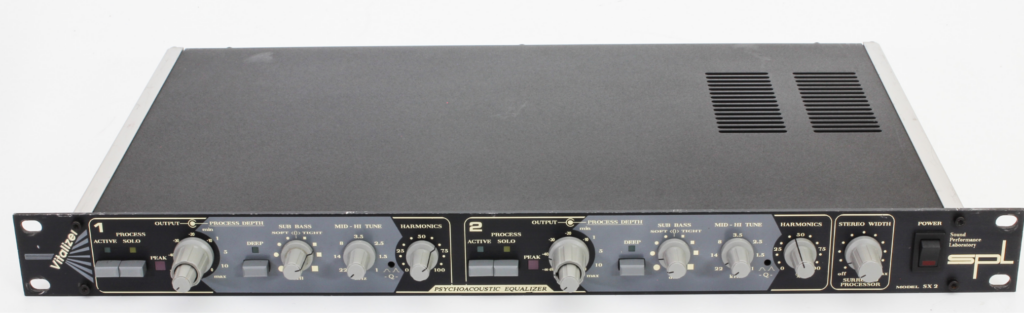
In a dark, dusty corner of my equipment rack sits an SPL SX2 Stereo Vitalizer.
Well, that’s not really true. You can see it. It’s right in the center.
But it seems like the sort of device that ought to live in a dark, dusty corner, waiting for the occasional recording that’s so dull, lifeless and generally miserable that ordinary equalization just isn’t going to save it.
And when that recording comes along, the Vitalizer can be a wonderful thing. The problem is knowing when to stop using it.
The miracle box of the 1990s
Back in the 1990s, when you needed to juice up a mediocre recording, a psychoacoustic enhancer was one of the boxes you might reach for. The SPL Vitalizer occupied much the same territory as the Aphex Aural Exciter and its Big Bottom circuitry: products intended to make dull recordings sound brighter, fuller and more exciting.
The SPL always struck me as a little less injurious to the original recording and a little less prone to an exaggerated, boomy bottom end. That’s not to say it was impossible to make something sound terrible with it. Quite the contrary.
What does the SPL SX2 actually do?
The SX2 isn’t a conventional equalizer, although filtering is a substantial part of what it does. SPL designed the Vitalizer around psychoacoustic processing: interacting filters and phase relationships that change how we perceive detail, frequency balance and bass energy. It can bring a sense of life to a recording without behaving exactly like a simple bass-and-treble boost.
Its collection of controls encourages experimentation, but they interact in ways that aren’t always intuitive. This is one of those rare pieces of equipment where reading the manual might actually save you some time.
The trouble with making everything sound better
You insert it into a recording that sounds a little dull. You adjust a few controls, and suddenly there’s more apparent detail, more presence and perhaps a little more excitement at the bottom end.
You think, Wow, that’s better.
So you add a little more. And it sounds even more exciting. At least for a while.
Then you add a little more, and before long you’ve managed to turn a perfectly acceptable recording into something bright, exaggerated and thoroughly unpleasant. The really dangerous part is that you may not realize you’ve done it until you come back the following day.
That’s why I think the Vitalizer is best reserved for recordings that genuinely need help rather than inserted automatically across every mix. It can be a rescue tool, but it is not a substitute for a good recording or sensible equalization.
Built in Germany
One thing worth mentioning is the construction. SPL is a German manufacturer, and the SX2 is a serious piece of professional equipment rather than a cheap novelty box. The controls and overall build reflect that.
It’s also interesting that the Vitalizer concept survived well beyond the original 1990s units. SPL subsequently offered tube-based Vitalizer models, which is a rather curious development for a processor built around manipulating perceived clarity and frequency balance. It’s a bit of an anachronism, but perhaps that’s part of the appeal.
Final thoughts
The SPL SX2 Stereo Vitalizer is one of those processors that’s terrific when you actually need it and potentially disastrous when you don’t.
For a dull, dingy, lifeless recording, it can be just the thing. For a good recording, it may simply encourage you to keep turning knobs until you’ve made it worse.
Of course, there are probably a thousand plug-ins that can accomplish something similar today. All right, maybe only 999.
But the original hardware still has its charm, and I still have mine sitting right in the center of the rack. Not in a dark, dusty corner after all.