Processor Reviews
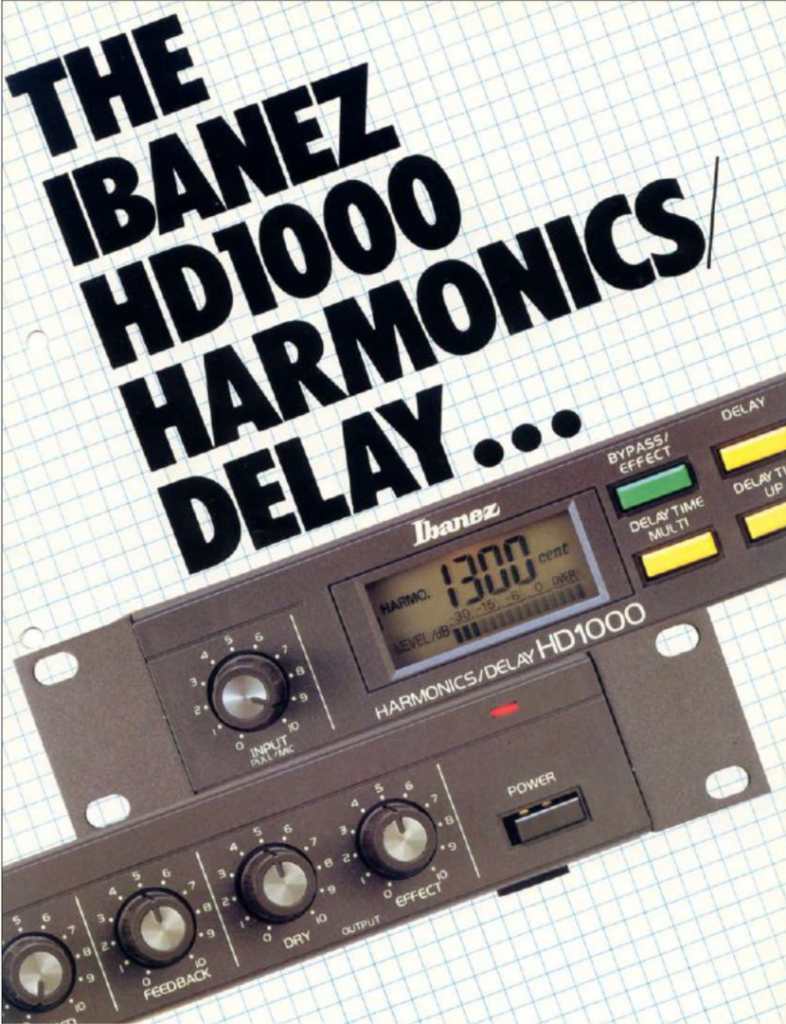
Ibanez HD1000 Harmonic Delay Review: The Poor Man’s Eventide
In this article
If you were in high school in 1983 and heard Yes’s Owner of a Lonely Heart come on the radio, you probably had the same reaction I did: Oh my God, how did they get those guitar sounds?
Trevor Rabin’s guitar work was extraordinary, and the pitch-shifting effects were unlike much of what we’d heard before. The answer involved the sort of expensive studio equipment that high school students generally couldn’t afford. An Eventide Harmonizer was one possibility, and I seem to remember the blue-faced MXR Pitch Transposer being part of that world as well.
I certainly wasn’t going to buy an Eventide. But I could afford an Ibanez HD1000 Harmonic Delay. And for someone who wanted to experiment with digital pitch shifting without spending a fortune, it was a revelation.
Digital effects for the rest of us
The Ibanez HD1000 was one of the least expensive ways to get something resembling a professional Harmonizer in the early 1980s. Was it as sophisticated as an Eventide? Of course not. The pitch shifting was comparatively crude, and the sound could get pretty grainy. But it was digital, it was affordable, and it could do things that ordinary analog delay pedals simply couldn’t.
It also had a terrific digital delay.
The HD1000 offered several delay ranges, with multipliers that changed the available span. As you moved into the longer delay settings, the available bandwidth decreased. In other words, the longer delays weren’t as clean or extended in frequency response as the shorter ones. Today, that would probably be considered a limitation. Back then, it was simply part of what made the machine interesting. And frankly, it’s part of why I still like it.
An actual display!
One of the genuinely exciting things about the HD1000 was that it had a digital display. That might not sound particularly remarkable today, but remember that this was an era when most effects processors had knobs with little numbers printed around them. If you found a sound you liked, you either remembered approximately where everything was set or wrote the settings down and hoped you could recreate them later.
With the HD1000, you could see the delay or pitch-shift value and return to a particular setting with much greater precision. It wasn’t preset memory in the modern sense, but it was a substantial improvement over guessing where a rotary knob had been positioned. For a high school student experimenting with unusual guitar sounds, that was pretty exciting technology.
Making it sound terrible—in a good way
One of the things I particularly enjoyed about the HD1000 was how readily you could abuse it. It had a pull-out input gain control, and if you drove the input hard enough, the unit would produce a wonderfully dirty, grainy sound.
This wasn’t the pristine digital processing that manufacturers would spend the next several decades trying to perfect. You could make the HD1000 sound decidedly unpleasant. And sometimes that was exactly the point.
Between the crude pitch shifting, limited bandwidth at longer delay settings, and the ability to overdrive the input, the HD1000 had a character that modern processors generally have to work rather hard to imitate.
The feedback loop was brilliant
Another particularly useful feature was the external effects loop associated with the delay feedback path. Instead of simply repeating the same signal over and over, you could insert another processor into the feedback path and change the character of successive repeats.
Put a filter in the loop, for example, and each repeat could become progressively darker. Insert another effect and the repeats could evolve in ways that weren’t possible with a conventional delay. It was an unusually creative feature for an affordable processor, and one that made the HD1000 considerably more versatile than its modest price suggested.
There was also conventional feedback control, so you could make the repeats continue, build up, or generally misbehave.
Built in Japan, built to last
I kept my original HD1000 for years and years. Eventually, it disappeared from my equipment collection, and I honestly don’t remember what happened to it. About five years ago, I bought another one. That probably tells you more about how much I liked the original than anything else I could say.
These were made in Japan, and my impression has always been that they were exceptionally well constructed for the money. They’re now more than forty years old, yet plenty of examples are still functioning.
Of course, any digital processor of this age can develop problems. Displays, switches, power supplies, and aging electronic components are all things to consider when buying one. But the underlying construction was good. And unlike some vintage studio processors, an HD1000 doesn’t necessarily require a second mortgage.
What is an Ibanez HD1000 worth today?
I’ve seen these sell in roughly the $100–$200 range, depending on condition and availability, although asking prices can vary considerably. At that sort of money, I think they’re tremendous fun.
You aren’t buying an HD1000 because it offers state-of-the-art pitch shifting. It doesn’t. You’re buying it because it represents a fascinating moment when digital effects were becoming affordable, and because its imperfections are now part of its appeal. The grainy pitch shifting, bandwidth-limited delays, and unusual feedback-loop possibilities make it a genuinely interesting creative tool.
Final thoughts
I still love the Ibanez HD1000. It was my affordable entry into a world of sounds that had previously seemed reserved for musicians with enormous recording budgets. It let me experiment with pitch shifting, digital delay, feedback processing, and all sorts of noises that weren’t supposed to come out of a guitar.
And there was one other important distinction.
Nobody else in my high school had one.
Forty-something years later, I still think that’s pretty cool.