Microphone Reviews
Audio-Technica AT4051b Review: A Microphone I Never Get Tired of Using
Manufacturer: Audio-Technica
In this article
By Richard Alan Salz
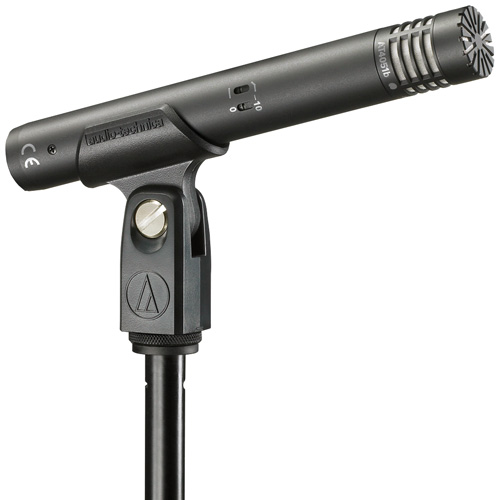
The Audio-Technica AT4051 is another one of those microphones that has been around for an extraordinarily long time. And unlike some long-lived microphones that I find rather difficult to get excited about, this one is genuinely terrific.
I love my AT4051s.
I’ve owned mine for decades, and they’ve been absolutely flawless. No problems, no peculiar behavior, no reason to question whether they’re going to work when I take them out of the microphone cabinet.
They just work.
And they sound excellent.

Not a Schoeps. Not a Neumann. So What?
Let’s get something out of the way. The AT4051 isn’t a Schoeps, and it isn’t a Neumann KM184.
But it doesn’t need to be.
Those are excellent microphones, and I’m certainly not going to suggest that the Audio-Technica is necessarily their equal in every application. But the AT4051 is an exceptionally useful microphone in its own right, and I’ve never felt particularly deprived when using one.
It’s a clean, detailed, well-balanced small-diaphragm condenser that doesn’t seem to have any particularly objectionable sonic characteristics.
That’s more important than it might sound.
There are plenty of microphones that sound impressive for the first thirty seconds and become rather less appealing after you’ve listened to them for an hour. The AT4051 isn’t one of those.
It’s simply a very good microphone that works on a remarkable variety of sources.
A Versatile Little Microphone
I’ve used my AT4051s on acoustic guitar, cymbals, and woodwinds, among other things.
On acoustic guitar, they capture articulation and detail without making the instrument sound artificially hyped. They’re particularly useful when you want a natural presentation rather than something that’s been given an exaggerated high-frequency sheen.
They’re also excellent on cymbals. They have the speed and clarity you’d expect from a good small-diaphragm condenser, but without an unpleasant emphasis that makes every cymbal strike sound like breaking glass.
I’ve used them on woodwinds as well, generally at some distance rather than right up against the instrument. That gives the sound a little room to develop and produces a more natural balance.
I’ve heard of people using them on snare drum, although I’ve never tried that myself. I can’t imagine they’d be bad at it, provided they’re positioned sensibly and protected from the occasional enthusiastic drumstick.
But there’s one application where my AT4051s spend more time than anywhere else.
The Hi-Hat
I absolutely love these microphones on hi-hat.
There’s something about the way the AT4051 handles the transient attack and the overall tonal balance of a hi-hat that just works for me.
You get the articulation of the stick, the metallic character of the cymbals, and the subtle changes in sound as the hats open and close, without an excessive amount of harshness or sizzle.
And that’s not always an easy balance to achieve.
A hi-hat can be a particularly unforgiving instrument to microphone. Some microphones make it sound thin and brittle. Others give you too much upper-frequency energy, which can become downright unpleasant once you start bringing the rest of the drum kit into the mix.
The AT4051 manages to capture the detail without making the hi-hat sound like it’s trying to saw its way through your forehead.
I like that.
Of course, microphone placement and the particular hi-hats you’re recording make an enormous difference. But after years of using these microphones, they’re still among my first choices for the job.
In fact, that’s where mine tend to live.
Built for the Long Haul
One of the things I’ve come to appreciate about Audio-Technica’s professional microphones is their reliability.
I’ve owned a number of 40 Series models over the years, and my experience has been remarkably consistent. They’re well engineered, well constructed, and generally do exactly what they’re supposed to do.
My AT4051s have been in service for decades without giving me any trouble.
That’s worth something.
A microphone isn’t particularly useful if it sounds wonderful but spends half its life waiting for repairs. And while there are certainly more exotic and more expensive microphones available, I have a great deal of respect for equipment that can be used regularly for twenty or thirty years without becoming a maintenance project.
The AT4051 is that kind of equipment.
It’s the sort of microphone you can buy, use every day, and reasonably expect to keep using for a very long time.
Perhaps a lifetime.
The Other Versions
The AT4051 is part of Audio-Technica’s interchangeable-capsule small-diaphragm condenser family.
The AT4051b uses a cardioid capsule. The related AT4049b is omnidirectional, while the AT4053b is hypercardioid.
Those different polar patterns make the family useful for a wide range of recording applications, particularly when you need greater control over pickup characteristics or room contribution.
My comments here are based on my experience with the AT4051, rather than a direct comparison of all three models. But it’s a versatile system from a manufacturer with a long history of producing dependable professional microphones.
The Verdict
I recommend the Audio-Technica AT4051 without hesitation.
It’s an excellent-sounding, versatile, durable microphone that has served me well for decades. It’s particularly good on acoustic instruments and cymbals, and it’s one of my favorite microphones for hi-hat.
There are more expensive microphones, and there are certainly more prestigious names.
But after all these years, I still reach for my AT4051s regularly.
I can’t think of a much better endorsement than that.