Buying & Gear Advice
KRK V4 vs V8 Series 4: Choosing the Right Studio Monitor
In this article
The KRK V4 and V8 Series 4 share a design family, but they address substantially different monitoring requirements. One is a compact desktop or secondary monitor; the other can serve as the primary monitoring system in a more substantial control room.
This comparison draws on Richard Alan Salz’s published long-term ownership reviews of both models. It is not a newly conducted level-matched shootout or a comparison with the newer V-Series Five.
KRK V4 S4 vs V8 S4 at a glance
| Consideration | V4 Series 4 | V8 Series 4 |
|---|---|---|
| Woofer size | 4 inches | 8 inches |
| Original studio application | Desktop monitoring | Main control room |
| Subsequent application | Home theater and general listening | Florida studio C room |
| Reported sound | Balanced, non-fatiguing | Surprisingly neutral, convincing imaging |
| Installation priority | Compact footprint and integrated isolation pad | Stable support, greater output and bass authority |
| Response adjustment | Rear-panel LF/HF controls | Seven-position LF and HF selectors |
Where the V4 makes sense
In the V4 Series 4 review, Salz explains that the original requirement was for a compact powered speaker that could sit on a work surface without a complicated installation. The integrated isolation pad was particularly welcome. He found the output impressive for the cabinet size and the high-frequency presentation cleaner than the older KRK designs he remembered.
The V4 remained useful after the original desktop monitoring system was retired. Its continued use is a good example of how a well-chosen secondary speaker can outlast the installation for which it was purchased. The review does not present the V4 as the author’s preferred primary monitor.
Where the V8 makes sense
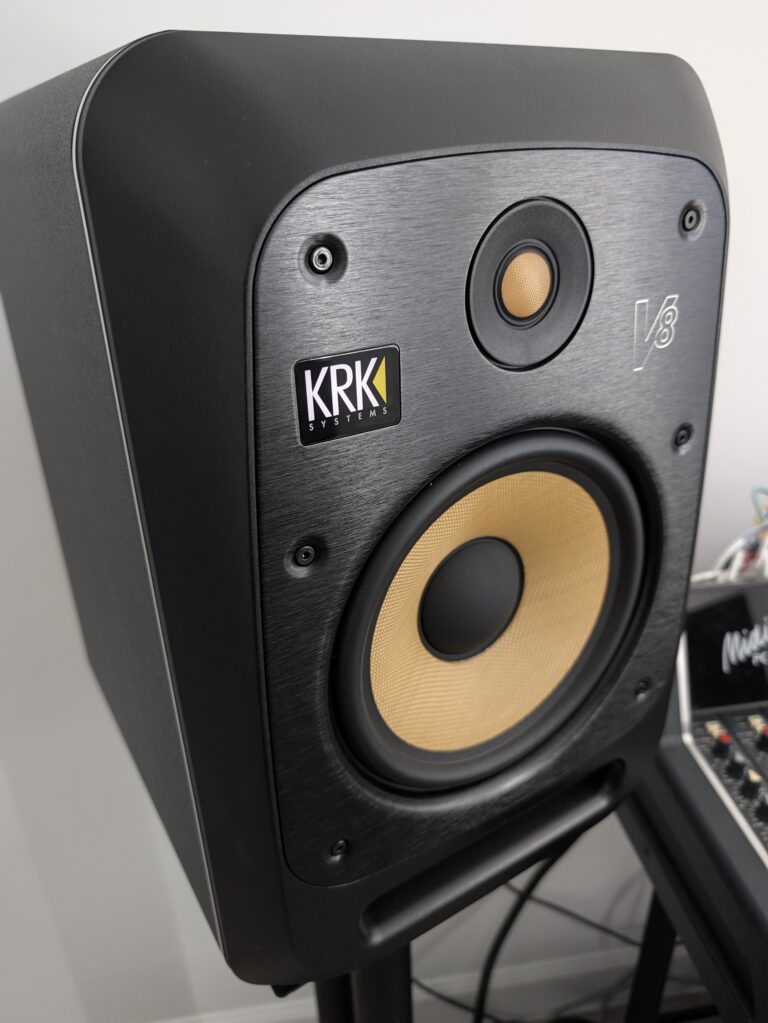
The V8 Series 4 review starts from a different requirement: greater output and low-frequency authority than the author’s passive Fostex NF-1 monitors could provide in a larger control room. The V8 impressed him with its tonal balance, imaging and response adjustments. Although subsequently replaced by a much more expensive ATC system, the V8 remains in service in another studio.
The V8 is substantially heavier and needs more physical space. The review also notes some hiss audible very close to the tweeter, although this was not objectionable at the author’s normal listening distance. These observations should be weighed against the actual listening geometry rather than treating a larger woofer as an automatic upgrade.
Room adjustment is not room correction
Both models provide useful rear-panel response controls. A particularly instructive example comes from the V8 review: after relocating the monitors, familiar recordings sounded thin because low-frequency attenuation from a previous subwoofer installation was still engaged. Restoring the settings corrected the problem.
Before judging a used or relocated pair, record the existing settings, establish a sensible baseline and verify that the left and right speakers match. Use the controls to address broad tonal balance, not as a substitute for dealing with severe room cancellations. See How to Set Up and Calibrate Studio Monitors and Understanding Room Modes and Standing Waves.
Which size is right for your studio?
Start with listening distance, available space, required playback level and the low-frequency information you need to judge. The V4 is especially relevant to a compact desktop or secondary system. The V8 is the more compelling candidate when greater bass authority and clean output are important and the room can accommodate it. Neither size eliminates the need for careful placement.
If buying either model used, check that both speakers behave consistently, that the drivers and cabinet are undamaged, and that the controls and inputs function correctly. Compare the total cost of suitable stands and any necessary repairs. See our used studio equipment buying guide.
What about the V6 or the newer V-Series Five?
The V6 sits between the V4 and V8 within the Series 4 family. TAM’s two ownership reviews do not establish firsthand conclusions about the V6 or the newer Series Five models, so we do not rank them here. Audition them if they are relevant to your installation.
The bottom line
The V4 and V8 are not interchangeable simply because they share a family resemblance. TAM’s ownership experience illustrates why different monitoring systems can remain useful in different rooms even after more expensive equipment arrives. Read the individual V4 review and V8 review for the full listening observations, and explore the studio monitor reviews archive for other systems. For the broader question of why familiarity matters, see Studio Monitors: Does Any of This Make Sense?.
More manufacturer coverage: KRK articles