Processor Reviews
dbx 120XP Subharmonic Synthesizer Review: Bringing Back the Bottom End
Manufacturer: dbx
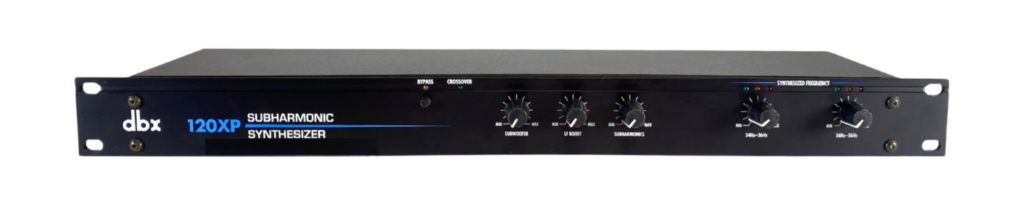
There was a time when just about every good engineer had a few secret weapons in the rack. Not necessarily expensive or particularly sophisticated pieces of equipment, but boxes that could do something useful when the situation called for it. The dbx 120XP Subharmonic Synthesizer was one of those boxes.
The trick, as with just about every processor of this type, was knowing when to use it—and, more importantly, when to stop.
The 120XP generates subharmonic content below the frequencies already present in the source material. Think of it as a more sophisticated relative of the old octave-divider effects guitar players were using in the Hendrix era. Except this one works considerably more cleanly, and its intended application is rather different.
If you want an idea of the kind of bass sound I’m talking about, listen to some of the early 311 recordings. Their bassist, P-Nut, reportedly used a dbx 120XP, which makes perfect sense when you hear that enormous low end.
A Little Goes a Long Way
The 120XP is particularly useful on bass guitar, where it can add an entirely new dimension to an otherwise ordinary sound. You can get a tremendous amount of low-frequency energy out of it, but that doesn’t mean you should.
The other application where I’ve found it especially useful is kick drum.
Let’s say you’ve got a kick drum that sounds like somebody hitting a cardboard box with a stick. There’s plenty of click, maybe some unpleasant midrange thump, but absolutely nothing happening down below. You can EQ it until you’re blue in the face, but if the low-frequency information isn’t there to begin with, there’s only so much an equalizer can accomplish.
The dbx actually creates that missing bottom end. That’s the beauty of the thing. You’re not simply boosting frequencies that are barely present in the recording. You’re synthesizing additional low-frequency content and blending it into the original signal.
The controls allow you to adjust the subharmonic contribution and its relationship to the original sound. It’s not particularly complicated, which is probably one of the reasons it’s so useful.
Of course, it’s also quite easy to turn a perfectly respectable bass track into an enormous, indistinct mess. Just because the box can produce all that low end doesn’t mean your recording needs it. And I certainly wouldn’t recommend slapping it across an entire mix. It’s a problem-solving tool, not a substitute for good recording or mixing.
The Fifteen-Year Loan
I actually have my original 120XP back in the rack now, which is something of a minor miracle.
Years ago, I lent it to a friend. He subsequently lent it to another friend, and somewhere along the way it effectively disappeared. For about fifteen years.
I had pretty much written it off, but eventually the thing found its way home. And after all that time, it’s nice to have it back.
There have been other versions of the dbx subharmonic synthesizer, and I suspect some of the newer implementations are perfectly good. But there’s something satisfying about having the original box again, particularly when it does exactly what I remember it doing.
Another One of Those Boxes
We’ve been looking at several of these 1990s processors lately—the Aphex Aural Exciter, the SPL Vitalizer, and now the dbx 120XP. They all have something in common: they can make a mediocre recording sound considerably better, or they can make a perfectly good recording sound considerably worse.
It depends almost entirely on the person turning the knobs.
Of the three, the dbx is probably the most straightforward in terms of what it does. It creates low-frequency information that wasn’t there before. When you need that, it’s an incredibly handy thing to have. When you don’t need it, leave it switched off.
Verdict: A genuinely useful specialist processor that can rescue an anemic kick drum or give a bass guitar some serious authority. The dbx 120XP earns its rack space by doing one thing exceptionally well, provided you have the restraint not to use it on everything.