Plug-In Reviews
Meyer Sound HD-1: A Monitor Only Roger Nichols Could Truly Love
In this article
In the late 1990s, I made the same mistake that so many other people did: I became convinced that what I really needed was a pair of active studio monitors.
Why I needed to replace my Tannoy PBM8s, speakers I knew intimately and had done great work on, is something I still can’t explain. I also had a pair of Electro-Voice Sentry 500s for loud duty, so it wasn’t as though I was lacking in the speaker department.
But apparently, I needed something new.
First up was a pair of Event 20/20 BAS monitors. They were kind of harsh, but reasonably okay. Unfortunately, I started getting tired of them fairly quickly and decided I needed something better.
Now, at the time, I could have bought JBLs, Genelecs, better Tannoys, or any number of other excellent monitors. There were plenty of good choices.
Somehow, though, I became convinced that what I really needed was a pair of Meyer Sound HD-1s.
The Roger Nichols Connection
The HD-1s were closely associated with Roger Nichols, one of the truly great recording engineers and a man responsible for some of my favorite Steely Dan albums.
That was certainly a compelling endorsement. If they were good enough for Roger Nichols, surely they would be good enough for me.
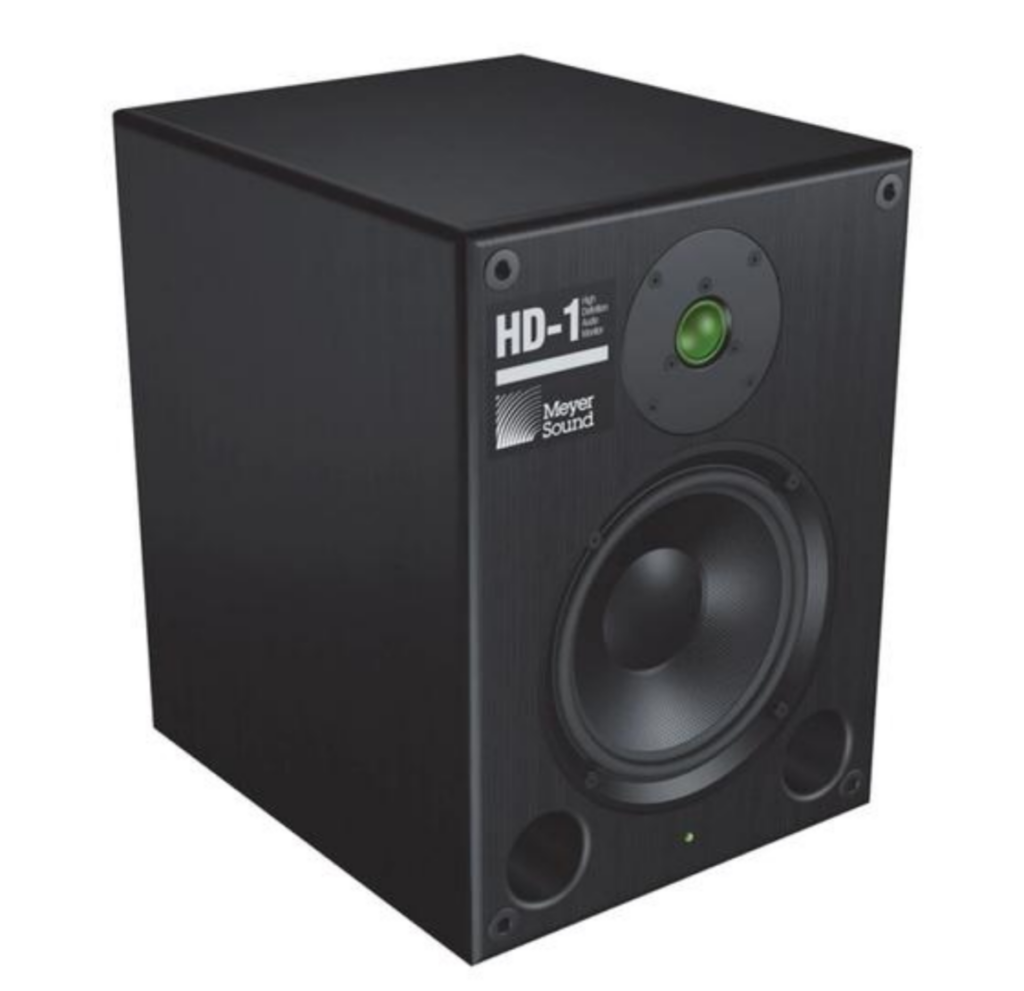
On paper, the HD-1s were practically perfect. Plenty of power, beautiful construction, sophisticated engineering, and those nifty green tweeters.
Who needs yellow woofers when you can have green tweeters?
They were also expensive enough to suggest that they must be something special. And to be fair, they really were something special. Just not necessarily in the way I needed.
A Perfect Storm of Blandness
At the time, I had a Neotek Series IIc console and a control room that was considerably overtreated, particularly in the midrange.
Combine that environment with the HD-1s, which were fairly uncolored, and the result was that I started making some remarkably bland-sounding recordings.
Everything was clean. Everything was controlled. Everything was technically quite respectable. And everything seemed to be missing a little life.
In retrospect, this makes a certain amount of sense. There was an aesthetic in high-end recording during that period that emphasized tremendous extension, precision, and control, sometimes at the expense of musical excitement.
Listen to Donald Fagen’s Kamakiriad and you’ll hear something of what I’m talking about. Whatever monitors were used, the same general aesthetic applies. Extended, pristine, meticulously controlled, and, to my ears, a little anemic.
I certainly don’t mean to suggest that the HD-1s were incapable of producing exciting music. Roger Nichols obviously did extraordinary work with them. But in my room, with my console, and with my particular sensibilities, they encouraged me to make recordings that were a little too polite for their own good.
And that’s an important distinction. A monitor can be objectively excellent and still be completely wrong for the person using it.
Meyer Sound Is Still Extraordinary
I should make something very clear: I have tremendous respect for Meyer Sound.
In fact, I think Meyer makes some of the finest loudspeakers in existence, whether we’re talking about concert reinforcement or permanently installed sound systems.
One of the best-sounding public spaces I’ve ever encountered was the bar area at the Archer Hotel in Austin, Texas. The Meyer loudspeakers installed there sounded simply spectacular. It was one of those rare situations where I found myself paying more attention to how good the sound system was than to whatever else was happening in the room.
So this is certainly not an indictment of Meyer Sound or its engineering.
I know Meyer now makes the Amie studio monitor, which is supposed to share some family characteristics with the HD-1. I haven’t heard the Amie, so I can’t offer an opinion about it.
And, frankly, it has been many years since I’ve heard a pair of HD-1s.
I’m genuinely curious how I would react to them today. My listening environments have changed, my equipment has changed, and I’ve certainly changed. Perhaps I’d appreciate them more. Perhaps I’d come to exactly the same conclusion.
I’d actually like to find out.
The Green Tweeter Problem
There was one other thing about the HD-1s that always bothered me. Those green tweeters.
They were certainly distinctive, but I lived in constant fear that someone unfamiliar with the speakers would walk into the control room and attempt to turn them off by pressing on the tweeter.
And before you laugh, people really did that sort of thing back in the day. Apparently, a green circle on the front of an expensive loudspeaker looks enough like a power button to invite experimentation.
Not exactly the sort of interaction you want someone having with a precision high-frequency driver.
Final Thoughts
The Meyer HD-1 was a beautifully engineered, exceptionally well-built, and technically sophisticated studio monitor. I have no doubt that in the right environment, with the right engineer, it could produce extraordinary results.
Roger Nichols certainly proved that.
But my experience with the HD-1 taught me something that has stayed with me ever since: the best monitor isn’t necessarily the most accurate, the most expensive, or the one your favorite engineer uses.
It’s the one that helps you make the best recordings.
And as much as I wanted to love the HD-1s, they simply weren’t the right speakers for me.
Maybe Roger Nichols was the only one who could truly love them. Or maybe I just should have kept my Tannoys.