Processor Reviews
dbx 163X Review: The One-Slider Compressor That Still Makes Me Happy
Manufacturer: dbx
In this article
The dbx 163X was the very first compressor I ever owned. At the time, I didn’t really understand what a compressor did. I knew it did something, and I knew that when I ran things through it, they sounded different. Whether they sounded better was another question entirely.
But that didn’t stop me from using it on practically everything.
I was making recordings on a four-track machine, and almost every signal I recorded went through that dbx 163X. Sometimes I’d push the slider until practically every LED on the front panel was illuminated. Other times I’d use just a little compression. There wasn’t much science involved. I was moving the slider around, listening to what happened, and hoping for the best. I also made frequent use of the front-panel input, which was particularly convenient in a small home studio.
Those old recordings actually sound pretty good
The other day I was listening to some of those old four-track recordings and found myself thinking, Wow, these actually sound pretty cool. Then I remembered: almost everything on those recordings had gone through the 163X.
I’m not suggesting the dbx was responsible for everything good about those recordings, but it was clearly part of the sound. It wasn’t until considerably later that I really understood compression and started using the 163X in a more judicious fashion. By then, I’d come to appreciate what I had.
One slider. That’s pretty much it.
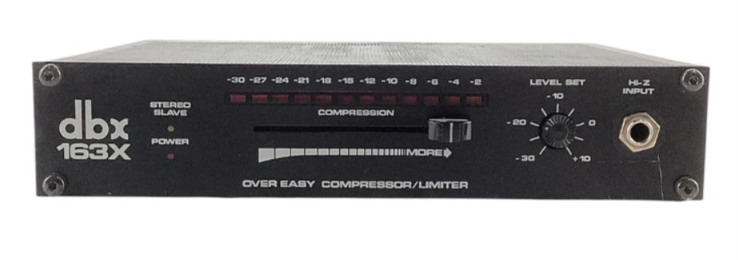
The genius of the dbx 163X is its simplicity. There aren’t separate controls for threshold, ratio, attack, release or makeup gain. You have a slider. Move it to the right, and you get more compression.
The 163X uses dbx’s OverEasy compression characteristic, progressively introducing gain reduction rather than abruptly switching into compression at a fixed threshold. The front-panel LEDs show compression activity. If you’re anything like I was when I bought my first one, you’ll probably discover that lighting up all those LEDs can be rather entertaining.
It also has a convenient front-panel high-impedance input for instruments. For such a simple device, it’s surprisingly versatile.
The dbx sound
One of the things I’ve always appreciated about dbx is that the company developed a recognizable sonic identity. A dbx compressor doesn’t necessarily sound like an 1176, a Fairchild or an SSL bus compressor. It has its own personality: a sense of control, density and punch that I associate with classic dbx compression.
While the 163X is a very different product from something like a dbx 160SL, I can still recognize a family resemblance. The 163X isn’t an especially sophisticated compressor by modern standards, and that’s part of its charm. It can make things sound thicker, more consistent and more assertive without requiring much effort.
Terrific on bass
If there’s one application where the 163X really shines, it’s bass. Electric bass and dbx compression have always been a particularly good combination, and the 163X makes getting a useful sound almost ridiculously easy. Plug in, move the slider until the dynamics behave the way you want, and you’re essentially finished.
It can give a bass track satisfying consistency and solidity without a lengthy session of adjusting attack and release controls. And that front-panel instrument input makes it easy to use when recording bass directly.
And it doesn’t suck on vocals
I also like the 163X on vocals. Is it the first compressor I’d reach for when recording a particularly demanding lead vocal? Not necessarily. I have other compressors that offer more control and, depending on the application, a more refined sound.
But the 163X can be surprisingly effective. For a backing vocal, a rough-edged rock vocal or something that needs to sit in the track without a great deal of fuss, it’s a perfectly legitimate choice.
The earlier dbx 163
Before the 163X, there was the original dbx 163. I’ve owned a couple of those as well. They were good compressors, but I always found them a little touchier and somewhat noisier than the later 163X. The 163X feels like a more fully developed version of the same basic idea. If I were choosing between the two today, I’d take the 163X.
Still in my rack
I have no idea what happened to my original 163X. Like a lot of equipment I owned when I was younger, it somehow disappeared. Eventually I bought another one, and I love it.
It sits in my rack alongside compressors that cost ten, twenty or perhaps even thirty times as much. And I still use it. That’s probably the strongest endorsement I can give a piece of equipment. When you have considerably more expensive alternatives but still find reasons to use the inexpensive little box, that tells you something.
The dbx 163X does something cool. It always did.
Final thoughts
The dbx 163X is about as close as you can get to a compressor that makes you happy in a hurry. One slider. A few LEDs. A convenient front-panel input. And that unmistakable dbx character.
It’s terrific on bass, surprisingly useful on vocals, and perfectly capable of making other sources sound more interesting. You don’t need to understand compression theory to get something useful out of it. I certainly didn’t when I bought my first one.
Decades later, listening to those old four-track recordings, I’m reminded that sometimes the equipment we used before we knew what we were doing was pretty good equipment after all.
If you find one at a reasonable price, buy it. You might find yourself keeping it for a very long time. Or, like me, buying another one after you foolishly let the first one disappear.