Guitar Reviews
EMG KH20 Pickguard Review: Metallica Isn’t My Thing, but These Pickups Certainly Are
In this article
I’ll start with a confession that probably won’t endear me to Metallica fans: I don’t particularly like Metallica.
I think Kirk Hammett is an excellent guitar player, but I’ve never been able to get past the Metallica vocals. The music itself has always struck me as a little too “meathead” for my taste. Nothing personal, and certainly no reflection on Hammett’s abilities. It just isn’t music I particularly enjoy listening to.
So why would I install a Kirk Hammett signature EMG KH20 pickguard in one of my Stratocasters?
Because, as it turns out, it’s a remarkably good product, and you don’t have to like Metallica to appreciate what EMG has done here.
A Stratocaster Upgrade That Actually Makes Sense
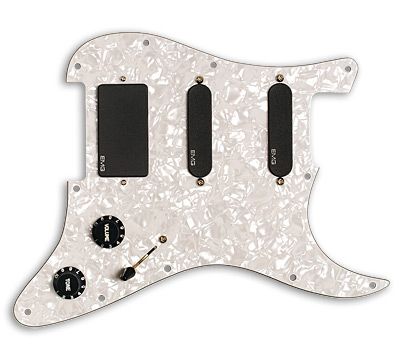
One of the best things about the KH20 is its simplicity. It’s a complete, prewired pickguard assembly that drops into a standard Stratocaster with very little modification.
You don’t need to spend an afternoon soldering pickup leads, figuring out switching arrangements (although EMG has been very forthcoming with wiring diagrams not included on their website), or wondering whether you’ve managed to introduce another ground loop into your guitar. EMG has already done the work.
In most cases, installation is largely a matter of removing the old pickguard, fitting the new assembly, connecting the output jack and battery, and putting everything back together.
There is one small detail worth mentioning: the ground wire that runs from the original Stratocaster electronics to the tremolo spring claw.
Traditional passive Stratocaster pickups generally use a bridge ground connection, which electrically connects the strings to the guitar’s grounding system. EMG’s active pickups don’t require that connection.
In my case, I simply clipped the wire. I could have desoldered it, but frankly, I was too lazy. I left the disconnected wire in the guitar, where it will still be there in the unlikely event I decide to reinstall passive pickups.
And that brings us to one of the less frequently discussed advantages of EMG’s approach.
A Word About Electrical Safety
Older guitarists, particularly those who have spent time playing in clubs with questionable electrical systems, will remember the unpleasant experience of touching a microphone while holding a guitar and receiving a shock.
This can be considerably more than unpleasant.
In 1972, Leslie Harvey, guitarist for Stone the Crows, was electrocuted onstage after contacting a microphone while holding his guitar. It’s one of the more tragic reminders of what can happen when electrical equipment and grounding arrangements go wrong.
With conventional passive guitar wiring, the strings are normally connected to the instrument’s electrical ground. Under certain fault conditions, that connection can become part of a dangerous current path between the guitar and other equipment.
EMG’s active pickups don’t require the strings to be grounded. Disconnecting the bridge ground therefore removes one potential conductive path through the player.
That doesn’t make a guitar electrically shockproof, and it certainly doesn’t excuse unsafe amplifiers, defective wiring, or improperly grounded stage equipment. But eliminating an unnecessary connection between the strings and the electrical ground is a worthwhile benefit.
It’s something I appreciate, particularly in unfamiliar live environments.
Two Knobs Are Plenty
Another thing I like about the KH20 is its control layout.
You get a master volume and a master tone control.
That’s it.
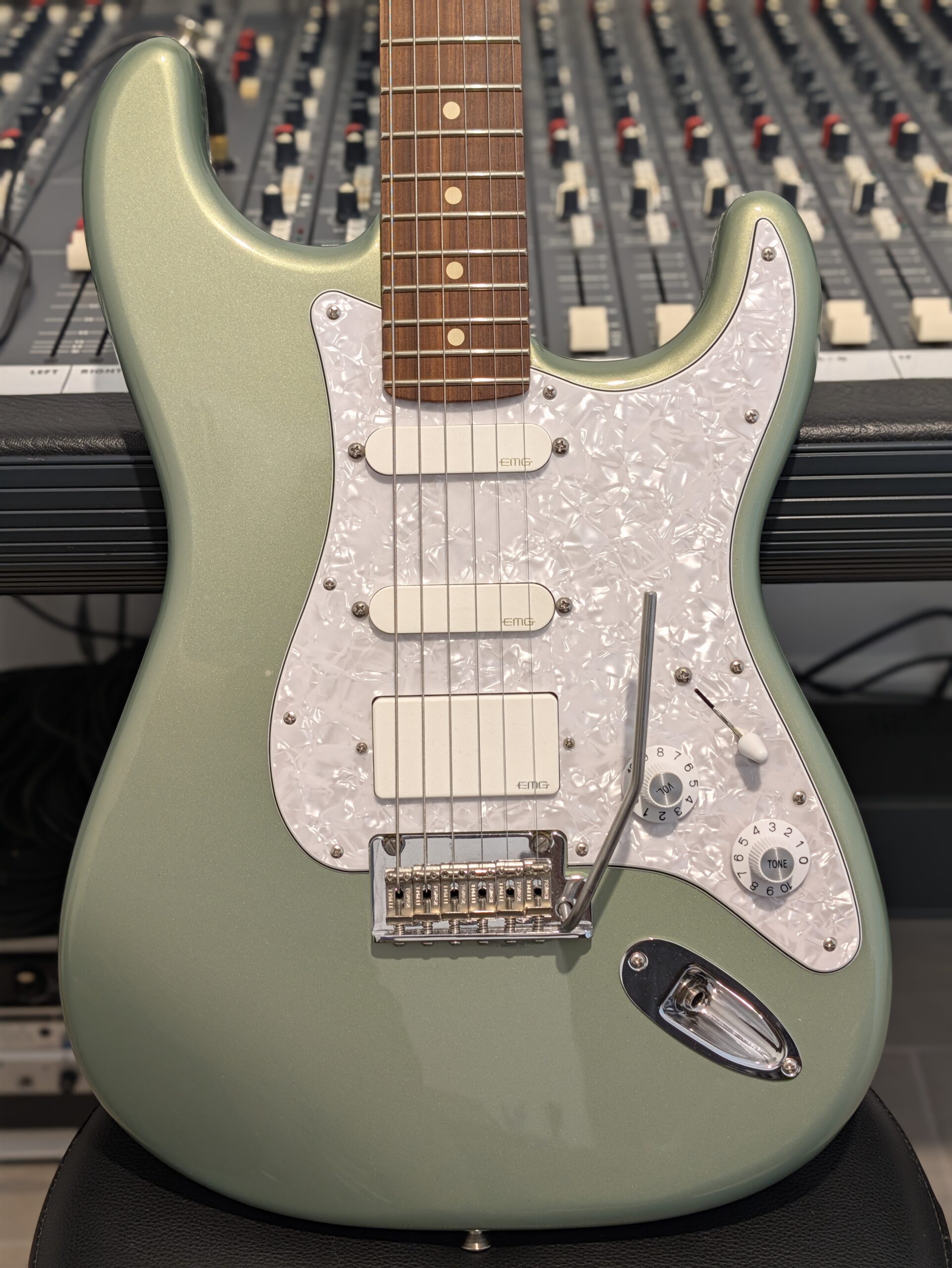
I’ve never found the second tone control on a conventional Stratocaster especially useful. I rarely touch it, and eliminating it makes the pickguard look cleaner while providing a little more room for your picking hand.
It’s a small change, but one that I prefer.
The layout also lends itself nicely to customization.
I replaced the standard knobs on mine with Jazzmaster-style knobs, which I think look considerably cooler. They’re a little more substantial visually, and they give the guitar a slightly different personality.
A detail worth mentioning is that the pickguard itself is of very high quality, easily the equal of a Fender or WD product, in my opinion.
I also happened to have a set of white EMG pickups around: two EMG S single-coils and an EMG 81 humbucker (exactly the same complement as the KH20…only in white).
I installed those in place of the original black pickups and put the black pickups from the set into (yet another) guitar.
The white pickups against the pickguard look terrific, at least to my eyes, and the Jazzmaster knobs complete the effect.
Consequently, my guitar no longer looks exactly like the KH20 assembly EMG sells, but that’s part of the appeal. The system is straightforward enough that you can switch all three pickups out in about five minutes since they are connectorized.
The Difference Is Not Subtle
The recipient of this particular transplant was a Mexican-made Fender Player Stratocaster.
I’ve always thought the Mexican Strats were fundamentally good guitars. The construction is generally solid, the necks are comfortable, and they make excellent platforms for modifications.
But the original pickups weren’t particularly inspiring.
Installing the EMG assembly completely transformed the instrument.
The first thing you notice is how quiet everything becomes. The familiar buzz and hum associated with traditional single-coil pickups largely disappear. That’s especially useful in a recording studio, where electrical noise from computers, lighting, power supplies, and other equipment can make an otherwise perfectly good guitar a nuisance.
The sound is also cleaner and more controlled.
There’s a consistency to the response that makes the guitar particularly useful for recording. You can concentrate on playing rather than finding the one position in the room where the guitar doesn’t hum.
And although EMG pickups have a reputation for being associated with high-gain rock and metal, there’s absolutely no reason to restrict them to those applications.
A quiet, articulate pickup is just as useful for clean rhythm work, pop, funk, or practically anything else.
In fact, the farther you get from heavily distorted guitar sounds, the more you may appreciate the absence of noise.
A Particularly Good Studio Upgrade
I’ve spent enough time recording guitars to know that noise problems are often much more annoying in the studio than they are onstage.
A little hum that goes unnoticed during a live performance can become painfully obvious when you’re recording a quiet passage, layering multiple tracks, or compressing a guitar signal.
You can use noise gates, edit the gaps between phrases, or attempt to remove noise afterward, but all of those approaches are compromises.
It’s much better not to record the noise in the first place.
That’s where EMG pickups really shine.
They make an ordinary Stratocaster considerably more useful in electrically hostile environments, whether that’s a studio full of electronic equipment or a stage with lighting systems and questionable power distribution.
And because the KH20 is supplied as a complete assembly, you don’t have to undertake a complicated rewiring project to get there.
A Warning About Counterfeit EMGs
One thing worth mentioning before you rush out and buy a set is that EMG pickups are frequently counterfeited. Their popularity, relatively simple external appearance, and premium pricing make them attractive targets for counterfeiters.
Genuine EMGs have several readily identifiable characteristics, including distinctive construction details, markings, and connector arrangements, although these can vary by model and production year. Once you know what you’re looking at, some counterfeits are fairly easy to spot. Others are considerably more convincing.
The problem is that you may not discover you’ve bought a counterfeit until you’ve installed it, and there’s no reason to assume that a fake will deliver anything resembling the performance of the genuine article.
My advice is simple: buy from a reputable authorized dealer or directly from EMG. The modest savings offered by an unfamiliar online seller aren’t worth the risk of receiving a counterfeit product.
If you’re buying used pickups, particularly through an online marketplace, examine the photographs carefully and verify the identifying details with EMG if you’re uncertain.
There are plenty of legitimate ways to save money on guitar equipment. Buying counterfeit pickups shouldn’t be one of them.
Review disclosure: I purchased the EMG pickups discussed in this review with my own money. They were not loaned or supplied complimentary by EMG or any retailer.
The Verdict
I bought into the KH20 concept because I wanted a quieter, cleaner, more practical Stratocaster, not because I wanted to sound like Kirk Hammett.
And that’s exactly what I got.
The installation is simple, the two-control layout is sensible, the active electronics eliminate the need for a string-ground connection, and the improvement in noise performance is substantial.
My modified Mexican Player Stratocaster is a much better instrument than it was before the conversion.
For anyone who needs a dependable guitar for recording or live performance in electrically inhospitable environments, this is an upgrade I can recommend without reservation.
You don’t have to like Metallica.
You don’t even have to like Kirk Hammett’s music.
You just have to appreciate a good guitar pickup.
And these are very good guitar pickups.